
Daryoush Ashouri’s words for Reza Pahlavi, set against Pahlavi’s record
On 5 November 2026 the online literary magazine Baru opened its new season with a forty-nine-minute conversation between the philosopher and lexicographer Daryoush Ashouri (b. 1938) and the sociologist Shahla Shafiq (b. 1954) about their meeting with Reza Pahlavi (b. 1960), the son of Iran’s last shah. Three months earlier, on 1 August, Ashouri had made much of the same case in a long interview with VOA Farsi, the Persian service of the Voice of America. In both, Ashouri presents an incompetent, divisive, inexperienced and arrogant contender as a powerful leader, which is ethically wrong, philosophically flawed and massively misleading to the masses. Coming from the man who wrote, as he reminded VOA’s viewers, the first political dictionary of the Persian language, it is also a dereliction of his intellectual, ethical and human responsibilities.
A photograph of the two writers with Pahlavi, released in late February, caused a storm, and about a month later I spoke to Ashouri on the telephone. He was unhappy at how strongly his friends and students had reacted. I told him that I had heard nothing from him on the subject, that a photograph alone explains nothing, and that perhaps he should write something or give an interview explaining himself. He told me that, in hindsight, the photograph had probably been a mistake. It was said, not written, and that is as far as it went. He never wrote anything. Then these two interviews appeared, and I saw that I had been wrong about him. He had not meant to recant. He went on defending the same case, and in doing so he exposed himself and allied himself with the monarchist movement. What follows, therefore, is a blunt assessment of what he has said, not of a photograph.
Let me grant first what is true in his case, because some of it is. Ashouri is right that a son does not answer for the crimes of his father and grandfather, and right that a transition which separates the clerk and the conscript from the men who gave the orders to kill is better than one which hangs them all together. He is right, too, that the name has a following: a survey of some 31,000 Iranians in late June, cited by Reuters, found about half of them favourable to Pahlavi – which means, of course, that about half were not. And it was probably too harsh to target him with less clemency than he expected, since disagreement gives no licence for abuse. None of this, however, was what Ashouri set out to judge.
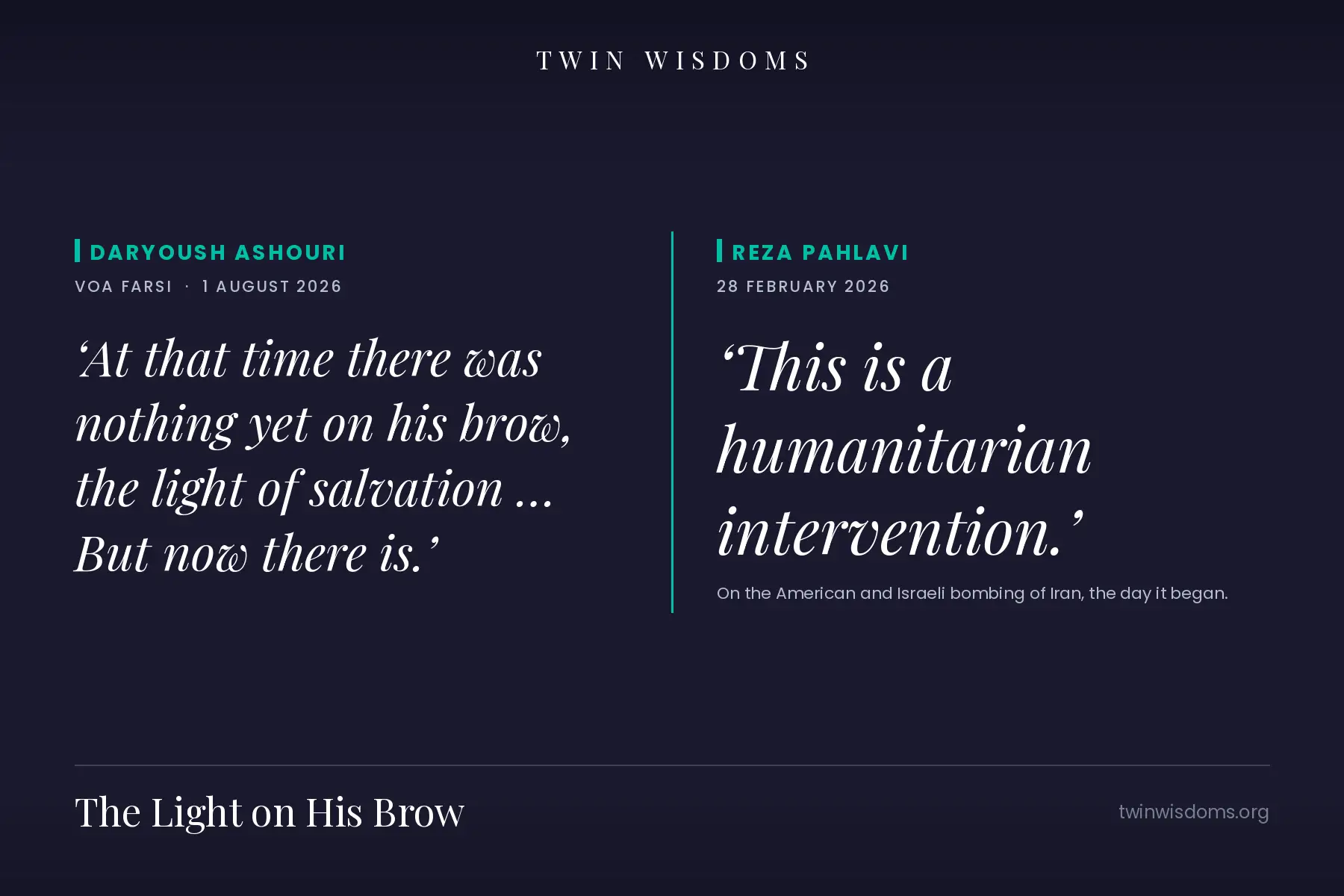
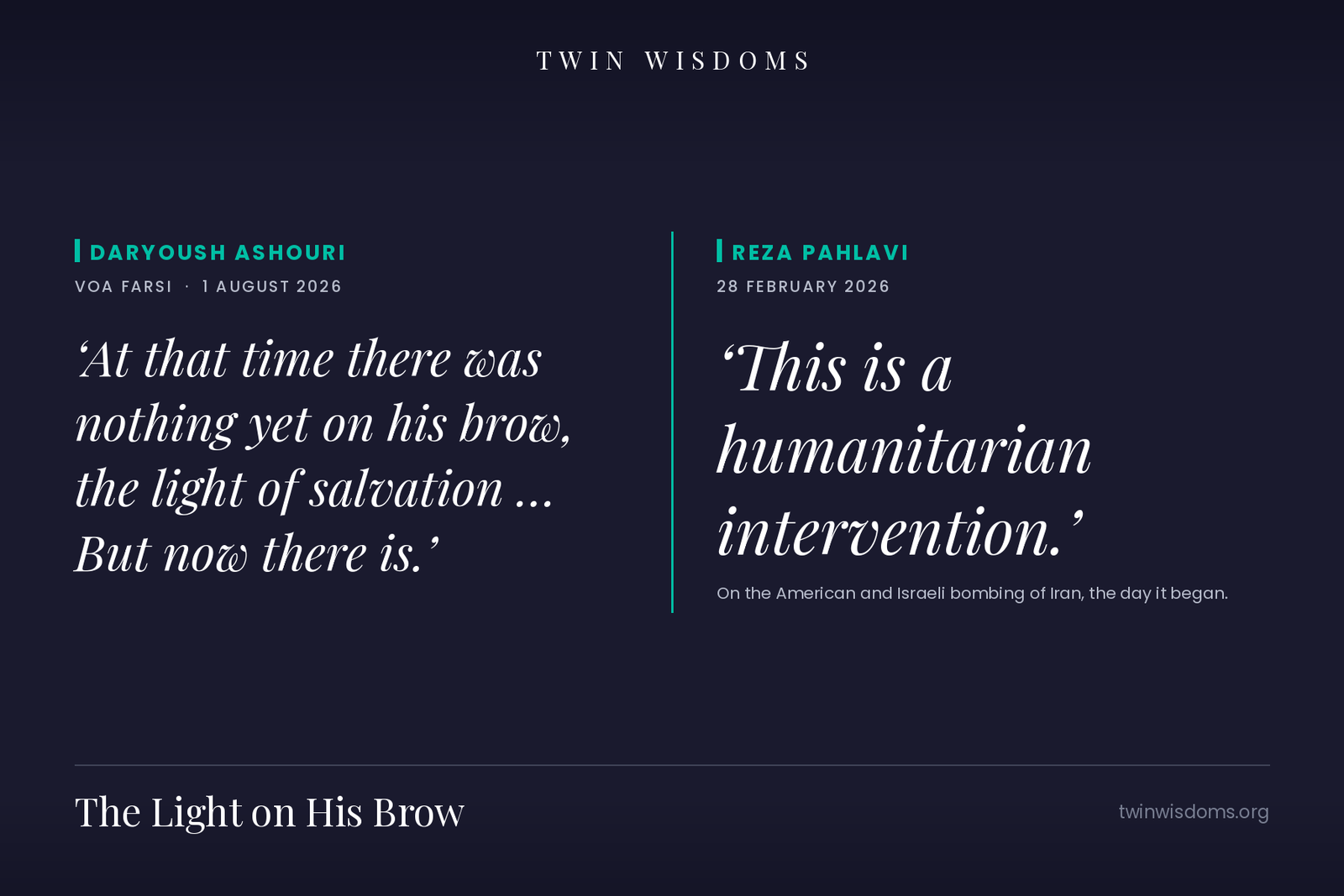
What he set out to judge was a man, and here his testimony is extraordinary. Pahlavi, he told Baru, is enlightened and open-minded, ‘very, very humble’, a man who has ‘never fallen into the pride of princehood’; and ‘I felt that this man does not lie.’ To VOA he said that when he first met Pahlavi, some forty years ago, there was ‘nothing yet on his brow, the light of salvation’; ‘but now there is’. These are the words in which kings were once anointed. In April I called Pahlavi the name of a recurring Iranian temptation, and I did not expect the translator of Friedrich Nietzsche (1844–1900) to supply the halo. Set it beside the record. Shortly after American and Israeli aircraft began bombing Iran on 28 February, Pahlavi announced on X that ‘the Iranian people have called on me to lead the transition’ and that he had ‘accepted that responsibility’. Nobody had voted. Reuters reported at the end of July that at sixty-five he had never held a conventional salaried job. His own donors urged him to ‘try harder to unify the opposition’ and to ‘forcefully condemn’ the violence of some of his supporters, and he ignored the advice, though he says he condemns it. The American president he courted said he did not know ‘how he’d play within his own country’; his administration sidelined him. Incompetent, divisive, inexperienced, arrogant: I use each word on that evidence, and each must go on earning its keep.
Ashouri’s proof that this man can lead is the crowd. ‘When he whistles’ – the verb is Ashouri’s – ‘when he summons and invites the nation, all these crowds come into the street.’ They did come, on 8 and 9 January, when Pahlavi called them out, and the security forces killed them in their thousands. The killing was the regime’s crime and nobody else’s. Yet a whistle blown from abroad costs the man who blows it nothing, and a crowd is evidence of anger and of very little else; it cannot tell us whether the man who names the hour could carry a country through the morning after. Nostalgia fares no better. Ashouri told VOA that the Pahlavi years had come to look like ‘a lost paradise’, and when his interviewer offered the word postcard, a picture in which the beauties stand out, he agreed. A philosopher who knows that the postcard is a postcard, and sends it anyway, has stopped describing the people and started addressing them.
The most misleading sentence in the film is the plainest. Shafiq, sitting beside him, insisted that Pahlavi’s plan for the transition ‘does not even propose a formula’ and leaves the form of government to a referendum. Ashouri had already told the camera what the formula was: ‘the return to the monarchical system’, constitutional and modern rather than absolute, ‘is what the people want, and what he wants’. Which is it? A referendum whose result has been announced in advance by a lexicographer of his standing is a coronation with a ballot box attached. Ashouri says he ‘no longer counts for anything’ and has no claim. The magazine that filmed him knows better: its own description says that millions welcomed the meeting as a sign that Iran’s writers keep step with the ‘national uprising’, and that it paved the way for other writers to meet the prince.
Ashouri translated Nietzsche’s Genealogy of Morality into Persian, and he urged Baru’s viewers to read it for its account of ressentiment, the grudge of the powerless that hardens into a whole way of life. I think he is right that Iranian politics is soaked in it. Watch what the diagnosis does. Ashouri names the hostility to the Pahlavi past ressentiment, Shafiq calls the critics’ conduct ‘pathological’, and the host adds that they are a small minority with an interest in the regime’s survival. Once an objection is a symptom, it no longer needs an answer, and the critic has been turned into a patient. What I wrote in May about senior scholars who are relentless in the seminar and numb in politics fits him closely. Minutes later he told the camera that ‘our Shiʿi faith is founded on ressentiment and the revenge of the desert of Karbala’, where the Prophet’s grandson Husayn was killed in 680, a death Shiʿis still mourn. What kind of reconciliation opens by telling most of a nation that its faith is a grudge? The monarchist kind, perhaps, which has spent months confiscating even the Lion and Sun, Iran’s old emblem, from Shiʿi history.
And Israel? Ashouri mentions it in neither interview, and he mentions the war only once, when he tells VOA that ‘with the war and so on’ Iran sometimes seems to have no future. Yet the man he vouches for sat with Israel’s prime minister in Jerusalem in 2023, asked for outside military help to ‘level the playing field’, and on 28 February greeted the American and Israeli bombs as aid: ‘This is a humanitarian intervention.’ A month later, in Texas, with the dead in Iran already past 1,900, he urged Washington to ‘stay the course’. To praise that man’s humility and truthfulness in August, and again in November, with those graves still fresh, is to rally behind Israel’s war on Iran without having to say its name. My red line is Iran. Whoever theorises damage to the integrity, the peace and the prosperity of Iran will meet a tough resistance from me, however senior he is and however much I owe to his books. Ashouri is senior. He should have kept his own respect by being wiser in a context this divisive.
I am not writing from clean hands. In the first months of the Woman, Life, Freedom protests of 2022 I let myself hope that Pahlavi might grow into a modest transitional role, and I have said on this site how quickly that hope evaporated, so I understand the temptation. Near the end of the Baru film Ashouri said that truth is not always with him, that it can be with others. I believe he meant it. He said something close to it to me on the telephone, about a photograph. It is not too late for him to say it in public, about the man.
Leave a Reply