
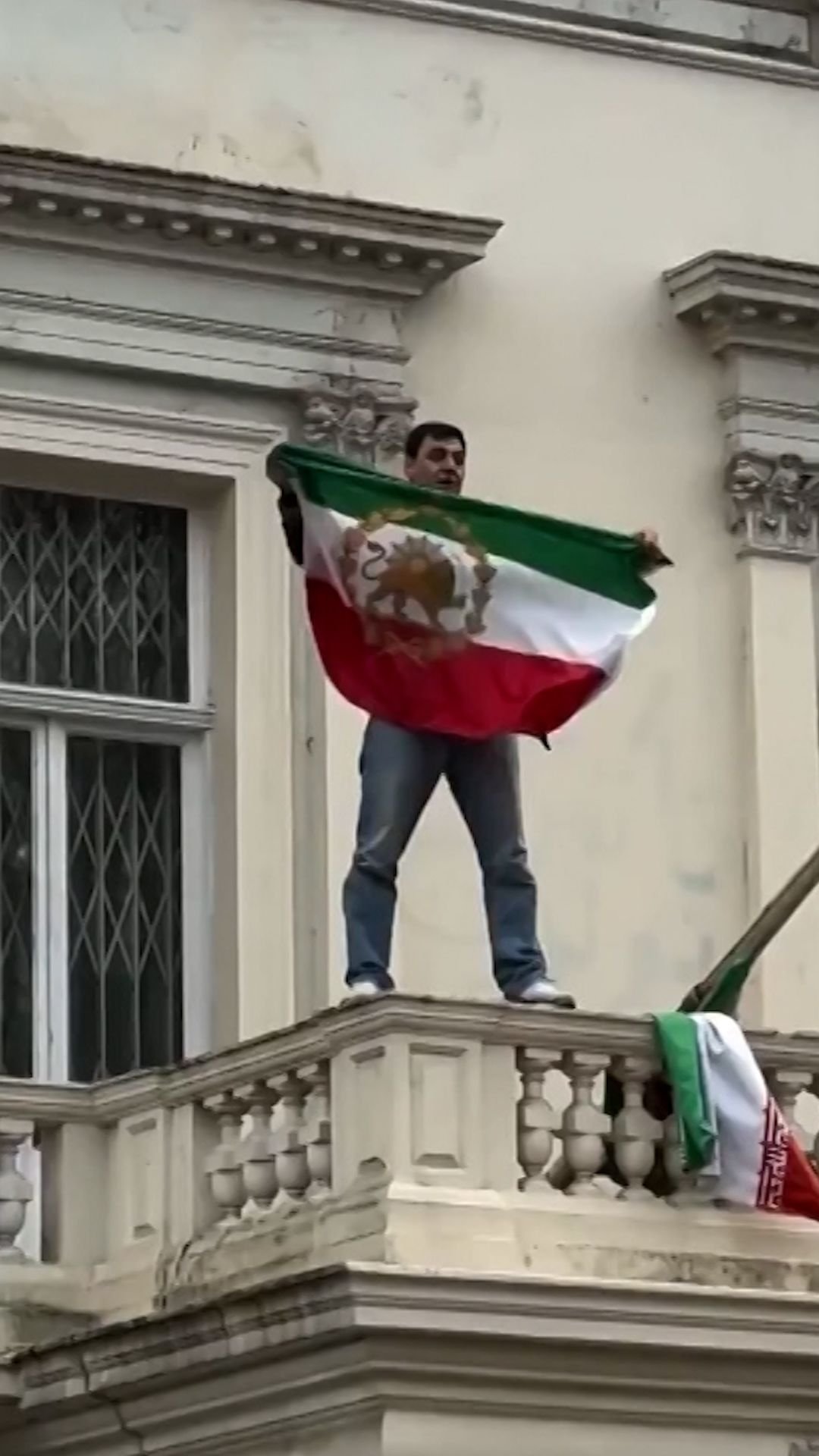
On the Equation That Turns a Nation Into Acceptable Rubble
Do we distinguish between Iran and the Islamic Republic? Are they one and the same? It sounds like a pedant’s quarrel, a hotspot for social media. It is not. And you may be surprised which side of it you find yourself on.
Begin with the historical fact, because it settles less than it seems to. To say Iran is the same as the Islamic Republic is chronologically incoherent. Iran — as a country, a nation, an idea — existed long before 1979. The Islamic Republic is a model of governance, and a model of governance is never equivalent to the entirety of a nation. Governments come and go; the country persists beneath them. The distinction is real. But here is the caveat, and it is the whole of the matter: it can be put to opposite uses, and both produce paradoxes.
Consider the first. There are those — and this has happened before, from inside the Republic itself — who insist the two are inseparable, that we must not drive a wedge between them. Why? To foreclose any invasion, any military attack. This cuts two ways. It can be a genuine patriotism, a shield held over a people. It can equally be the survival instinct of a repressive state, draped in the national flag. One has to make the distinction.
Now the second position — and here the spear must go in. There are those who say: this regime is evil, therefore the state must be destroyed, therefore the country may be bombed. And they have made it very clear, in their recent pronouncements, that even if the country is destroyed they will simply rebuild it. Better than before. From scratch. Notice what is conceded in that promise. The infrastructure dies. The cultural heritage disappears. The historical Iran vanishes. The people are killed. Reza Pahlavi has said it plainly: collateral damage is inevitable; there is a price; the dead are a necessary cost of liberation. He has even reached for new vocabulary to separate his dead from the Republic’s martyrs — as though a change of noun could change the arithmetic of a grave.
This is the position I want to name without euphemism. When loss of life becomes negligible — filed under the column marked acceptable, inevitable, necessary — the quarrel over names has already done its work. For observe: it no longer matters which side of the equation you chose. Believe Iran and the Republic are two things, and you may invade and call it a strike on the Republic. Believe they are one, and you may invade and call it the same. The semantic question was never the real one. The real question is the only one that counts: in your judgement, do the people of Iran get hurt — and if they do, do you consider them negligible? If your answer is yes, then whether you split the two names or fuse them, you have already decided to destroy Iran and to call the destruction a beginning.
What, then, of the distinction itself? It is real, but it must be delicate. The Islamic Republic and Iran are not one and the same — I have argued this before and I hold to it. Yet the existence of a central government, of a system of law and order, with all the necessary caveats, sustains the continuity of a nation. Only under the rarest circumstances can the collapse of a state be said to serve the future. And we need no thousand years of history to know this. We need only the recent past — Afghanistan, Iraq, Syria — and how military intervention spilled over, within those countries and into their neighbours. The lesson is there. It is the learning that is missing.
One last word, on a word. Regime. It is not neutral. It carries an orientalist, a colonialist charge. We do not speak of the British regime or the French regime; we reserve the term for Iraq, for Libya, for Iran. It is a real word that has been misappropriated — deployed in obedient service to expansionist and interventionist power. We should at least be conscious of what we are doing each time we reach for it.
A nation is not a sentence to be deleted and retyped. Those who promise to rebuild it from scratch should be asked, very quietly, who they imagine will be left to live in it.
Leave a Reply