
Get new essays in your inbox
Subscribe to receive the latest critical observations on Iran, politics, and the Muslim world.
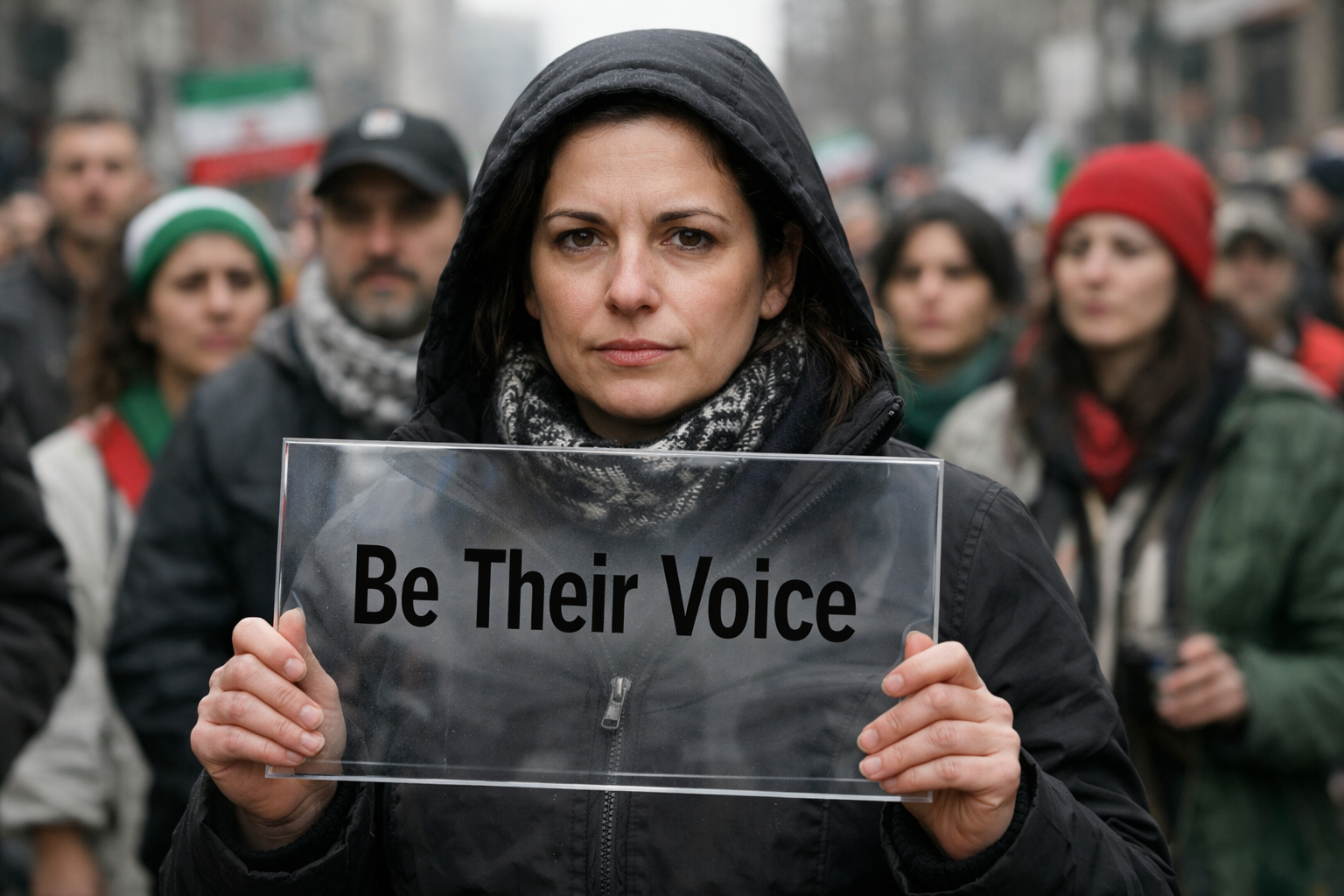
The placard is simple, humane, and emotionally irresistible: “Be their voice.” At first glance, who could object? If people are censored, jailed, beaten, or killed, should they not be heard? Of course they should. But politics begins precisely where sentiment ends. The real question is not whether Iranians should be heard. The real question is this: heard by whom, for what end, and translated into what programme of action?
This is where the slogan begins to darken. Too often, in the online activism of a segment of the Iranian diaspora, “be their voice” does not mean careful solidarity, disciplined witness, or intellectually honest advocacy. It means: amplify the suffering of Iranians until it becomes morally easier to justify sanctions, sabotage, siege, or military intervention. The slogan sounds compassionate, but its political afterlife is often brutal.
I have been circling this problem in several earlier essays. In “The Depth Illusion” I argued that moral language is frequently used as philosophical scaffolding for war apologism. In “The Normalcy We Must Defend” I showed why sanctions do not principally wound repressive elites; they wound the civilian fabric of society—the sick, the poor, the ordinary family trying to keep life going. And in “War Unseen, War Unleashed” I wrote about the peculiar spectacle of distance masquerading as courage: those with no skin in the game speaking as though other people’s ruins were a form of principle.
The slogan sits at the intersection of all three.
Let me be clear, because the fallacy arrives predictably: “So, you want people’s voice not to be heard?” No. Nothing could be further from the truth. I want voices to be heard without being ventriloquised. I want suffering to be witnessed without being converted into a permission slip for more suffering. I want the grief of Iranians to remain Iranian grief—not raw material for the fantasies of exilic heroism, foreign intervention, or civilisational theatre.
The world already knows that the Islamic Republic is repressive. This is not hidden knowledge waiting for a hashtag to disclose it. The prisons are known. The executions are known. The violations of due process are known. Women’s struggles are known. Labour grievances are known. Ethnic and religious marginalisation are known. What, then, is really being added when the slogan is repeated with such fever? Very often, not knowledge, but pressure—pressure towards a conclusion already desired.
And that conclusion is almost always sold dishonestly. It is rarely stated in full. Nobody wants to say openly: I want sanctions that will make medicine scarcer; I want instability that will make daily life harsher; I want foreign powers with their own strategic interests to decide that Iran is now a suitable site for managed destruction. So the cruelty is wrapped in the language of care. A poster says “Be their voice”, but the subtext is too often: help intensify the conditions under which ordinary people will break.
Yet life inside Iran, however wounded, is not reducible to a theatre of total despair. People still bury their dead, celebrate their children, translate books, fall in love, quarrel, study, work, laugh, pray, and endure. This does not mean life is normal in the shallow sense, nor does it excuse repression. It means that a society is more than its torment, and that those who claim to speak for it must not desire its collapse as proof of their moral seriousness.
If one wants a more rigorous test of this matter, one might begin not with a slogan, but with coherence. That is precisely why I created the Political Consciousness Toolkit: not as a test of loyalty, but as a test of symmetry, consistency, and moral seriousness. Can one oppose authoritarianism and foreign bombing at the same time? Yes. Must one? I would argue that any politics worthy of the name requires precisely that double refusal.
To refuse the slogan in its current usage is therefore not an act of silence. It is an act of resistance—resistance to sentimental blackmail, to bad faith, and to the cheap moral glamour of speaking for others while prescribing the instruments of their further harm. Solidarity does not mean borrowing another people’s pain and spending it recklessly. It means refusing to make their pain serve the ambitions of empire, exile nostalgia, or dynastic fantasy.
Iranians do not need ventriloquists. They need honesty. They need political literacy. They need allies who can distinguish between amplifying a voice and hijacking it, between witness and weaponisation, between conscience and performance. A slogan is never innocent when its consequences are not.
So yes, hear the people of Iran. But hear them as human beings, not as ammunition. Hear them in their plurality, their fatigue, their endurance, and their right not to be “saved” into rubble. The task is not to become their voice. The task is harder, humbler, and far more moral: to stop drowning it out with the echo of our own desires.
Leave a Reply to «صدای مردم ایران»، اما در خدمت کدامین افق؟ – ملکوت Cancel reply