
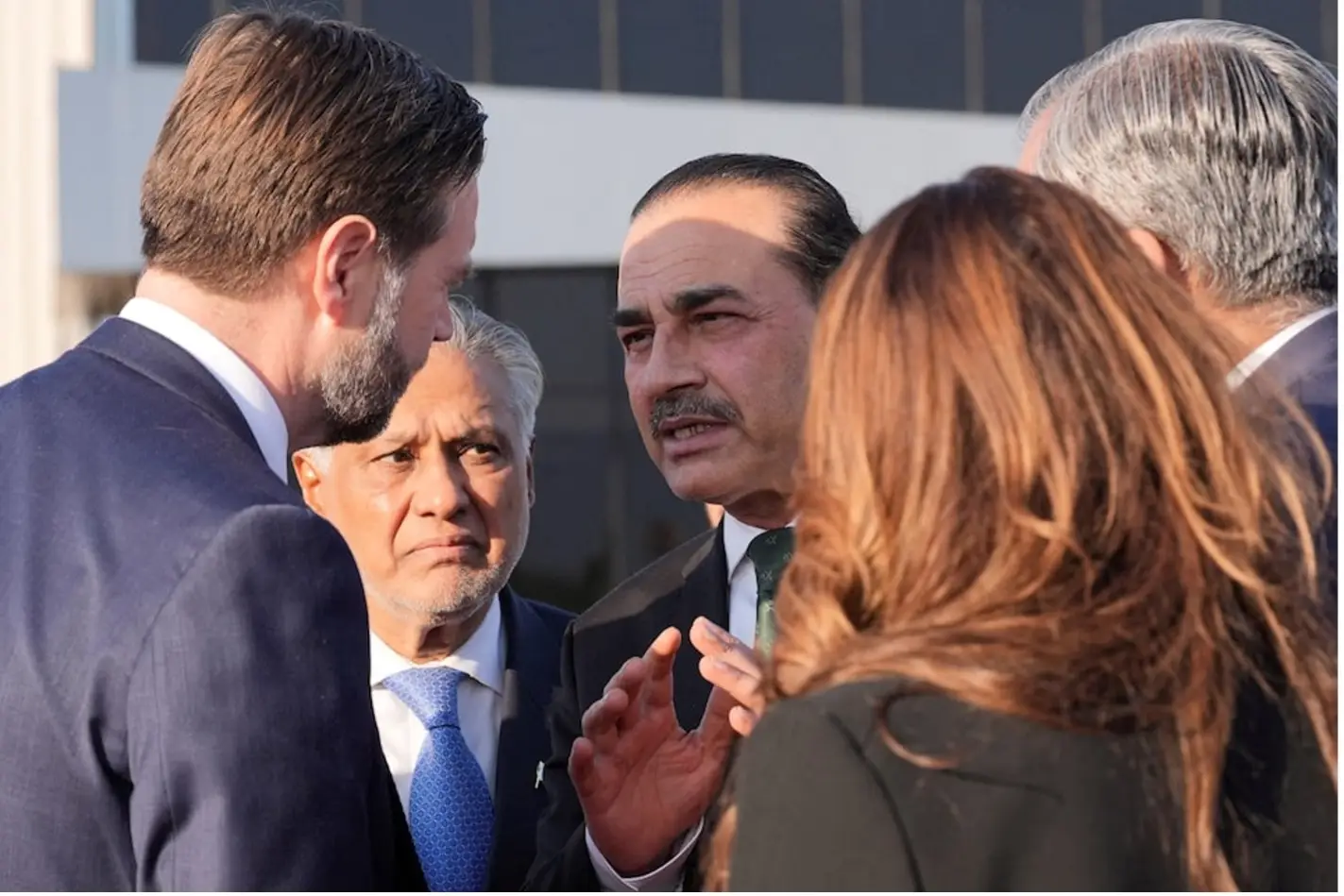
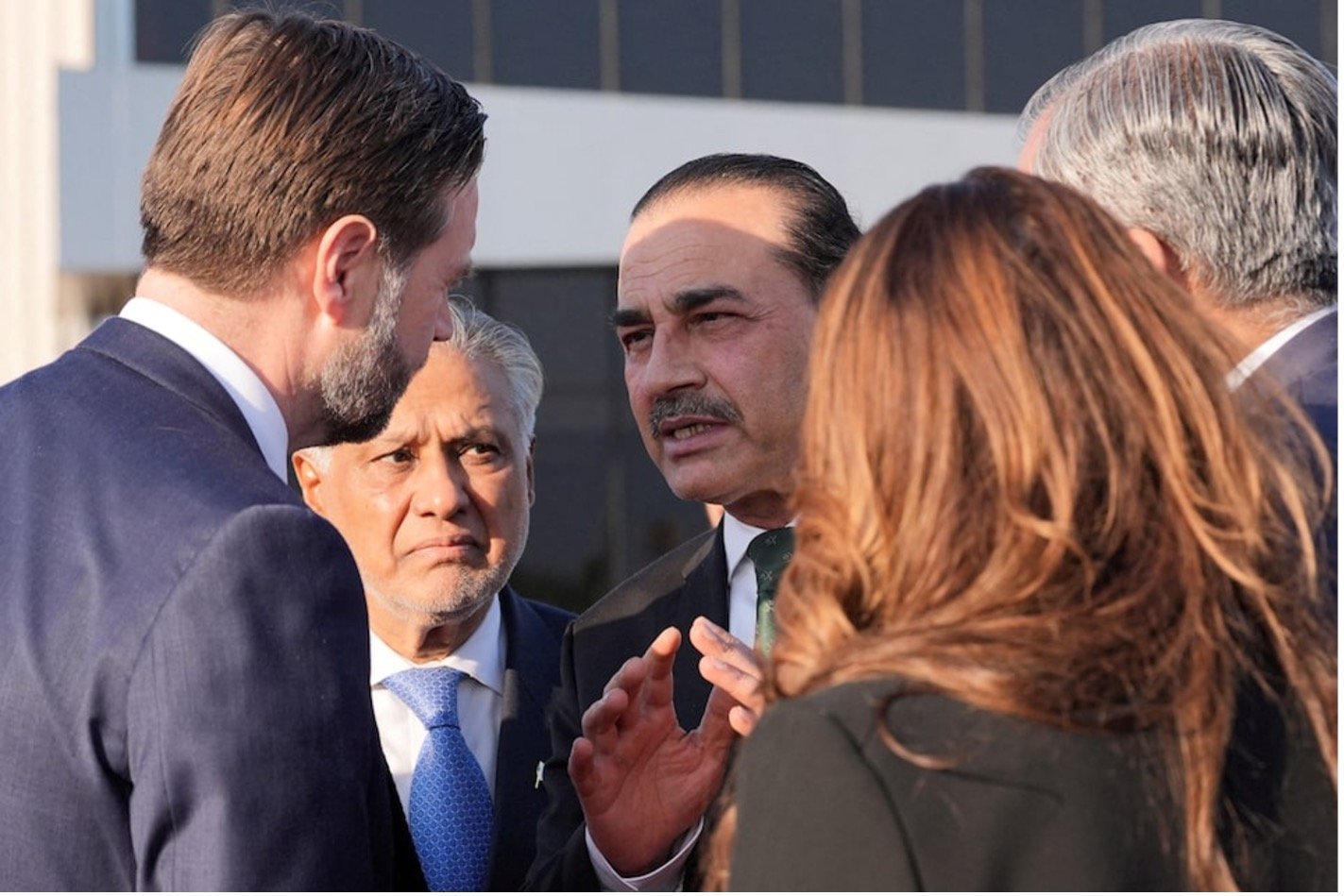
Image: Delegates during the Islamabad talks on the US–Iran track, April 2026. Credit: Reuters.
A Dialogue with Ambassador Sada Cumber
Ambassador Sada Cumber’s recent essay for the National Security Institute, “Dialogue to Truce: Pakistan’s Role in Reshaping the Regional Structure,” reads, at its best, as a quiet warning. He argues that what we are witnessing across West Asia is not stability but a pause — a breathing space purchased by pressure, not produced by structure. Ceasefires hold for a season; chokepoints remain latent; dialogue dissipates unless it accumulates into institutions. The core proposition — that durable outcomes require continuity, coordination and institutional anchoring, and that Pakistan is moving from facilitator to potential anchor — deserves to be read carefully by anyone who takes the region’s future seriously. I find myself in agreement with the spine of his argument. What I want to offer here, in the most deferential spirit, is a widening of the frame.
First, a point of reinforcement. Sada is right that the present moment is defined by asymmetry: disruption is less costly to generate than stability is to sustain. That single sentence is, in effect, a theorem of the contemporary regional order. It explains why the Strait of Hormuz functions not as a closed route but as a latent pressure point; why external guarantees have thinned; why time horizons in Tehran and Washington cannot be synchronised by diplomacy alone. It also explains why Islamabad’s convening of the recent US–Iran engagement — not Muscat this time — signals something more than a change of venue. It signals a change in the geography of trust. That is a non-trivial shift, and Sada is right to name it.
Where I would respectfully expand his analysis is on the question of who, precisely, generates the disruption that makes stability so expensive. Sada’s framing is systemic and elegant; it treats fragility as an emergent property of the region’s interdependence. I agree that interdependence without governance produces fragility. But interdependence does not decay on its own. It is actively destabilised by specific actors whose strategic interest lies precisely in preventing the region from consolidating. Any honest reading of the last two years — from the Saudi energy strikes to the Islamabad talks, from the covert logic of sabotage to the overt logic of air campaigns — points to a structural spoiler that cannot be folded neatly into the language of “external actors.” Israel, armed with an undeclared nuclear arsenal and shielded by the American veto, is the central asymmetry the region must learn to speak about in plain terms. No anchor state, however capable, can hold a system that is being actively pulled apart from within. Naming this is not a polemical indulgence; it is a condition of analytical seriousness.
The second place where I would gently extend Sada’s argument concerns Pakistan itself. He writes of a transition from facilitation toward potential anchoring. I would go further and argue that the transition has already begun, and that it carries a contradiction Islamabad must now metabolise in public. The Strategic Mutual Defence Agreement with Riyadh, and the integration of Pakistani airpower into Saudi air defences, has given Pakistan the convening weight that makes its mediation credible. It has also, unavoidably, compromised the appearance of neutrality on which mediation is presumed to depend. Foreign Minister Dar’s visit to Tehran in March, with its explicit disclosure of SMDA obligations, was a first attempt at squaring this circle through strategic transparency. It is, to my mind, the most interesting diplomatic innovation of the year: a wager that honesty about one’s commitments is more stabilising than performative impartiality. If it holds, it may become a template for how medium powers mediate in a post-hegemonic order.
This brings me to the deeper theoretical point. Sada distinguishes between dialogue that dissipates and dialogue that accumulates into structured institutions and practices. I would add a third category, and it is the one on which the region’s future most depends: dialogue that deters. The paradox of the current pause is that it is being held together, in part, by the very asymmetries Sada identifies. A nuclear-capable Pakistan inside Saudi defences raises, rather than lowers, the cost of Iranian miscalculation, and by the same token raises the cost of Saudi adventurism. Mutual deterrence is not an institution, but it can be the scaffolding on which institutions are built, provided it is explicitly linked to a framework of mutual constraint. A mutual cap-and-reduction understanding between Islamabad and Tehran — on enrichment, on stockpiles, on the doctrines governing their use — is, as I have argued elsewhere on Twin Wisdoms, the only credible long-term path. It is also the hardest.
I close with a critical-rationalist caveat, in the spirit of the friendship that animates this exchange. Every framework offered for the region’s future — Sada’s, mine, anyone’s — must remain falsifiable. We should be suspicious of any account, however elegant, that immunises itself against refutation by absorbing every counter-example into its schema. The next twelve months will test whether Pakistan’s anchoring is real or rhetorical; whether the Islamabad channel accumulates or dissipates; whether the spoilers are contained or indulged. Sada has given us the right question. What remains, for the rest of us, is to refuse the comfort of a premature answer, and to keep the dialogue honest enough to survive the asymmetries it is trying to name.