
The funeral has ended, the firing has resumed, and the next fortnight will decide whether the June understanding can be rebuilt. It can, and it probably will be.
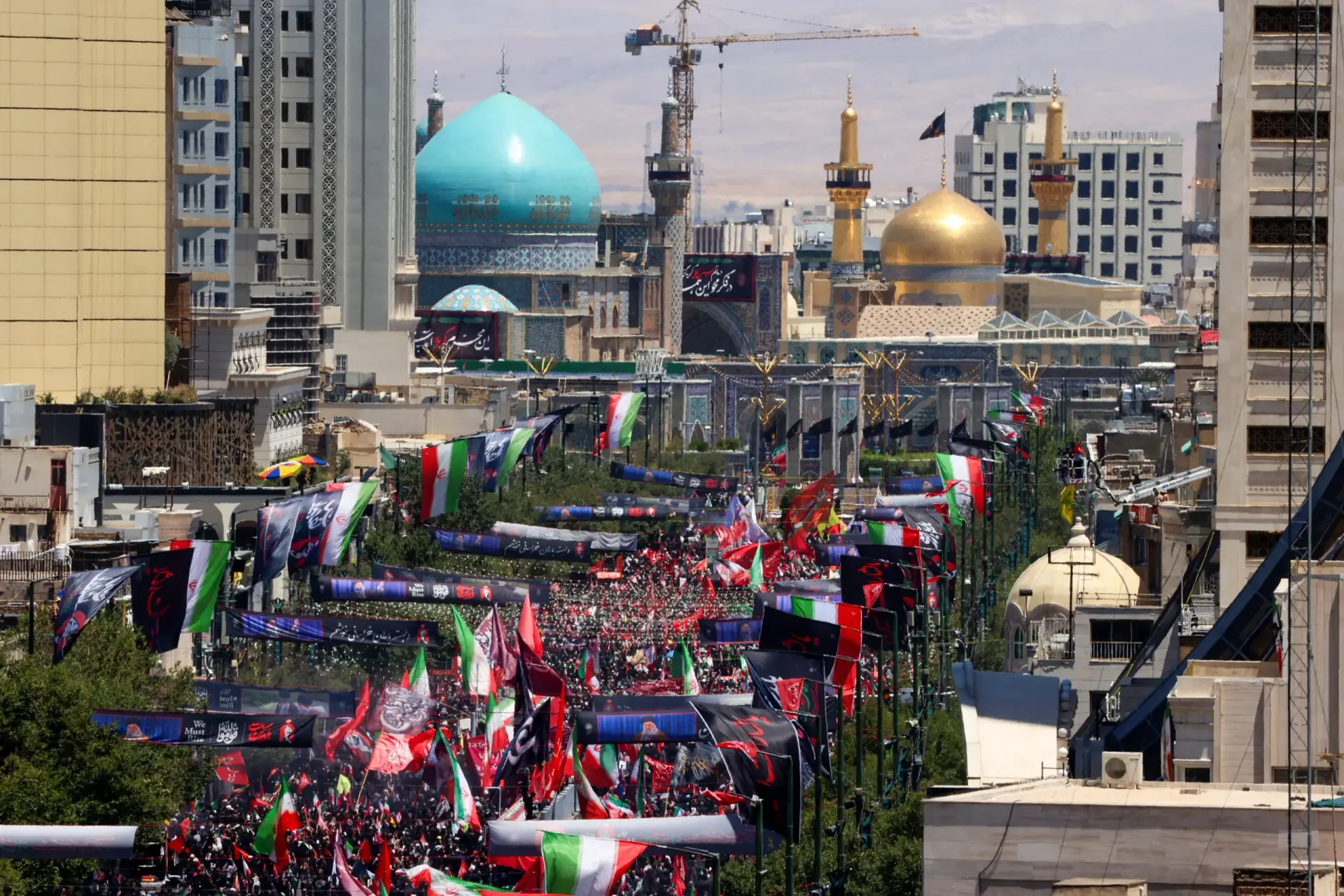
Ayatollah Khamenei was buried in Mashhad today, at the close of a six-day procession through Tehran, Qom, Najaf and Karbala that his state mounted, at great cost, as a demonstration of survival. The same week produced the sharpest exchange of fire since the June memorandum: shooting around tankers in the Strait of Hormuz, two nights of American strikes on Bandar Abbas, Bushehr and the Qeshm coast, Revolutionary Guard missiles against American bases in Kuwait, Qatar and Bahrain, and an attack that cut the railway carrying mourners to the burial. Cortège and cruise missile shared one news cycle. That looks like the opening of a second war. I read it as the closing argument of the first – bargaining by fire between two sides that have already learnt what they most needed to know about each other, and now need a table more than a target list.
 The fire cannot hold
Consider what the exchange has avoided. It began around shipping and it has stayed in the Gulf; Israel is bracing but untouched, and Iran has aimed at bases whose defences and politics it knows intimately. The American targets were naval facilities and a railway line – damage without decapitation. Washington’s language tells the same story. Trump pronounced the memorandum ‘over’ one day and allowed that talks could continue the next, while Vance reduced the whole architecture to a price list: the blockade stays lifted so long as the ships go unmolested. A price list is an invitation to haggle. Pakistan, which brokered the June understanding, urged restraint within hours, and the Gulf states – struck again, absorbing it again – will press for de-escalation, because their airspace and their insurance premiums carry the cost of every round.
Then there is the market, which has stopped extending credit to either side’s theory of victory. The effective closure of Hormuz has already cost upwards of $60 billion in damage to energy infrastructure and more than $150 billion in lost export revenue, and the reinsurance industry now warns that a single chokepoint event of this kind could swallow the annual premium base for the entire war-risk class. Nobody underwrites a burning strait twice. Iran hurts too, but it hurts differently: its grip on Hormuz has become an organ of the state’s post-war survival, its trade with China runs largely outside the dollar system, and five months of bombardment have taught Tehran that endurance, plus the power to make global commerce bleed, is a currency no sanctions regime can freeze. Deterrence by bombardment has produced fragmentation and called it security. Neither treasury can sustain this posture through July, and neither leadership wants to; confined targets and open channels are the recognisable prelude to renewed talks, probably on wider terms than shipping alone. My expectation: a pause within days, and a restored – perhaps renamed – understanding within two or three weeks.
A year’s ledger
Now set the year in order. The war of 28 February began, in the middle of live negotiations, with the assassination of Iran’s head of state and much of its high command. Its declared purpose, in Washington and among parts of the exiled opposition, was to finish the Islamic Republic – the maximalist wager that has organised American policy for a generation, now tested to destruction against a polity that closes ranks under siege. Five months on, the ledger reads differently. The Assembly of Experts met under bombardment – its Qom office was hit mid-session – and produced a successor within nine days. The state then staged a five-city funeral across two countries and ran it with a discipline nowhere in evidence at Khomeini’s burial in 1989. A Friday prayer leader in Qom promptly claimed the crowds as a fresh plebiscite on the system. Stage-managed, certainly, and ruinously expensive. But the machinery worked, and after a season of decapitation strikes a working machine is itself an argument.
The scale bears recording, because it will be disputed. In Karbala, by an eyewitness account received last night, one entry point alone – the approach from Najaf – held a 12-kilometre stretch filled with people and service stations. None of this launders January, when the system answered protest with a repression that credible monitors reckon at no fewer than 7,000 dead. The crowds were an alliance of the convinced and the affronted: the ideological core marching beside Iranians of no settled loyalty, for whom foreign bombs had rekindled an old reflex of national defence. That bloc is broad and it is loud, and it remains well short of half the country. But wars are settled by states, and the state stood. Pakistan sent its Prime Minister; the Gulf monarchies split the difference, sending deputies who kept the channel to Tehran warm while committing to nothing; Russia and China lent the occasion their presence while keeping their signatures off it; and more than 30 governments asked to take part. What carried the moment past confessional lines was the oldest grievance in politics: a head of state assassinated on his own soil. A power that was supposed to be broken is instead burying its leader before millions and negotiating as a state. The upper hand that matters is not military parity but outcome, and on outcome the year belongs to Tehran.
An opposition that answered its own question
If the war consolidated the state, it exposed the state’s loudest rivals. The restoration movement treated foreign bombardment as its moment. Satellite hosts cheered attacks on the country’s grid and ports; Reza Pahlavi reportedly told a forum in Odesa that Iranians had celebrated them, a claim I answered at the time. The constituency never materialised. Manoto, the movement’s flagship channel, had already gone dark for want of a paying audience. The Lion and Sun was waved over rubble, and the January dead – who belong to no exile’s column – were conscripted into arguments their families never made. Iranians who despise the Islamic Republic drew the obvious conclusion about an opposition that needed foreign bombs to feel within reach of power. That opposition is weaker today than at any point since 2022, and the monarchist project is, for practical purposes, finished. Western policy built on the premise of a government-in-waiting now has nothing left to point at.
The fortnight ahead
Four things are worth watching between now and the end of July. First, the maritime patch: quiet Pakistani shuttling, with Qatari help, toward the ships-for-blockade formula under a new name – and, running beneath it, Muscat’s quieter proposal to govern passage through the strait by ‘service fees’, which reads as administration where a toll would read as siege. Second, Tehran’s tone. Rhetoric will stiffen before it softens: a new leadership must prove its firmness to a grieving base before it can risk flexibility across a table, so a loud interval will precede a quiet one. Third, consolidation: whether Mojtaba Khamenei appears in public, and how the division of labour settles between the clerical office, Larijani’s security council and Pezeshkian’s government. Fourth, the spoilers. A sunk tanker, a strike that kills the wrong man, an Israeli decision to widen the theatre beyond the Gulf – any of these could turn bargaining by fire into the war neither principal wants this month.
Behind all of it stands a constraint that nobody in Washington or Brussels says aloud. Europe has neither the capacity nor the politics for another refugee movement on the scale of 2015, the region has less, and no market can price a closed Hormuz for long. The system in Tehran will remain – for how long, nobody knows, and I make no prediction – and every serious government has conceded as much by negotiating with it. The Gulf capitals have gone a step further: their planners now argue that there is no return to the status quo ante, and that the durable answer is a regional compact – a collective non-aggression arrangement that acknowledges Iran’s weight and sets hard limits on its conduct – written by the neighbours who must live with the outcome. The honest policy follows from the same admission: a charted settlement covering the nuclear file, shipping and sanctions, agreed with the state that exists, on a timetable measured in weeks. The funeral is over. The table is waiting.
Leave a Reply