
Popper’s two ways of reading a definition, and why the names I give on these pages stay open to revision
I went back this week to the chapter of Karl Popper’s The Open Society and Its Enemies in which he separates two kinds of definition, and I went back to it because of a habit of my own. Since March I have been giving names to things on these pages, and I have said more than once that a phenomenon has to be named before we can know how to deal with it. A careful reader (and I have a few, not all of them friendly) might fairly ask whether this habit of naming is Platonism let in through the back door, which is what Popper spent a whole volume taking apart. My answer is no, and the reason lies in the direction in which the name is read. The names I give are labels for a pattern of behaviour. They are drawn from what people do, they are offered for testing, and I hold them only for as long as the behaviour holds. What Popper attacked, as I read him, is the opposite movement, in which the name is taken as a door to a hidden essence and the label hardens into a verdict. In April I wrote that political clarity begins with refusing to call things by names they have not earned, and I would only add now that a name has to go on earning its keep, or be given back.
Reading a definition from the right
Popper’s example is deliberately homely. Take the sentence ‘A puppy is a young dog.’ The essentialist, as Popper calls him, reads it from left to right, as the answer to the question ‘What is a puppy?’, and so treats the word on the left as the thing to be explained, as though by digging hard enough into the word we would reach the truth of the animal. The other reading, which Popper defends as the habit of the sciences, runs from right to left. We have described something, a young dog, and we agree to call it a puppy for short. The name comes last, it is a convenience, and nothing hangs on it. If the description turned out to be wrong we would change the description, and the name would follow. Behind the first reading stands Plato, for whom names point upwards to Forms, perfect and unchanging, so that knowledge of the name becomes a kind of knowledge of the divine order of things. Behind the second stands a more modest ambition, which is to describe how a thing behaves in different circumstances and whether there are regularities in that behaviour. I claim no more than this for my own names.
What my names were for
The clearest case is the figure I called Homo Exsul Furens in March, the raging exile. It emerged from watching one part of the Iranian diaspora: the royalists, the supporters of a restored monarchy, the people who jumped on the bandwagon of the Israeli state and its machinery of war as it was turned on Iran, in violation of international norms. These are human beings who shout, who make noise, who display their emotions, and who seem to believe that by making noise and appearing to mourn certain tragedies their entire behaviour is suddenly legitimised, so that whatever they do afterwards is perfectly fine and nobody may question it. We know, moreover, that the moment someone shows an excessive passion for the victims of injustice in Iran, or elsewhere in the Middle East and the Muslim world, that passion is very often turned into an argument against whole categories of people: against Muslims, against the Shia, against the reformers, against the left. The slogan I quoted in April, ‘death to the three corrupt: the mullah, the leftist and the Mujahid’, does just that, and in a single line it removes three bodies of people from the conversation altogether. By naming the figure I was trying to draw the contours of a behaviour, so that I, and my reader, would know what to expect from it and could engage with it more critically and with more consciousness than if we did not know what we were dealing with.
The same holds for the other names: the emergency mind, the occupation myth, the algorithmic militia, the moral market. In May I wrote that each of them was coined, defined and stress-tested against counter-examples. I would put that more carefully now, since ‘defined’ was the wrong word for what I was doing, and Popper would have told me so. None of them was a definition of anybody’s nature. Each was a short label for a description that came first.
I concede two things. The labelling can sound aggressive, and I know it does. It can also sound Platonic, as though I had found the hidden essence of a whole group and pronounced on it. I did not help matters by closing the March essay with the line that what is unnamed cannot be resisted, which makes the name sound like a weapon. I stand by the essay. Its last line, however, I would now put differently, because the purpose of the name was never resistance as such. It was orientation: knowing where one stands and what one is likely to meet.
Room on both sides
What separates such a name from a verdict is that it is tentative, and tentative in two directions. It leaves room for the person I am describing to change, and it leaves room for my own theory to be proven wrong. The relation is an interaction between my naming and the named, between the name and whoever bears it. If their behaviour changes, if their attitude shifts, if their way of engaging with the realities of the world is different from what it was, then I prefer to shift the name. I have done so already, more than once. In September I went back to the emergency mind and said that it explained why judgement is suspended but not why the suspension always turns outward, towards the nearest available category, so that it needed another name beside it. In June I revisited the moral market, kept the picture and dropped the cure I had offered for it. Neither revision embarrassed me. Both were the method doing what it is for.
Compare the names that do not move. When the royalist slogan calls the mullah, the leftist and the Mujahid corrupt, it names an identity and leaves no room for change on either side, since a leftist who behaves impeccably remains a leftist and therefore remains corrupt. When opponents are called a cancer, as I argued in March, the word announces that transformation has been abandoned for annihilation. And when anyone associated with a cause can be called a criminal, as I wrote last month, the naming serves as the proof, because the verdict came first. All of these are read from left to right. The word is supposed to contain the truth of the person, and no conduct, however changed, can reach it.
Working backwards from the Qurʾān
There is an objection I can see coming, and it comes from a direction Popper did not have in mind. Someone may say that names do have a divine dimension, and that the Qurʾān says as much, since God taught Adam the names, all of them (Q 2:31). Is that not Plato confirmed by revelation, and my modest labels exposed as a modern prejudice?
I have no quarrel with the metaphysics of it. What God taught Adam is beyond our reach, and I do not intend to defy it; it is completely beside my point. When I read that verse alongside the angels’ objection last month, what struck me was that Adam’s warrant was a capacity to know, shown before the angels, and not a list handed down for safekeeping. The objection, however, works backwards. It takes a metaphysical element, brings it down to the level of human beings, and once it has become earthly, projects it back up to divinity, as though our labels were the names Adam was taught. What comes down has come down. The moment it goes back up, it is no longer divine. It is tainted, painted with our humanity, covered with the stains of our human behaviour, and we need to be very cautious about giving it that kind of super-metaphysical standing. The man who says his three corrupt categories are simply what those people are has made the same round trip, and he returns with an authority his slogan never earned. If the verse bears on my practice at all, I would suggest it is as a warning against mistaking our names for His.
What would make me drop a name
I cannot show that every name I have used fits every person it might seem to touch, and I have not tried to. What I can say is how each would fail. If those I described as raging exiles stop treating their grief as a licence, stop turning sympathy for victims into a case against whole categories of their compatriots, and argue with the people they disagree with instead of shouting them out of the room, then the name describes nothing and should go. If a reader shows me that I have fixed one of my labels on an identity, on royalists as such or on exiles as such, and not on a behaviour, then I have committed the fault I am charging, and the label goes for that reason. And if a name has done no work, if knowing it told us nothing about what to expect, it was an ornament, and I will drop it without regret. I would much rather lose a name to a change in the people it described than keep it against the evidence, and if that change comes, I hope I will be among the first to notice.
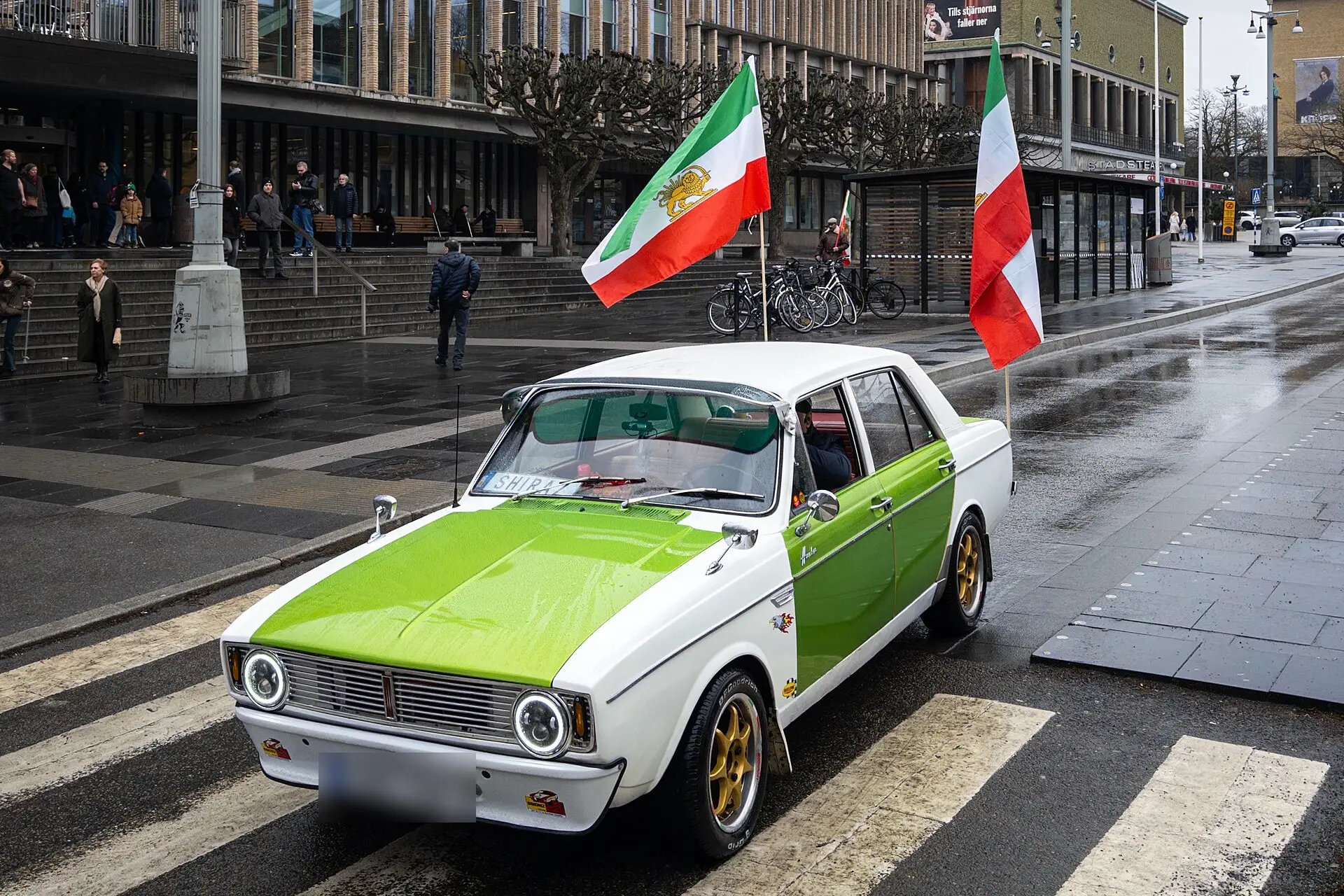
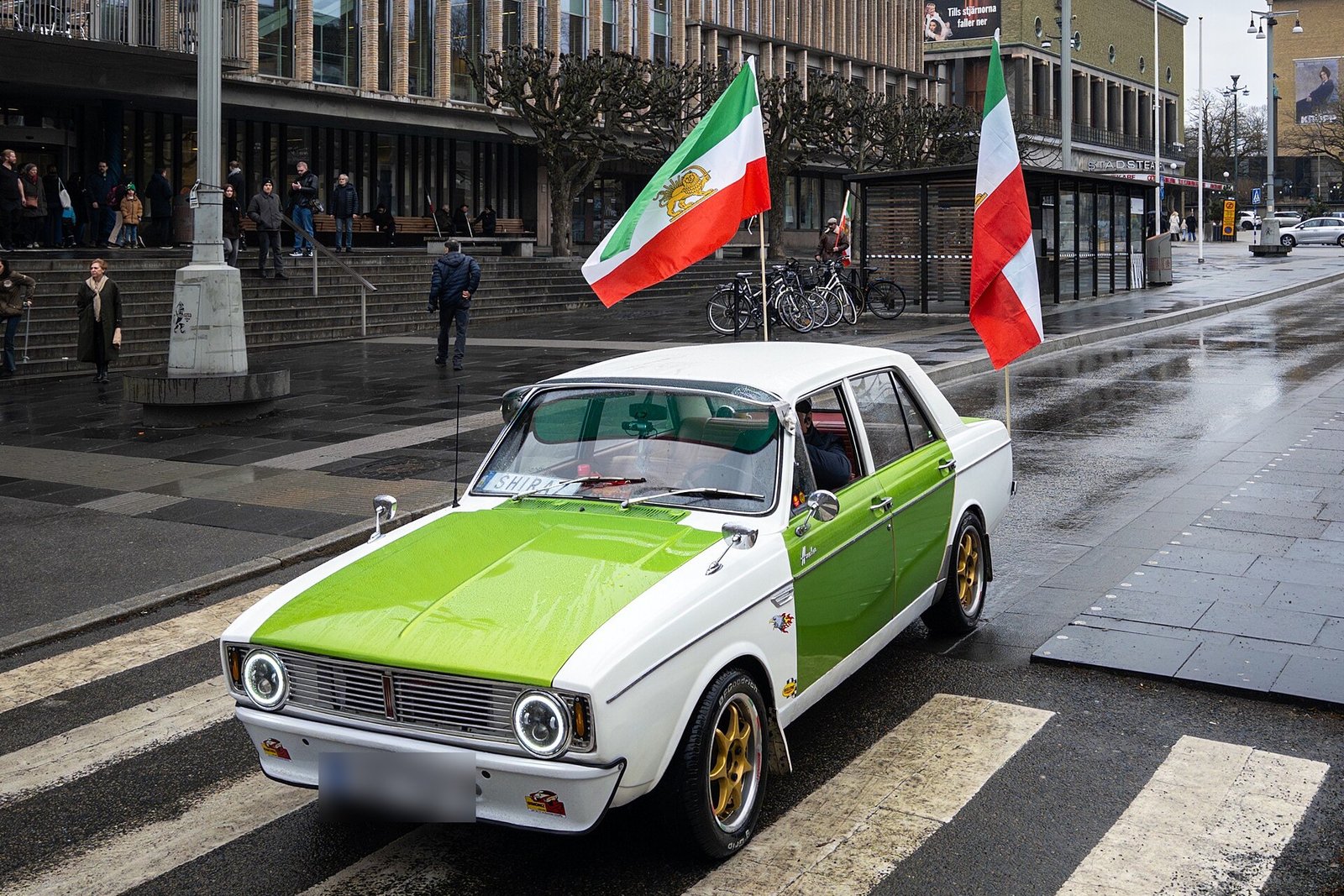
Image: A car flying the Lion and Sun flag on Kungsportsavenyn during an anti-Islamic Republic rally in Gothenburg, Sweden, 7 March 2026. Credit: Crannofonix News, via Wikimedia Commons (CC BY 4.0); cropped, registration plate obscured.
Leave a Reply