
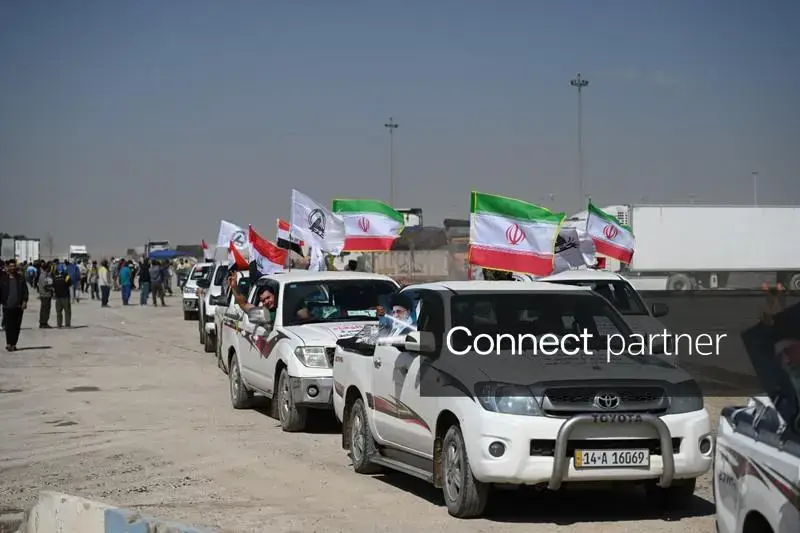
Credit: Haidar Mohammed Ali / Anadolu via Reuters Connect
[Note: The Reuters Connect page itself says the asset is provided by Anadolu Agency and that Reuters Connect “has not verified or endorsed the material.”]
One of the lazier slogans in recent Iranian political discourse is the claim that Iran has been “occupied” because the Islamic Republic has relied on Afghan, Iraqi, Lebanese and other aligned forces beyond its borders, and at times appears to have drawn on some of these networks closer to home. The slogan is emotionally potent, especially in parts of the diaspora. It converts anger into clarity. It offers a simple culprit. But as political analysis it is weak. It confuses repression with occupation, transnational ideology with foreign rule, and auxiliary force with the replacement of a nation by outsiders.
My first proposition is straightforward. Not every foreign presence amounts to occupation. Occupation, in political and legal terms, implies effective control by an external power over the territory and governing authority of another state. That is not what we are dealing with in Iran. However troubling the presence of transnational Shiʿi networks may be, Iran is not being governed by Kabul, Baghdad, Beirut or Najaf. It is governed by an Iranian state, through Iranian institutions, Iranian elites, Iranian security organs and Iranian collaborators. To say otherwise is not merely exaggerated; it is a categorical error.
This distinction matters because it separates two different criticisms. One criticism says that the regime has built a regional security architecture and has used ideologically aligned groups for strategic depth. That criticism is broadly sustainable. The other says that Iran has ceased to be ruled by Iranians and has become an occupied country. That second claim does not follow. A state may be authoritarian, predatory and regionally entangled without ceasing to be its own state. To collapse these two claims into one is to replace analysis with slogan.
My second proposition is that states routinely use outsiders, auxiliaries and proxies. This is not peculiar to the Islamic Republic. France has long treated the Foreign Legion as a legitimate arm of state force. Britain has relied on Gurkha regiments. The United States, including in Iraq and Afghanistan, has worked through contractors, tribal auxiliaries and partner militias. European and democratic states also externalise coercion when it suits their interests; they simply describe it in more respectable language. When others do it, it becomes alliance management, expeditionary doctrine or burden-sharing. When Iran does it, some suddenly discover a language of occupation. The hypocrisy is obvious.
This does not excuse the Iranian case. It simply restores proportion. If the use of foreign-born or non-national fighters proves occupation, then one would have to describe a host of other states in the same way. Very few who use this slogan would accept that conclusion. The standard is therefore not analytical but polemical. It is applied selectively because it serves a psychological need: it allows one to imagine that the country was stolen only by foreigners, not also by one’s own institutions, factions and failures.
My third proposition is that even the language of “mercenary” is often too blunt for what is happening. Groups such as the Fatemiyoun Brigade or elements linked to Hashd al-Shaabi are not simply hired hands in the narrow sense. They are usually tied to the regime through ideology, patronage, training, strategic dependency and a shared language of resistance. This makes the matter more serious, not less serious. But accuracy still matters. What we are seeing is not a foreign nation ruling Iran; it is an Iranian regime projecting power through a transnational ideological ecology, and at times drawing reassurance, manpower or symbolism from it.
My fourth proposition is that the occupation myth rests on a poor form of nationalism. It assumes that the only “real” Iranians are those who think as we do, and that those who do not may be treated as alien bodies, imported agents or occupiers. Nothing could be further from the truth. A brutal judge, a corrupt cleric, a repressive officer or an opportunistic bureaucrat does not become non-Iranian merely because he is politically repugnant. The problem is not that such figures are foreign. The problem is that they are ours too: products of our own political history, institutions, fractures and unresolved struggles.
This is precisely why the slogan is so seductive. It relieves us of a harder reckoning. It is easier to say the homeland has been occupied than to admit that a domestic authoritarian order, with local roots and local recruits, has endured for decades while also building regional ties of coercion and influence. The first story offers emotional release. The second demands political maturity. Yet only the second story can help us think clearly about change.
There is, of course, a real experience underneath the exaggeration. People have heard non-Persian accents in moments of repression. They have seen the symbolism of foreign militias celebrated in Iranian political space. They know that the regime has invested heavily in organisations beyond Iran’s borders while large parts of Iranian society have been impoverished, silenced or brutalised. These observations should not be dismissed. But from a number of visible and painful instances one cannot infer a total condition of occupation. Good political judgement requires proportion, scale and evidence.
The broader literature in political science and international relations is useful here precisely because it cools the temperature. States do not survive by purity. They survive through combinations of coercion, legitimacy, patronage, ideology and external leverage. They borrow methods from one another. They justify their own violence in universal terms and denounce the same conduct in their rivals. That pattern can be observed in empires, republics, democracies and authoritarian states alike. Iran is not unique in this respect. Its configuration is particular, but the underlying logic is not.
My final proposition is practical. The occupation myth does political damage because it misdiagnoses the problem. If Iran is occupied, then the implied remedy is liberation by an external force. If, however, Iran is ruled by an entrenched domestic state that also works through regional clients and ideological allies, then the task is different. It is to weaken the machinery of coercion, split the ruling bloc, reduce the costs of collective action, build broader coalitions and think institutionally rather than mythically. That is a harder politics, but it is also a more honest one.
We should therefore hold two truths together. First, transnational militias and aligned formations have intensified repression, fear and regional entanglement, and references to groups such as Fatemiyoun or Hashd al-Shaabi are not invented out of thin air. Second, Iran is not an occupied country in the serious sense of the term. To confuse these truths is to hand propaganda a victory over judgement. Anger is understandable. Slogans are easy. But if we want a freer Iran, we need a language that names the regime’s violence without surrendering reason, proportion and intellectual self-respect.
Selected Works Engaged
- Arendt, Hannah, The Origins of Totalitarianism.
- Bayat, Asef, Revolution without Revolutionaries.
- Keohane, Robert O., After Hegemony.
- Mann, Michael, The Sources of Social Power.
- Popper, Karl, The Open Society and Its Enemies; Conjectures and Refutations.
- Thomson, Janice E., Mercenaries, Pirates, and Sovereigns.
- Tilly, Charles, Coercion, Capital, and European States, AD 990–1992.
- Weber, Max, Politics as a Vocation.
- Waltz, Kenneth N., Theory of International Politics.