
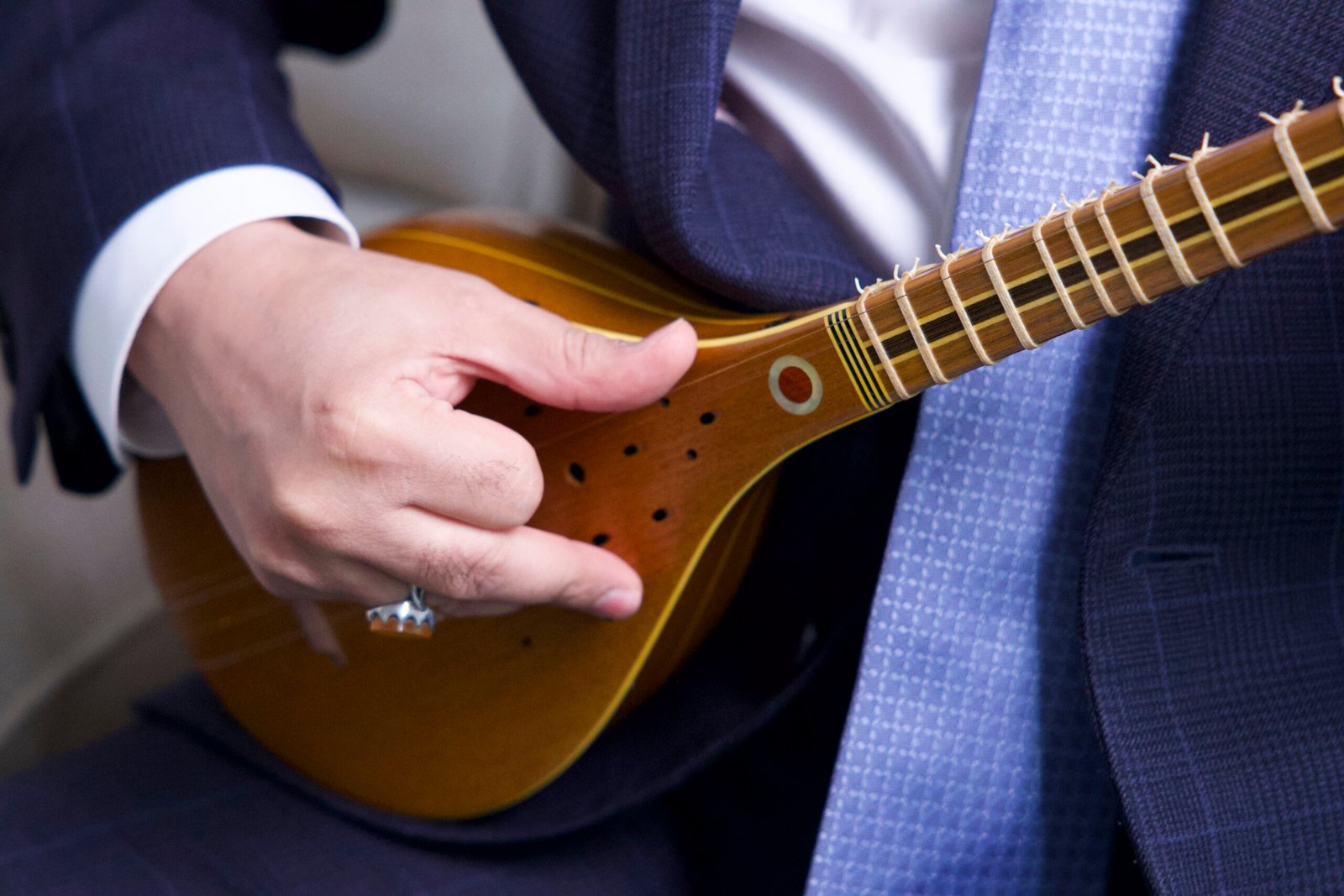
On 21 September my colleague Rehana Virani filmed me at the Institute playing two short pieces on the setār, the Persian lute whose name means ‘three strings’. The first is Murgh-i Saḥar, the ‘Bird of Dawn’. The tune is by Murtaḍā Nay-Dāvūd, and the words, by the poet Muḥammad-Taqī Bahār, blame a tyrant and a hunter for a nest scattered to the wind. When Qamar al-Mulūk Vazīrī sang it at the Grand Hotel in Tehran in 1924, it was the first time a Persian woman singer had appeared in public without the veil. The song has been sung against tyranny ever since. The second is the Nashīd, the anthem of the Ismaili Imamat, which was set to music in the time of Sulṭān Muḥammad Shāh, Aga Khan III. Its Urdu lyric names the Aga Khan and his descent, the five of the household of the Prophet and the continuity of the light of the Imamat. I play the melody without the words. What I want to say about them comes down to one small fact about the instrument and one thing that fact has taught me. The fact is that the frets are tied on with gut, so that a thumb can move them. The lesson, which I trust more than most of what I have read on the subject, is that the tuning I have always played is a decision rather than a property of the object, and that I am the one who has to hear when a note is in the wrong place, and move it.
The frets on a setār are loops of gut tied round the instrument’s neck, and they slip in damp weather. Retying them takes ten minutes and involves some small amount of swearing. I have been doing it for years, most days of most of them. The frets that matter carry notes flattened by something near a quarter of a tone. Each of those notes has to sit where the mode wants it, the mode being a scale with its own inherited repertoire of melodies, or the whole piece sounds like a translation of itself. Because the frets are only tied on, a thumb can also push them along the neck in the middle of playing. Nearly everything else in the room where I was filmed had its tuning settled somewhere else and shipped to me: the format in which the camera saved its file was agreed in committee, its colours were standardised, the time on its clock was legislated, and the line from which the world counts its hours was voted on in Washington in 1884. The frets were not. Their placing is a decision, it is revisable, and it does get revised, by hand, whenever the ear says so. I have adjusted a fret in the middle of a phrase and thought nothing of it. It is the most ordinary thing a player does, and it is very nearly the only thing in either film that somebody else had not already decided for me.
How do I know that a note on this instrument is meant to move, and is not simply wobbling? Earlier this month I recorded the anthem at home, on my phone, and had the recording measured. The instrument is never tuned to a piano, because I tune it to itself and to my hand and to nothing else in the room. Two of the notes fell close to where the mode wants them, which is not where a piano would put them. Lower down, one note arrived in two groups nearly a third of a semitone apart, a semitone being the step between two neighbouring keys on a piano. A note that lands in two places like that is a note meant to move, sharpened or flattened according to where the phrase is going. You cannot do that on a keyboard. You cannot do it on a guitar either. Did the numbers of those intervals tell me anything about the music that I did not already know? They did not. About the room the music was sitting in, however, they told me a great deal. The home recording is not published with the two films, so anyone who wants to check should ask me for it. Put through a pitch-tracker, a programme that plots the pitch of each note, it should show the notes within about a tenth of a semitone of where I have put them.
The instrument also answers back, and this is the second thing it has taught me. It goes thin and nasal when I hurry. It tells me my hand is tense before I have noticed. Yet it has no interests. It does not soften when I push at it, and if my hand is wrong the sound stays wrong. That indifference is the whole of its teaching. The writing assistants that many of us now use resemble instruments in one respect, since in my experience what comes back from them reflects the quality of attention that goes in. A person who asks an assistant to think on his behalf gets thinking of the sort he asked for. A person who turns down the first answer it gives to his question, supplies his own sources for it to work from and asks it to argue the side he does not hold is dealing with something nearer to an interlocutor, a partner in argument.
I will defend the comparison that far anywhere.
It fails where the two look most alike. An assistant has a company behind it with an interest in my continuing to use it, which means an interest in my approval. In October 2023 researchers at Anthropic, one of the firms that make such assistants, reported that people who rate answers tend to prefer the ones that agree with them, and that models trained on such ratings drift towards agreeing with whoever is in front of them. The makers say the drift has since shrunk. OpenAI reported in August 2025 that its GPT-5 model drifted this way less than half as often as the one it replaced, on tests built to provoke it; in June 2026 Anthropic called Claude Sonnet 5, one of its newer models, ‘markedly improved’ on the same count. They may well be right, although these are the makers’ own measurements. Anyone can check at a desk which report fits the assistant they use: ask for a judgement, then push back without offering any new evidence and see whether the judgement holds.
My instrument’s limits, moreover, are visible, since I can count the strings and hear in a single phrase what it will not do. The limits of a model are not visible from where I sit, and as these systems currently ship, they change between releases. Some makers now publish, with each new model, a long report of what they tested and what they found. Since August 2024 Anthropic has also kept a public, dated record of the standing instructions its own chat assistant is given. Useful as the reports and the record are, they describe the model as its maker tested and instructed it. Neither tells me where its limits now fall on the work in front of me. What I cannot learn about a model by using it, someone has to be obliged to tell me.
The instrument carries a history of its own, and it runs a great deal closer to mine than I had any reason to expect. Setār means three strings, and the thing in my hands has four. The fourth is credited to Mushtāq ʿAlī Shāh and is still named after him, although it does not sit where the name implies, since it was slipped in among the others rather than added at the edge. So the name of the object stopped being accurate more than two hundred years ago and nobody has troubled to correct it, and the extra string carries the name of a man who was killed. Mushtāq was a dervish of the Niʿmat Allāhī Sufi order who came to Māhān in 1785 with Nūr ʿAlī Shāh and settled afterwards in Kirmān, where the order gathered disciples quickly enough to alarm the clerics of the city. The two were protected by Abū’l-Ḥasan ʿAlī, the forty-fourth Ismaili Imam, who was also governor of Kirmān and ruled the province more or less independently for four decades. A cleric named Mullā ʿAbd Allāh pressed a campaign against the Sufis and got nowhere for as long as the Imam was in the city. Then, in May 1792, the Imam left to restore order at Shahr-i Bābak and Sīrjān, and Nūr ʿAlī Shāh was also away. Mullā ʿAbd Allāh, preaching in the Friday mosque, saw Mushtāq among those who had come to pray and turned the congregation into a mob which stoned him to death as an infidel. Mushtāq was buried beside that same mosque. The Imam died a few months later, in the same year, and was buried in Mushtāq’s tomb. A dervish was killed in the week his protector was away from the city, and the protector, who could not save him, ended the year under the same dome.
Kirmān was not incidental to the story. In the 1740s the forty-second Imam had moved his residence from Kahak to Shahr-i Bābak, in the Kirmān region, partly so that the Khoja pilgrims coming up from the Gulf, Ismailis from the Indian subcontinent, would have a safer road to travel. From there the province became the seat of the Imamat for two generations. Abū’l-Ḥasan governed it. His grandson Ḥasan ʿAlī Shāh was appointed to the same governorship in 1835, fell out with the Qajar court and left Persia as the first Aga Khan. In other words, the extra string on my instrument and the community I belong to are joined by a friendship in an eighteenth-century provincial capital. I have been playing across that join for years without knowing it was there.
The anthem comes from further down the same line, from the time of Aga Khan III. A listener who knows it hears the Urdu words anyway, of course, which is among the things a melody is for. A listener who does not know it hears a Persian mode on a Persian instrument, and hears no Urdu at all. The instrument, for its part, made a crossing of its own. It was built by Rafīʿ Maḥmūdī, a maker from Tabriz, on a commission from Ḥusayn ʿAlīzādeh, who is one of the major figures of Iranian music and – this matters to the story – a friend of mine. It was finished and handed over, and then the twelve-day war of June 2025 broke out and nothing moved. When I telephoned ʿAlīzādeh some weeks later to ask whether he was all right, one of the first things he said was that the instrument was safe and would be sent. I have thought about that sentence more than once since. My brother collected it from ʿAlīzādeh in the end, and it was carried out of Tehran by hand, with a traveller, as such things have always been carried.
It would be easy, and false, to turn the instrument’s story into a parable about the beauty of mixture, and the strongest objection deserves to be made first, in my own case rather than in the abstract. When I recorded the anthem at home earlier this month I was wearing a Pamiri cap of green wool, made in Tajik Badakhshan among people who are themselves Ismailis, which an Ismaili living in North Macedonia had sent me as a gift. It travelled to Berlin in July for the Didar of the present Ismaili Imam, the Imam’s audience with his community. Somebody who lives in London brought it the rest of the way and put it in my hands. That makes four countries and three pairs of hands for one wool cap, with no postal service anywhere in the chain. I was also wearing a sweatshirt bought at Auckland airport last September, after a visit to the Ismaili Jamat of New Zealand for the Institute. A man on a warm sofa with an iPhone worth a month of somebody’s wages is not what most people mean when they talk about the movement of peoples. My cosmopolitanism cost me nothing. The cap was a gift; the sweatshirt was an airport; the iPhone was a contract. Whoever assembled that phone will not be filmed on one. A frame can be full of the whole world and still be a picture of who gets to sit still. The traffic runs one way and it has run one way for a long time.
What survives the objection? Very little in the two films, or in the recording I made at home, was put there in order to be cosmopolitan, and almost all of it has a history anyway. Some of it arrived by accident, the meridian and the camera’s clock among it. Some of it, however, arrived along a road that somebody has been maintaining for a very long time, and that part runs through a single community, from the dervish’s string to the anthem of the Imamat to a cap that reached London through Ismaili hands. Cosmopolitanism as a condition, then, is the ordinary case and was never an achievement; any of us would find it in two minutes of our own lives if we looked closely enough. The discipline is the harder thing, and it is the part that costs. What does it cost? It is the willingness to hold one’s own tuning as revisable: to say that the note you have always played in that place may well be in the wrong place, to put a thumb on the fret and move it and listen again, and to do all of that in front of people who liked the old note and were not asking. Most of what passes for openness is the condition mistaken for the discipline. So a man with four continents on his body passes for open even if he has never once moved a fret in his life. I have been that man more often than I care to count. You can be made of everywhere and corrigible about nothing.
Rehana Virani filmed both pieces at The Institute of Ismaili Studies and took the photographs.
Leave a Reply