
The Lion and Sun has been systematically claimed by Iran’s monarchist restoration movement, which deploys it as a pre-Islamic or anti-Islamic identity marker — a visual shorthand for the proposition that authentic Iranian identity is secular and fundamentally in tension with Shi’i Islam. This is not an interpretation of history; it is a confiscation of it. The emblem’s most consequential chapter is precisely Shi’i: from the Seljuq tribal banners where the lion first appeared, through the Safavid state that made Shi’ism Iran’s official religion and placed the Lion and Sun at the centre of its sovereignty, to its formal ratification by the First Constitutional Parliament in 1907 — attended and endorsed by the most eminent Shi’i jurists of that generation.
The cynicism has reached its most visceral form in the stands of the 2026 World Cup, where Pahlavist supporters have waved the Lion and Sun flag to unsettle the Iranian national team on the pitch — wielding a symbol of Shi’i sovereignty, with calculated irony, as a weapon against the very country and people whose history it encodes.
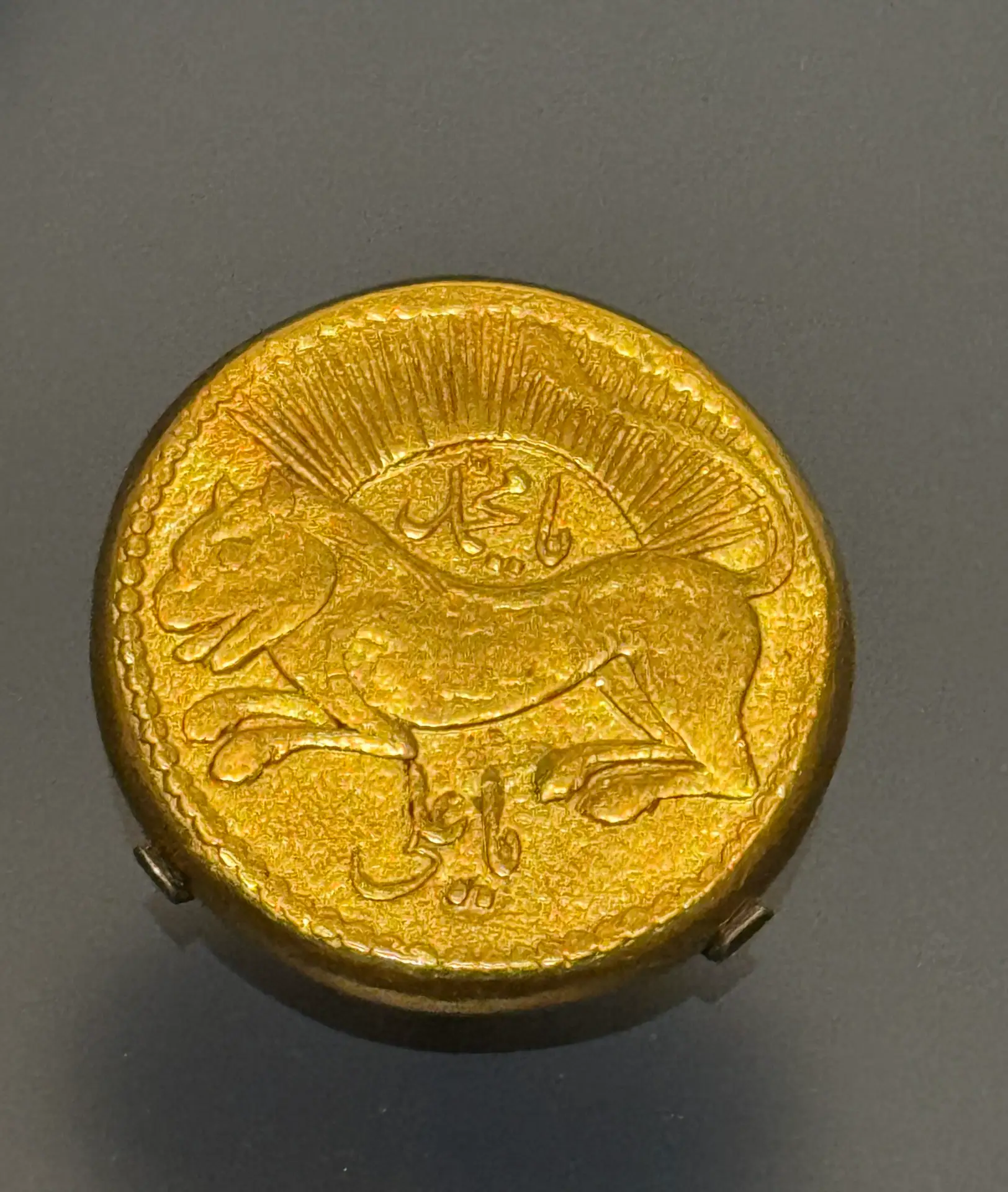
The two texts below were composed in September 1979, when the Prime Minister’s Office of the newly established Islamic Republic commissioned expert scholars to advise on whether the emblem should be retained in the new constitutional order. Their authors — Mohammad Mohit Tabataba’i and Seyyed Ja’far Shahidi — were among the foremost historians of Islamic civilisation of their time, and their assessments constitute an authoritative, point-by-point rebuttal of the mythology now circulated by Pahlavist advocates. The coin pictured is on display at the Aga Khan Museum, Toronto. Both texts are translated from the original Persian, with AI assistance.
Image description
Order of the Lion and the Sun
Iran, ca. 1840
Gold, champlévé enamel, precious stones
The Qajars introduced a complex system of orders and decorations inspired by European practice in the early 19th century. The appearance of the decorations varied according to whether the order was civil or military and whether the recipient was a local or foreign official. Most combine gem-studded star designs modelled on British and French examples, but with the distinctly Iranian image of the lion and sun in the centre. The lion and sun were used as symbols of royal kingship in Persia since pre-Islamic times. Combined, they became a prominent dynastic emblem by the 19th century.
AKM627
The Lion and Sun Emblem
Several artists had submitted proposals for the country’s official emblem, and the Prime Minister’s Office convened a session to review them, in which the designer Morteza Momayez participated. One of Iran’s most perceptive and forward-looking graphic artists, Momayez proposed at the outset that specialists in history should first offer their views before the submissions were assessed on artistic grounds. Two additional sessions were accordingly arranged, to which a number of scholars were invited by the Prime Minister’s Office. After the deliberations, the participants jointly recommended that Professor Mohit Tabataba’i compose a concise, organised summary of the proceedings for the government’s information and transmit it accordingly. What follows is the text of that memorandum; its principal sections were published in several newspapers, including Bāmdād.
1 Mehr 1358 [23 September 1979]
After offering prayers for success and good fortune, [I attended] on the morning of Monday, 9 Mehr, in Room 102 of the Prime Minister’s administrative building, in response to Letter No. 71145 dated 7 Mehr 1358, which invited my participation in a session convened for the purpose of selecting an emblem for the Islamic Republic of Iran. Present at this session were several scholars of Islamic history, civilisation, culture, and the arts: Mr Mostafavi, archaeologist; Dr Shahidi, Islamicist; Mr Iraj Afshar, palaeographer; Mr Yahya Zaka, art historian; Mr Javadipour, professor of graphic design; Mr Momayez, teacher of design; and Mr Maʿsumi, painter.
Following the arrival of Messrs. Abolfazl Bazargan and Abd al-ʿAli Bazargan as representatives of the Prime Minister’s Office, a productive discussion began on the subject of Iran’s official emblems across the ages. The session examined the question from multiple perspectives, and after an hour and a half of deliberation, the participants arrived at the following conclusions, which are set out here in summary for the consideration of the relevant authorities:
1. From the Sasanian Empire, not a single banner, coin, seal, or mark bearing the Lion and Sun has survived that Islamic-era Iranians might have drawn upon or emulated.
2. In the Islamic period, the distinguishing insignia of Islamic governance was the colour of banners, garments, and turbans — white, green, and black. The last of these served as the emblem of the Abbasid Caliphate for more than five hundred years, without any graphic device upon it whatsoever.
3. Throughout that long period, the court of Baghdad was the paramount model for the princes, sultans, and governors of the various Iranian territories who had asserted their autonomy; whatever their military power, none could escape its gravity. Sultan Mahmud of Ghazna, ʿAdud al-Dawla the Buyid, and Malikshah the Seljuq all regarded themselves as deputies of the reigning Caliph within their own domains.
4. Among the dynasties nominally subject to the Abbasid Caliphate, the Seljuqs, in keeping with their tribal customs, bore a lion on their family banner — a motif that occasionally appeared among the remnants of the Atabeg principalities, inside and outside Iran, as late as the seventh Islamic century. It was at this stage that the image of the sun was added to the lion — whether on account of the established astronomical correspondence between the sun and the sign of Leo, or for some other reason.
A specimen of this combination survives on a motif within Iran that predates the reign of Ghiyath al-Din Kaykhusraw in Anatolia altogether — proof that Bar Hebraeus on the Lion and Sun is no more to be taken at face value than Bar Hebraeus on the burning of the Library of Alexandria at the dawn of Islam. Both are accounts that call for caution rather than credence.
The lion on the Seljuq banner stirred the admiration and praise of Persian poets, and in the eyes of the country’s ever-growing Shīʿa — who lived in expectation of the Imam’s advent — the lion’s image suggested a graphic rendering of the beloved epithet of ʿAli ibn Abi Talib: Asadallāh al-Ghālib, the Triumphant Lion of God. In this emblem they found a vehicle for expressing their inner devotion. It was for this reason that during the Mongol period they twice seized the opportunity to have the Lion and Sun struck on coins — alongside the names of the Twelve Imams — once on a coin of Muḥammad Khudābanda, and before that on a coin of the Il-Khan Abaqa.
Junayd, grandfather of Shah Ismāʿil and great-grandson of Sheikh Ṣafī al-Dīn, had spent many years among the extremist Shīʿa of Syria and Anatolia, nurturing the spiritual formation of the ʿAlid communities there. When he sought to transform his inherited dervish’s cloak into an acquired royal throne, he placed the Lion and Sun on the banner of his disciples — who in the time of his son Sultan Ḥaydar came to be known as the Qizilbash, and who went on to found the Shīʿi Safavid state.
The Lion and Sun banner of the Safavid house — champions and patrons of Shīʿism — stood for three centuries as the recognised symbol of Shīʿi Iran, in direct counterpoint to the crescent on the Ottoman standard, the established emblem of Sunni Islam.
The Lion and Sun of Safavid and Qajar Iran appeared on banners — upright or recumbent — and on copper coins, with no sword in the lion’s hand. Under Aqa Muḥammad Khan, the sun was inscribed with the name Muḥammad and the lion with the name ʿAlī, conveying to the minds of the faithful the idea that the sun embodied prophethood and the lion the wilāya — divine guardianship — the lion being, in short, the lion of God.
Under Fatḥ-ʿAli Shah, the Lion and Sun banner was paired with a separate standard bearing the Dhūʿl-Faqār sword; by the mid-nineteenth century, these two banners were merged into a single flag depicting a Lion and Sun in which the lion held that sword aloft. The sun had previously been rendered with a human face — complete with eyes and brows — which was removed and simplified during the Constitutional period, giving the emblem the form in which it currently appears.
The Lion and Sun emblem has been recognised continuously for five hundred years as the symbol of the world’s sole Shīʿi state, Iran. In 1325 AH [1907 CE], when the Supplementary Fundamental Law was ratified by the deputies of the First Parliament — among whom were several mujtahids and many Shīʿi scholars — this emblem received their formal approval. It is self-evident that had they harboured any religious objection to its retention, they would assuredly have spoken, given the remarkable freedom of expression that deputies of the First Parliament enjoyed; their views would have been recorded in the proceedings, and they would, if necessary, have withheld their approval.
Five hundred years ago, after their conquest of the Eastern Roman Empire, the Ottoman Turks renamed Constantinople Istanbul and converted the Church of Hagia Sophia into a mosque. Yet they preserved the crescent — the hallmark of Eastern Rome’s greatness — as their own inheritance. And fifty years ago, when they abolished the Ottoman sultanate and caliphate and founded a modern republic in place of the constitutional monarchy, they were prepared to strip Hagia Sophia of its religious adornments — yet they were not prepared to replace the crescent, which over five centuries had become the symbol of Islam before the Christian world, with any other device.
In light of all of the foregoing, the Lion and Sun has for five hundred unbroken years been recognised the world over as the emblem of Shīʿi Iran. Iranian Shīʿa of every condition — mystic and layperson alike — have regarded it as a sacred mark, choosing it to adorn their religious, mystical, and moral publications; and in the company of the Red Cross of Christian states and the Red Crescent of Muslim countries, Iran’s Crimson Lion and Sun has announced itself to the world as the emblem of the one Shīʿi Muslim nation. It is therefore fitting — now that the constitution of the Islamic Republic of Iran is in the process of ratification — that, in recognition of the honour and prestige this emblem has secured for the Shīʿi faith and the Muslim people of Iran over the centuries, the authorities concerned and the members of the esteemed Assembly of Experts should view the Lion and Sun with the same veneration and respect it received at the dawn of the Constitutional period from the leading religious authorities of that era: the late Ākhund Mullā Kāẓim Khorāsāni, Seyyed Moḥammad Ṭabatabāʿi, Seyyed Abdullāh Behbahāni, Sheikh Moḥammad Taqi Najafī Iṣfahāni, Seyyed Ḥasan Modarres Ṭabatabāʿi, and the other eminent scholars of Iran. They should consent to no fundamental alteration in its internationally recognised form, should ratify it, and should add it to the approved colours of the national flag.
With highest regards,
Mohammad Mohit Ṭabatabāʿi
Dr Seyyed Jaʿfar Shahīdi also submitted the following supplementary observations in a separate letter:
1. From the close of the Mongol period through the entirety of the Safavid era and into the Qajar period, the Lion and Sun was regarded as a symbol of the Shīʿi faith. When Moḥammad Shah Qajar placed a crown above the Lion and Sun at the outset of his reign, his apparent intention was to signal that he was the ruler of a Shīʿi country. The Lion and Sun was thus an emblem of religion and nation — not of the political apparatus of the state.
2. Banners, funeral pall-covers, and carpets adorned with the lion, or the lion and sun, have been in use for three hundred years in tekiyya assembly halls, rawda-khvānī mourning gatherings, and taʿziyya passion plays. This confirms beyond doubt that the Lion and Sun is a religious symbol, not a political one.
3. The sun or half-sun that appears above the inscriptions and prayer niches of certain mosques appears to allude to the radiance of ʿAlid wilāya.
4. When the late Mumtaz al-Dawla attended the Red Cross Union as Iran’s representative, he worked tirelessly to have the Lion and Sun accepted by the other member states as equivalent to the Ottoman crescent. Since the cross is a religious emblem rather than a governmental one, it becomes evident that the Lion and Sun was proposed to the Red Cross organisation precisely because it is a symbol of the Shīʿi faith — not because it is the political insignia of the Iranian monarch or state.
Taken together, these observations leave no room for doubt: for six centuries, the lion — or the lion and sun — has been the emblem of Iranian Shīʿa, an allusion, it seems, to Asadallāh al-Ghālib, ʿAli (peace be upon him), and to the sun of wilāya.
Seyyed Jaʿfar Shahīdi
Source: “The Lion and Sun Emblem,” Majalla-yi Āyanda, vol. 5, pp. 703–708.
Leave a Reply