
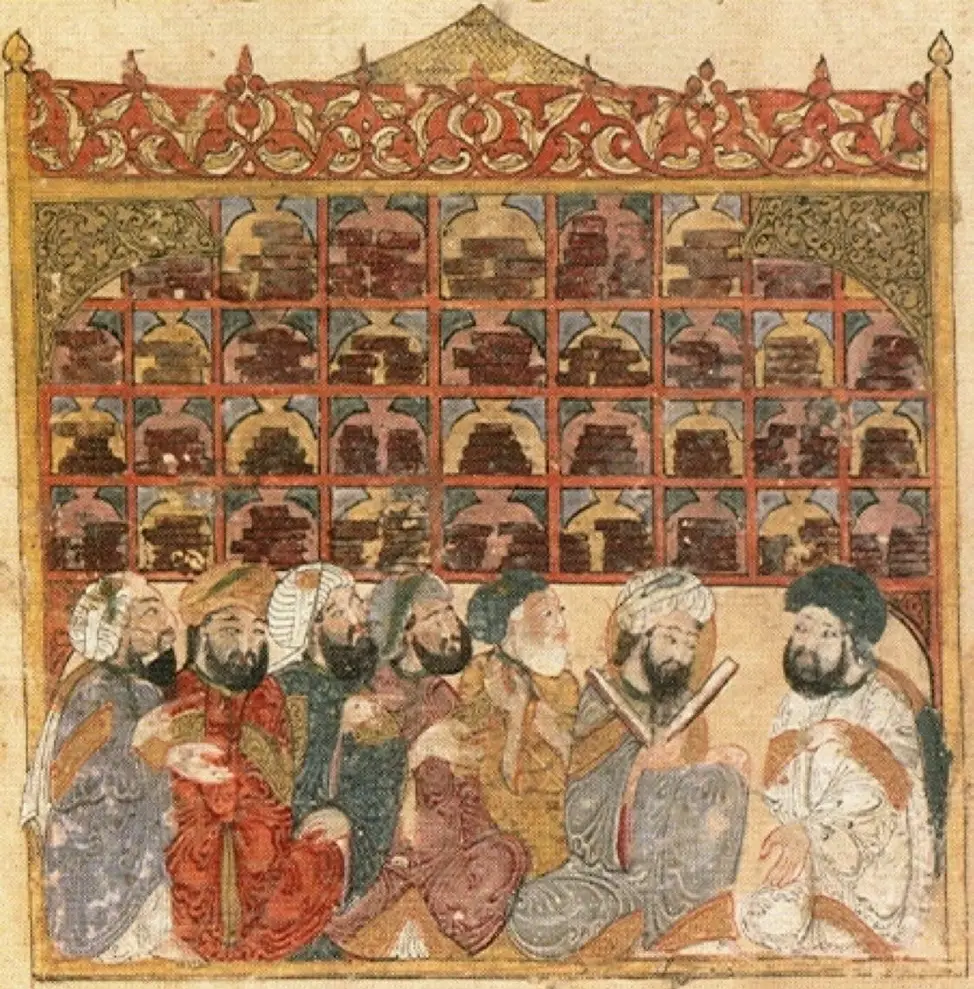
Bibliothèque nationale de France, Département des manuscrits, MS arabe 5847, folio 1v. Illuminator: Yaḥyā ibn Maḥmūd al-Wāsiṭī. Baghdad, 634 AH / 1237 CE.
On a Pluralist, Non-Eurocentric Modernity
A Sentence That Carries the Argument
There is one sentence that has come to carry the whole of my argument about modernity, and I want to put it down at the outset rather than build up to it. Our future is not their past. Our future is the intelligent use of our past and of anybody else’s past, the responsible and critical creation and invention in the present, and the intelligent prediction of what is to come. That is the formula. Everything else in this essay is commentary on it.
I write the sentence in this compressed form on purpose, because the temptation in our public conversations is to surrender to a much shorter slogan: that to be modern is to follow Europe. The slogan is so well established that even those who reject it tend to argue against it on its own terms. They concede the geography of modernity even as they protest its content. They assume that someone has reached the destination and that the rest of us are still on the road, and they then quarrel about how quickly to walk. The first task of any honest reflection on a non-Eurocentric modernity is to refuse this picture entirely.
There is no destination. There never was. What is called modernity in the European story is itself a particular history, with its own losses, its own injustices, and its own unresolved questions. To take it as the universal template is not to honour it; it is to flatten it. The intelligent thing is neither to imitate that history nor to pretend it never happened. The intelligent thing is to read it carefully, to learn what can be learned from it, to refuse what should be refused, and to set it alongside our own history with the same critical attention.
How the Linear Story Was Imposed
To understand why the slogan has had such a grip on us, we need to recall how it entered our intellectual life. It did not arrive as a gentle suggestion. It arrived together with the military, financial, industrial and scientific might of European colonial expansion. The encounter, for most Muslim societies and for much of the wider world, took place under conditions of subjugation. The first impressions were of overwhelming material superiority. Cities were bombarded; economies were rearranged; institutions were dismantled or made subordinate; languages were displaced from the offices of state. People who had thought of themselves as inheritors of a great civilisation found themselves addressed as backward children who needed to be brought up.
In that situation, the natural human response was a wound to dignity, and the natural response to such a wound is to want to prove oneself. The reformist movement of the late nineteenth and early twentieth centuries grew out of this. Its founders were brilliant and serious people. They took the measure of the imbalance and tried to do something about it. They wanted to show their interlocutors, and themselves, that they too could think, that they too could organise, that they too could legislate, that they too could be modern.
But the manner in which they tried to demonstrate this had a hidden cost. It accepted, as the very ground of the demonstration, the framework that the conqueror had set. The questions to be answered, the criteria of progress, the markers of seriousness, the timeline along which one’s society was to be assessed: all of these were borrowed from the very civilisation whose dominance was the original wound. The result was a curious kind of mirror politics, in which the ambition was to do, in the twentieth or twenty-first century, what Europe had done in the eighteenth or nineteenth. Our future was to become their past. The arrow of history pointed in only one direction, and our task was to walk it as quickly as we could.
Why the Linear Story Misleads
The first problem with this picture is that it is empirically wrong. There is no single line called modernity along which all societies are travelling at different speeds. There are, instead, many entangled processes, technological, economic, political, religious, aesthetic, that have unfolded differently in different places and that continue to unfold. To call only the European version of these processes modern is to mistake one example for the genus. It is, ironically, a provincial mistake disguised as a universal one.
The second problem is that the picture is ethically corrosive. If we accept that our future is their past, we accept by the same gesture that we are behind, that our traditions are obstacles, that our languages are quaint, that our forms of authority are at best transitional, and that the only respectable destination is the one already mapped by someone else. This is not a posture compatible with self-respect, and it is certainly not a posture from which one can contribute anything new to the world. It is a posture of permanent apology.
The third problem is intellectual. The linear story disables the very faculty by which a civilisation renews itself, namely the patient, critical reading of its own resources. If those resources are by definition pre-modern, there is nothing to read; one’s only work is to clear them away. Whole generations have been raised on this assumption, and the result has been a strange amnesia in which our libraries are full of books that no one has been trained to engage.
A Different Picture
Against this picture, I want to set another. To be modern, in the sense that I find defensible, is not to occupy a place on a line. It is to inhabit one’s time intelligently. That has three components, and the order in which I name them matters.
The first is the intelligent use of the past, both our own and anyone else’s. Use is the operative word. We are not asked to worship the past, nor to repeat it, nor to put it on a museum shelf and bow before it. We are asked to use it, which means to read it for what it can teach us about the questions we are facing now. Some of what we will find will still be alive and applicable; some will be dead and best laid to rest; some will be alive but only on condition that we revise it for new circumstances. Discrimination of this kind is itself a high intellectual virtue, and it is the opposite of nostalgia. It also extends across borders. The intelligent use of the past does not stop at the boundary of one’s own civilisation. It includes the European past, the Indian past, the Chinese past, the African past, the indigenous pasts of the Americas. To insist that we draw on our own history is not to refuse other histories. It is, on the contrary, to acquire the standing from which one can engage other histories without flinching.
The second component is responsible and critical creation in the present. This is the moment that the linear story most reliably erases, because it cannot imagine that anything new could come from outside the path it has already mapped. But invention does not require permission. The Persian poets did not ask permission to invent the ghazal; the Arab grammarians did not ask permission to invent the science of naḥw; the Iranian filmmakers of the last half-century did not ask permission to make the cinema they have made. Where these inventions have flourished, they have done so by drawing on local resources while engaging the wider world, and by holding themselves to a high standard of craft. There is no reason we cannot do the same now in law, in education, in finance, in architecture, in technology. The question is not whether we are allowed to create; it is whether we are willing to do the work.
The third component is the intelligent anticipation of the future. By this I do not mean futurology, which is mostly entertainment. I mean the disciplined imagination that reads present tendencies and asks where they are pointing, what they will demand of us, and what we ought to be preparing for. Climate disruption, demographic change, the next revolution in computation, the reorganisation of work, the migration of authority away from the territorial state: these are not science fiction. They are the conditions in which the next generation will live. To be modern in any non-trivial sense is to be already thinking about them, and to be thinking about them with our own concepts and our own commitments rather than borrowing the worry list of someone else’s commentariat.
Pluralism Without Relativism
Notice what happens when these three components are taken together. The picture they draw is not of a single arrow but of many traditions, each engaged in its own version of intelligent use, critical creation and disciplined anticipation. This is what writers on the subject have come to call multiple modernities, and it is the only honest description of the world we actually inhabit. It is also the only description that allows us to honour both the unity of human experience and the irreducibility of its plural expressions.
It is important not to confuse this pluralism with relativism. To say that there are several modernities is not to say that anything goes, or that all arrangements are equally good, or that judgement has been suspended. It is to say that the standards by which we evaluate human flourishing, justice, knowledge, beauty, are themselves not the monopoly of any one civilisation, and that any serious conversation about them has to be conducted with humility on every side. Some inventions of the European modern period are durable contributions to the human inheritance and should be received as such. Some are local solutions whose universalisation has done more harm than good. The task is to tell the difference, and the only way to tell the difference is to do the patient work of comparison rather than reach for the slogan.
The Self–Other Trap
The linear story has a habit of producing self–other binaries that, once produced, are very hard to dismantle. East against West, tradition against modernity, faith against reason, authenticity against borrowing: each pair, on inspection, turns out to be a way of organising the question so that whichever side one chooses one has already lost. To be on the side of the East is to accept that one is not on the side of modernity. To be on the side of tradition is to accept that one is not on the side of progress. To be on the side of faith is to accept that one has surrendered the rights of intellect.
The argument I am pressing here is that none of these binaries is real. They are the after-effects of a particular history, and they can be undone by the same instrument that built them, which is sustained intellectual work. To use one’s past intelligently is already to refuse the binary between tradition and modernity. To create critically in the present is already to refuse the binary between East and West. To prepare for the future with one’s own commitments intact is already to refuse the binary between authenticity and engagement. The synthesis of the two wisdoms, philosophical and revelatory, of which I have written elsewhere, is precisely a refusal of the binary between faith and reason. None of these refusals is a piece of theory. They are practices, sustained over time, by which a community demonstrates that it does not need anyone’s permission to be itself.
What This Asks of Us
What follows from this for those of us who write, teach, design institutions, raise children, or simply try to live well in our particular corners of the world? Three things, perhaps, are worth naming.
First, we owe our past more attention than we have been giving it. Not the sentimental attention of identity politics, which uses the past as a costume, but the demanding attention of the student, who reads slowly, asks hard questions, and is prepared to be surprised by what he finds. The library is much larger than we have been told. It contains resources we have not begun to inventory.
Second, we owe the present our courage. The most important inventions of the next decades will not be made by those who are waiting for permission. They will be made by those who have noticed a problem in their own setting, gathered the relevant tools from wherever the tools are to be found, and set to work. This requires a particular kind of confidence that is neither arrogance nor mimicry. It is the confidence that comes from knowing one’s resources and being willing to use them.
Third, we owe the future our seriousness. The ease with which the linear story has been accepted is partly a symptom of a deeper unwillingness to think long. To prepare for the conditions of the next generation requires that we lift our heads from the cycle of headlines and ask the harder questions about what kind of human beings, what kind of communities, what kind of institutions we want to be. This is the work of generations, and it begins with declining the offer to be only consumers of someone else’s plans. It also requires institutions that can carry the work, that is, schools, universities, professional bodies, civic associations, networks of patronage for the arts, and the quieter spaces in which ideas are tested before they are launched. Such institutions are not built by accident. They are built by people who have decided, in advance, that the improvement of the quality of life of those around them is a responsibility worth shouldering and that no one is coming to do it for them. There is, in this commitment, an old and quiet dignity that no slogan can imitate.
A Closing Note
The entire argument can be compressed into the sentence with which we began. Modernity is not a place to which some have already arrived while others lag behind. It is not a terminus to be reached by walking in someone else’s footsteps. It is a practice, and the practice is threefold: the intelligent use of the past, ours and theirs; the responsible creation of new solutions to present problems; and the disciplined anticipation of what is coming. Each of these requires that we refuse the small story we have been told. The small story says we are late. The true story says we are exactly on time, provided we do the work.
That work is not glamorous, and it does not announce itself with slogans. It is the slow accumulation of knowledge about our own tradition, the patient invention of new forms that answer to present needs, the building of institutions that can carry the work forward, and the raising of a generation confident enough to use what it inherits. There is, in this commitment, an old and quiet dignity that requires neither permission nor applause. It simply gets on with living intelligently in one’s time, and that is modernity enough.
Our future is not their past. It cannot be. The clock does not run backwards, and the world has more than one centre. Our future is what we will make, by drawing wisely on our inheritance and on the inheritance of others, by creating with care in the present, and by preparing for what is coming with our eyes open. It is the work of intelligent people who know who they are. There is no shortcut to it, and there is no substitute. There is only the work.