

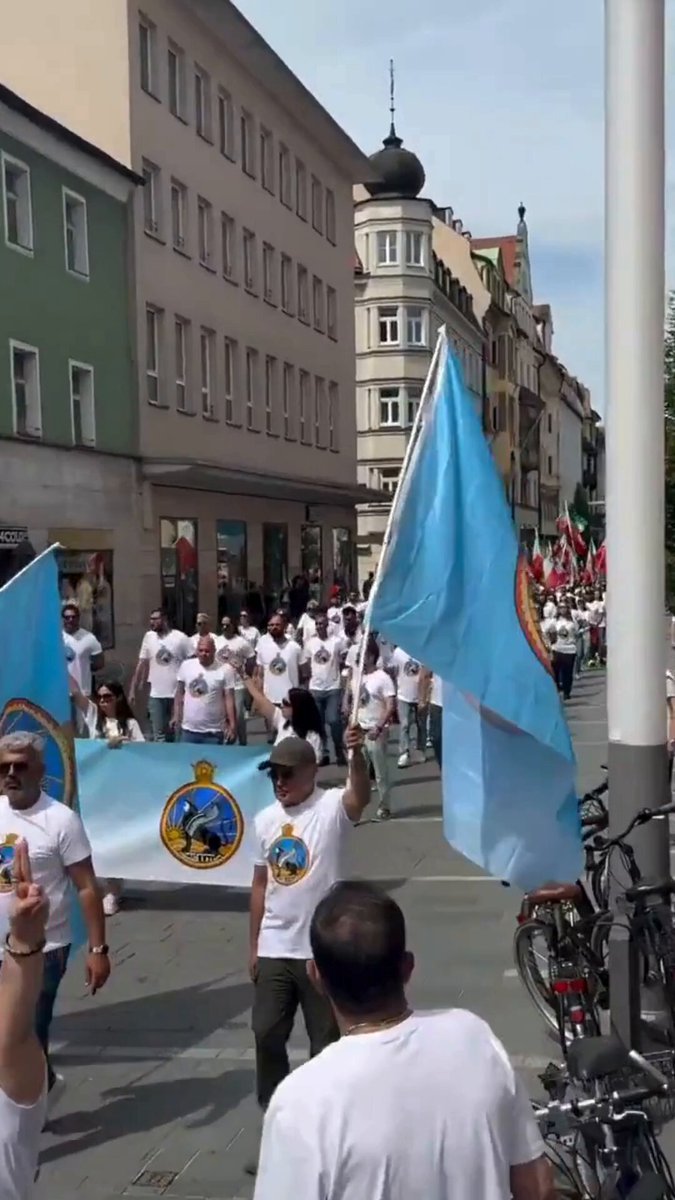
SAVAK, State Torture, and the Dangerous Nostalgia of Forgetting
In cities across the West—Los Angeles, London, Munich, Regensburg—a strange phenomenon has taken root. At demonstrations ostensibly calling for a free Iran, young men and women don SAVAK T-shirts, wave the emblem of the Shah’s secret police, and chant slogans glorifying a security apparatus that tortured, disappeared, and destroyed tens of thousands of their own countrymen. Most of these demonstrators were not born during the Pahlavi era. They have no memory of the screams that echoed through Evin and Komiteh. Their nostalgia is not for something they experienced but for a fantasy manufactured by satellite television, social media algorithms, and exile mythologies—a curated golden age in which SAVAK was merely a firm hand keeping order, not an institution that raped prisoners, crushed genitals with weights, and turned a person’s own screams into instruments of psychological annihilation.
This essay is about what SAVAK actually was. It is anchored in the testimony of Abdee Kalantari, a university student in Tehran who, in the summer of 1976, stumbled upon the truth in the pages of TIME magazine—and whose world was permanently shattered by what he read. His story is one among thousands. But it carries a particular force because it captures the precise mechanism by which totalitarian states maintain power: not merely through violence, but through the compartmentalization of knowledge, the architecture of selective ignorance that allows ordinary citizens to live comfortably alongside machinery of extraordinary cruelty.
That architecture is being rebuilt today—not in Tehran, but in the diaspora, by people who substitute propaganda for history and identity politics for moral seriousness. To them, and to anyone tempted by the dangerous seduction of authoritarian nostalgia, the historical record offers an unequivocal response.
The Threshold
The year was 1355 by the Iranian calendar—1976 in the Western one. Iran, under Mohammad Reza Shah Pahlavi, occupied a peculiar position in the geopolitical imagination: a stable, pro-American monarchy presided over by a self-styled modernizer, courted by American presidents, defended by Henry Kissinger. Beneath this facade, SAVAK—the Sazeman-e Ettelaat va Amniyat-e Keshvar, the Organization of Intelligence and National Security—operated with bureaucratic precision. It maintained twenty thousand officers and a network of one hundred eighty thousand informants. It was not a rogue operation. It was the state itself.
Abdee Kalantari was a second-year student at Daneshgah-e Melli-e Iran, the National University. His was a life of modest privilege: a government stipend, access to films at the Iran-America Society, evenings in cafes above Tehran, and—crucially—an English-language bookshop that seemed to operate outside the constraints of Iranian censorship. From its shelves he purchased Max Weber, Karl Mannheim, Werner Stark. He read TIME and Newsweek, their pages arriving unviolated by the censors who strangled Iran’s domestic press. He was, by his own admission, “not particularly political.” He knew fear and surveillance permeated the university. But knowing that a regime is authoritarian in the abstract and confronting the specific mechanics of its cruelty are separated by an epistemic chasm.
The Shah’s system understood this perfectly. It permitted foreign journals, elite universities, even theoretical study of Marx and critical theory—calculating that controlled cosmopolitanism would burnish its modern image. What it did not anticipate was the possibility that a young reader might, in the very act of consuming the regime’s legitimating narratives, encounter within them an indictment of the regime itself.
The Rupture
On an ordinary day in the summer of 1355, Kalantari’s eyes fell upon a headline in TIME: “Torture As Policy: The Network of Evil” August 16, 1976. Four pages of documented accounts—not dissident whispers, not underground pamphlets, but the flagship publication of American journalism, read in the State Department and corporate boardrooms—detailing the methods of SAVAK’s torture apparatus.
The methods were specific and industrialized: the dastband-e qappani, the “clutching cuff”; the otaq-e temshiyyat, the “punishment room”; the kolah khoud, the “helmet”—a device placed over the head that amplified the victim’s own screams back at them, turning the human voice into an instrument of self-destruction. Weights were suspended from genitals. Electric shocks were administered. Sexual assault was carried out by dogs trained for the purpose. The International Commission of Jurists in Geneva had documented a pattern of torture “unprecedented in scale” since the 1953 coup. The French human rights lawyer Jean Michel Braunschweig confirmed the findings after visiting Iran’s prisons.
Most devastating was the Shah’s own response when TIME correspondent Christopher Ogden asked about torture directly. “We use the same methods that advanced countries use,” the Shah said. “Psychological methods.” He did not deny having political prisoners—he quibbled over the number, insisting it was “thirty-four or thirty-five hundred,” not five thousand. “But these are not political prisoners,” he clarified. “They are people who do not feel loyalty to the homeland.”
In that response, the architecture of justification collapsed entirely. The Shah was not hiding torture; he was defending it. Torture was not an aberration within his system—it was the system’s logic. For Kalantari, this was the epistemic rupture: the comfortable separation between the world of intellectual culture and the world of state terror dissolved in the time it took to read a magazine article.
The Apparatus
The TIME article also drew a devastating comparison. In Chile, following the CIA-backed overthrow of Salvador Allende in 1973, Pinochet’s regime had killed nearly one thousand people under torture within three years. In a single wave of repression, two thousand were arrested; three hundred seventy disappeared permanently. Torture centers like Villa Grimaldi operated with documented efficiency: of eighty-five women prisoners held at Tres Alamos, seventy-two confirmed they had been tortured.
The pattern was unmistakable: wherever American military and economic support flowed, torture followed. The three most notorious human rights violators of that moment—Pinochet in Chile, Marcos in the Philippines, the Shah in Iran—were all intimate allies of the United States, all recipients of American military aid, all defended by Kissinger. The brutality was not incidental to the alliance; it was its price, and Washington had deemed it acceptable.
But what distinguished Iran’s system was not the methods themselves—it was their institutionalization. As the TIME article observed, “the most terrible aspect of this policy in Chile and Iran might be the institutionalization of torture, the fact that torture has become transformed into a normal procedure and the particular domain of independent, semi-autonomous security and police institutions.” SAVAK did not merely torture; it maintained a torture apparatus—with budgets, reporting structures, training programs, performance metrics, file numbers, ledgers, and case reviews. A man tortured by a sadist is tortured by someone acting outside rational order. A man tortured as an administrative procedure has been reduced to a data point.
Among those named in the article as victims were Vida Hadjebi Tabrizi, a sociologist who became Amnesty International’s Prisoner of the Year; Gholamhossein Saedi, the celebrated playwright whose work Kalantari might have read; Fereydoun Tonokaboni, the novelist. These were not anonymous political abstractions. They were writers, intellectuals, artists—people who inhabited the same cultural sphere as Kalantari. The realization was devastating: the world of literature and the world of terror interpenetrated. To be an intellectual in Iran was to be vulnerable to the machinery he had just discovered.
The Dangerous Nostalgia
Kalantari’s awakening—recorded decades later in a Facebook reflection dated 22 Bahman 1397 (11 February 2019)—is significant not merely as personal testimony but as a precise illustration of how totalitarian systems sustain themselves: through the compartmentalization of consciousness, through the creation of separate epistemic worlds that do not speak to one another. The diplomat reads foreign policy journals; the student reads newsmagazines; the university exists in its own discursive space; the prisons exist in silence. The genius of such systems lies in maintaining these separate worlds while appearing integrated.
This is precisely the architecture being reconstructed today—not by the Islamic Republic, but by monarchist factions in the Iranian diaspora who have turned SAVAK into a brand. In Munich, they march in SAVAK T-shirts. In Los Angeles, former SAVAK official Parviz Sabeti appears at rallies to applause. On social media, accounts boast about reinstating SAVAK to “deal with” critics. A British-Iranian rapper releases tracks featuring SAVAK logos. Satellite channels like Manoto broadcast curated images of the “zaman-e Shah”—the era of the Shah—depicting a carefree pre-revolutionary Iran, carefully excising the screams, the electrodes, the helmets.
The people doing this are overwhelmingly young. They were not born when SAVAK operated. They have never met Vida Hajebi Tabrizi. They have never read the TIME article that shattered Kalantari’s world. They know nothing of dastband-e qappani or kolah khoud except, perhaps, as exotic terms in a history they have chosen not to learn. Their nostalgia is manufactured—a product of exile mythologies, algorithmic echo chambers, and the human tendency to romanticize what one never experienced.
The consequences, however, are not merely academic. As Al Jazeera documented in 2023, survivors of SAVAK torture—people who carry the scars of cables and electrodes on their bodies—find themselves confronted at diaspora demonstrations by young people celebrating the very apparatus that destroyed them. The divisions this creates are precisely what the Islamic Republic exploits: the regime points to SAVAK glorification as proof that the only alternative to theocratic rule is a return to monarchist brutality. It is, as critics have noted, “free propaganda for the mullahs.”
This is the cruelest irony. People who claim to want freedom for Iran are rehabilitating the iconography of unfreedom. People who never suffered are mocking those who did. People who demand that the world take Iranian suffering seriously are erasing the suffering that preceded the revolution—the very suffering that made the revolution possible.
What Knowledge Demands
The moment of awakening that seized Kalantari in that Tehran bookshop was not a conversion to revolutionary politics. It was something more fundamental: the recognition that once certain knowledge enters consciousness, it cannot be expelled. He could not un-read what TIME had published. He could not return to the insulated world of permitted intellectual culture. The bookshop would still be there, the magazines would still arrive, the seminars would continue—but they would be haunted by what he now knew.
The revolution of 1978–79 was shaped by thousands of such awakenings. It did not emerge from those who had always known and always resisted. It emerged from those who came to know—who could no longer bear the contradiction between what they believed about their country and what they discovered to be true. The regime’s fatal error was assuming that by permitting controlled channels of Western information, it could manage consciousness. Consciousness, once awakened, is ungovernable.
Today, the architecture of cruelty is being whitewashed by those who mistake ignorance for innocence and nostalgia for patriotism. To the young Iranian in Los Angeles wearing a SAVAK T-shirt: you are not honoring your heritage. You are desecrating the memory of everyone that apparatus destroyed. To the diplomat considering engagement with monarchist factions: examine what they celebrate before you assess what they promise. To the activist seeking justice for Iran: the struggle against the Islamic Republic does not require rehabilitating the horrors that preceded it. A nation that cannot honestly reckon with its past will never build a just future.
The architecture of cruelty that Kalantari discovered was more than a set of methods. It was a revelation about the nature of modern power—how totalitarian systems operate not merely through violence but through the compartmentalization of consciousness, the creation of worlds that do not speak to one another. The act of breaking through those walls, of insisting that knowledge produced in one realm be heard in all others, remains the most fundamental act of resistance: the refusal to live in a state of willing ignorance, the insistence that the machinery of terror be named and confronted.
That insistence is as urgent now as it was in the summer of 1355.
———
References
Amnesty International. Report on Allegations of Torture in Brazil. London: Amnesty International, 1972.
Brancilovick, Jean-Michel. “Prison Conditions and Torture in Iran.” Report to the International Commission of Jurists. Geneva: ICJ, 1975.
“Divisions Roil Iranian-American Protest Movement.” Al Jazeera, 2 March 2023.
International Commission of Jurists. Report on the Administration of Justice and the Protection of Human Rights in Chile. Geneva: ICJ, 1974.
Kalantari, Abdee. “Epistemological Rupture: Consciousness and Complicity in the Summer of 1355.” Facebook Note, 22 Bahman 1397 / 11 February 2019.
Kinzer, Stephen. All the Shah’s Men: An American Coup and the Roots of Middle East Terror. Hoboken: John Wiley & Sons, 2003.
“SAVAK March, Rap, and Aggression: How Iran’s Monarchists Are Propping Up a Dying Regime.” National Council of Resistance of Iran, 2024.
“Torture As Policy: The Network of Evil” TIME Magazine, Vol. 108, No. 7 (August 16, 1976): 32–35.
Leave a Reply