
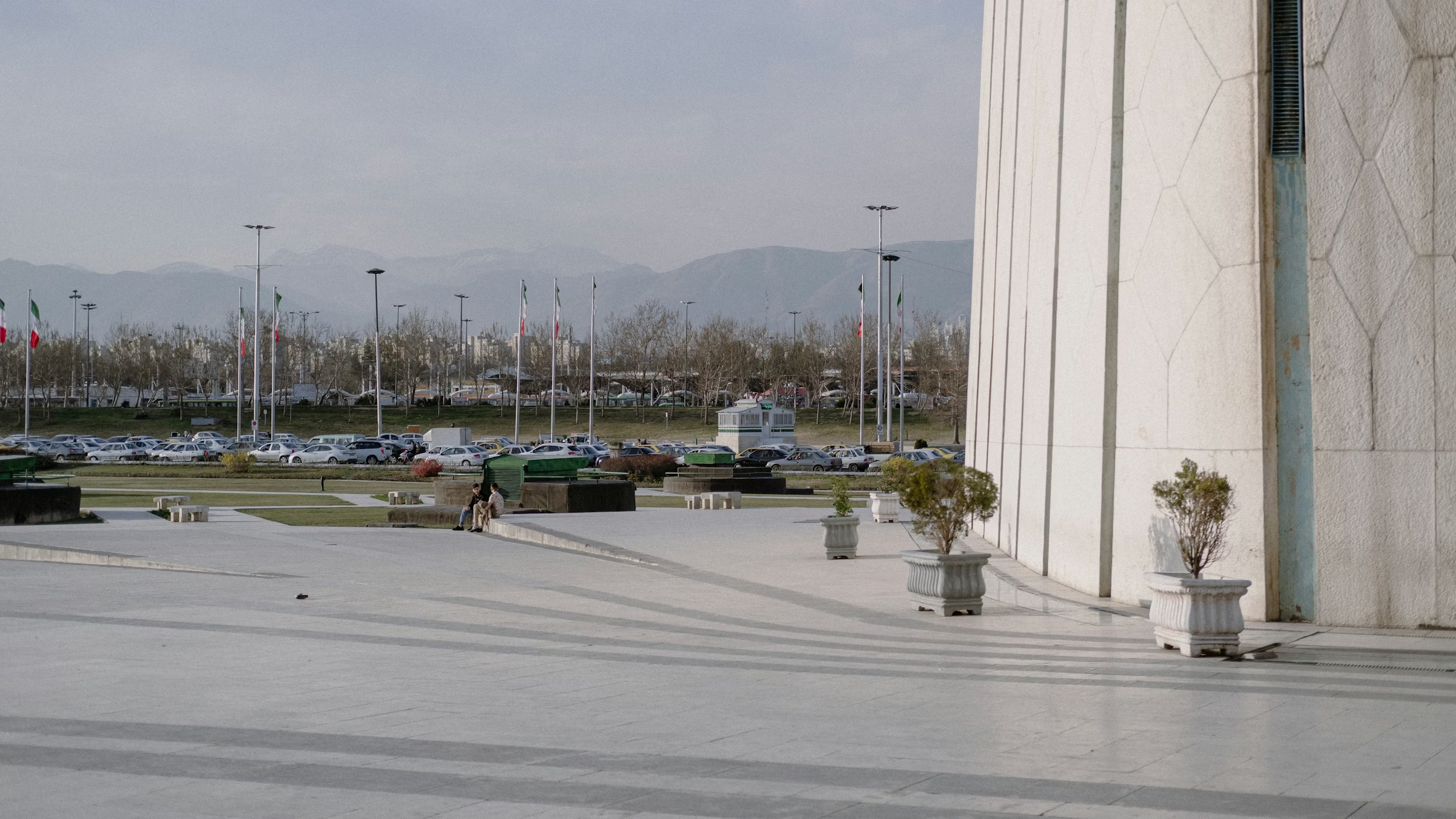
Photographer: Parastoo Maleki – Unsplash
A narrative essay drawn from a dialogue between Hossein Hamdieh and Daryoush Mohammad Poor
The Polarised Mirror
In the spring of 2026, Iran and the United States were engaged in careful, tentative diplomatic contacts—first talks in Islamabad, Pakistan’s army chief Asim Munir travelling to Tehran, a fragile ceasefire still holding. That was the larger backdrop. In a quieter register, a different kind of conversation was taking place: scholars and young researchers working inside Iran—people who invite such exchanges at genuine personal risk—had arranged a dialogue with those of us in the diaspora, and they deserve full credit for kick-starting it. Hossein Hamdieh, speaking on behalf of this circle, put a question to me that I initially thought was straightforward but turned out to be far harder than expected: does Iran possess a common point of departure from which all its citizens can begin the journey toward development? Over the next half-hour I tried to answer it. What follows is my attempt to reconstruct that conversation and, in the process of writing it down, to sharpen arguments that were necessarily compressed in speech.
The question itself was not new. Since at least the Constitutional Revolution of 1906, Iranian thinkers have wrestled with the problem of where “we” begin. I built on themes from a previous conversation on the “Copernican Revolution of the Iranian Mind”—drawing on Hamid Dabashi’s analysis of how that revolution diagnosed the shattering of the West as Iran’s fixed reference point—and turned the lens inward: what remains once the mirror of Western validation is broken? The answer is not a triumphant nativist identity but something more demanding: the irreducible fact of shared humanity. Whether this framing is adequate to the full scale of the problem is a question that can only be tested by pressing it as far as it will go—which is what this essay attempts.
The Anatomy of the “White Camp”
Hamdieh opened the conversation by sketching a portrait that many observers of Iranian diaspora politics would recognise immediately. He described a segment of Iranian society—both inside the country and abroad—that has constructed what he called a “white camp” mentality. This is the worldview encapsulated in the Pahlavi-era aphorism that Iran’s location in the Middle East is a “geographical mistake.” For those who inhabit this mental geography, Iran belongs not with its Arab, Afghan, or Central Asian neighbours but with the civilisational West. Their “whiteness” is less a biological claim than a status marker: it signifies membership in the club of modernity, a seat at the table of progress.
Yet Hamdieh noted a corrosive irony at the heart of this self-image. The camp that claims kinship with modernity does not necessarily embrace modern values—freedom, human rights, feminist principles—except instrumentally, as a rhetorical weapon against the Islamic Republic. The “Aryan we” at the centre of this identity constructs an “other” that is Arab, Muslim, ethnically marginal, and expendable. This dynamic produces grotesque distortions: victims of violence in the southern port city of Minab can be dismissed as part of a “project,” their deaths unworthy of the communal grief reserved for “our own.” At its most extreme, this worldview can even welcome an external military attack on Iran, reasoning that “we”—the real Iran, the white Iran—are merely attacking the aberrant regime that has occupied our proper civilisational space.
I recognised the portrait Hamdieh was drawing—it describes a syndrome visible in many diaspora communities. Rather than contesting it, I widened the frame. The polarisation Hamdieh identified is not an Iranian peculiarity. It is a structural feature of human societies under stress. The United States has its own version, made visible in the rise of Trumpism; Britain has its version, legible in the Brexit vote; Israel is living through yet another variant, as citizens who identify with the state find themselves increasingly uncomfortable in international company. To claim polarisation as uniquely Iranian would be as misleading as the exceptionalism it aims to critique. But there is a genuine tension here worth naming: by universalising the problem, one risks evading what is distinctive and urgent about the Iranian case. The more productive question is not “why are Iranians like this?” but rather: “under what conditions does any society intensify its bipolar space?” What economic pressures, what educational failures, what media distortions converge to push a population toward the extremes?
The Obsolescence of Old Frameworks
The intellectual frameworks that once organised our understanding of the world—the tradition-versus-modernity binary, the Euro-centric narrative of linear progress—have been dying since the start of the twenty-first century. The events of September 11, 2001 were not merely a security catastrophe; they inaugurated an era in which the West’s confident prescription of democracy-by-force collided with the intractable realities of sectarian demography, regional power, and civilisational depth.
Consider the tragicomedy of Iraq. The Western coalition overthrew Saddam Hussein and introduced elections, only to discover that democratic majority rule in a Shia-majority country would produce a government sympathetic to Iran. “We handed the meat to the cat,” I said, borrowing a vivid rural idiom. The ensuing cascade—Afghanistan, the Arab Spring, Iran’s 2009 Green Movement—did not merely rearrange geopolitical furniture; it dismantled the very room in which the old conversations about modernity and tradition had taken place. The thoughtful European intellectual already understands that the singular, Euro-centric modernity is an exhausted discourse. Whether Iranians can internalise the same lesson without falling into the opposite trap of reactionary nativism remains an open and consequential question.
This is the terrain on which the “white camp” mentality flourishes. When old frameworks collapse but new ones have not yet been built, people reach for the most accessible source of meaning: identity. And identity, unmoored from critical reflection, devolves rapidly into exceptionalism—the comforting fiction that our suffering is unique, our civilisation is sui generis, and the rules that govern other nations do not apply to us.
The Only Honest Starting Point
The position I advanced tries to sidestep both the nativist and the cosmopolitan camps in Iranian intellectual life. The common starting point is neither a glorious Aryan past nor an imported Western modernity. It is the bare, unglamorous fact of shared human need. “Even the person who says, ‘Come drop a bomb on my head so this misery ends,’” I observed, “what do they want at the end of the day? A roof that doesn’t leak. Food for their children. A decent school.”
The originality of this claim should not be overstated—it is, in many ways, a restatement of ideas that development economists and human rights thinkers have articulated with greater rigour. But the specific application to the Iranian debate is worth pressing. The development indicators—education, shelter, healthcare, the right to happiness—are pre-ideological. They precede and undergird every argument about identity, religion, ethnicity, and political system. A woman in childbirth suffers the same regardless of her skin colour. A cancer patient’s agony does not discriminate between Shia and Sunni, Iranian and American. “Have you ever heard a white person say, ‘My cold is different from a black person’s cold’?” I asked. The question sounds almost absurdly simple—but the absurdly simple is precisely what gets lost in the fog of civilisational posturing.
If this position has any force, it comes from refusing to privilege any culturalist starting point. It sidesteps the entire debate about whether Iran is “really” Eastern or Western, Muslim or secular, Aryan or Semitic, by asserting that none of these categories is the foundation on which a just society is built. The foundation is the human being and that human being’s non-negotiable need for dignity, safety, and flourishing. Everything else—every grand narrative of civilisational belonging—is a superstructure erected atop this base, and it must be judged by whether it serves or obstructs those elementary needs. This framing has an obvious limitation: it does not tell you what to do when those needs conflict with each other, or when reasonable people disagree about what dignity requires. That is where the hard work of politics begins—but it begins on the right foundation.
Pluralism as Struggle, Not Nature
If shared humanity is the starting point, pluralism is the discipline required to stay on the path. And here the conversation moved to genuinely difficult terrain: pluralism is not natural. Human beings are not born pluralists; they are born monists. The default setting of the human ego is to regard its own identity—white, black, Muslim, Shia, Kurdish, Tehrani—as a source of special privilege. “You must constantly struggle with yourself,” I said, “to train your own mind so that you slowly get to a place where you say: take it easy, you are just a person like all other people.” I include myself in this diagnosis. The impulse toward monism is not something any of us has overcome; it is something we contend with.
This argument sits uneasily with an era that celebrates diversity as an intrinsic good. I was not dismissing diversity; I was warning against the assumption that tolerance is an automatic product of exposure. Left to its own devices, the ego will exploit difference—race, religion, ethnicity, language—as a ladder of hierarchy. Only education, in the broadest sense of the word, can interrupt this cycle. And by education I mean not merely schooling but the entire apparatus of cultural formation: family, media, public discourse, and—crucially—the daily practice of self-examination. I invoked the mystic Ayn al-Quzat Hamadani’s compulsive need to write, and the Persian poet Saye’s admonition never to believe one’s own flattery, as examples of traditions within Iranian culture that already contain the resources for this kind of critical self-reflection.
The implications for Iran are stark. If pluralism must be taught, then the absence of pluralism in Iranian public life is not a failure of character but a failure of institutions. The educational system, the media landscape, the political structure—all have conspired, whether by design or by neglect, to reinforce the monist default. The “white camp” and its mirror image—the regime’s insistence on a monolithic Islamic identity—are two symptoms of the same disease: an untrained ego projecting its anxieties onto the body politic.
Agency Within Structures
There is a risk that everything said so far collapses into a structuralist determinism in which individuals are merely the puppets of historical forces. That conclusion must be resisted. Structures matter—the Islamic Republic is a structure, American hegemony is a structure, colonial history is a structure—but within every structure, individuals retain what I called “agency.” “Every person in a specific situation can act differently,” I said. The question “under what conditions does a society vote for Trump, or for Brexit, or produce the convulsions of Iran in 2009?” is not an invitation to fatalism but to forensic curiosity: what economic, cultural, and educational pressures converged to produce this particular outcome, and what might be done to alter the conditions next time? The tension between structure and agency is not a problem to be resolved in the abstract; it is a tension that must be held and worked through in each concrete case.
This emphasis on both structure and agency should make it harder to simply condemn those Iranians who wave Israeli flags in the street to celebrate the bombing of their compatriots, or who shout for foreign intervention. These are not evil people. They are people trapped in what I called an “artificial situation,” an emergency mindset so total that it suspends normal moral reasoning. They have put their own humanity on hold because the crisis seems to demand it. The task of the intellectual is to ask what conditions produced their despair, and to work patiently toward changing those conditions.
Hamdieh reinforced this point by drawing attention to the dangers of Iranian exceptionalism—the belief that what befell Syria or Afghanistan cannot happen to Iran because Iran possesses some intrinsic civilisational essence that renders it immune to historical forces. I agreed, and wanted to add something that matters. The long civilisational memory of Iran—its millennia of history, its vast literary and philosophical heritage—is a genuine asset, but it becomes a liability the moment it curdles into arrogance. “The fact that you have a civilisational history of four thousand years shouldn’t cause arrogance in you,” I said plainly. “If you know this, you’re on the right track. You can move forward.”
The Entanglement of Cultures
The fantasy of cultural purity kept coming up in the conversation. Responding to the slogan popular in certain nationalist circles—“We are Aryan, we do not worship Arabs”—I pointed out that the very concept of a “pure Arab” is an invention. There is no such thing. Lebanon’s Arabic-speaking population is not the same as Egypt’s, which is not the same as Syria’s. I recounted a conversation with a Syrian friend who described how some Syrians had attempted the identical manoeuvre: “We are not Arabs, we are Phoenicians.” The parallel was both comic and instructive—a reminder that the impulse to escape the burden of a stigmatised identity by retreating into an invented ancestral purity is a human universal, not an Iranian monopoly.
The deeper point was about entanglement. Persian poetry cannot be separated from its Arabic antecedents. Islam flows through every fibre of Iranian culture, whether any given Iranian practises it or not. The name on your birth certificate—Ali, Hossein, Mohammad—is a testament to this entanglement, and changing it to John or Jason, as I wryly noted, does nothing to alter the cultural substratum that shaped your consciousness. A Syrian claiming Phoenician ancestry does not thereby escape the Arabic that structures his daily thought. None of this means Iranians must embrace Islam uncritically; it means that any honest reckoning with Iranian identity must begin by acknowledging the irreducibly composite nature of that identity. There is no pure Iranian culture waiting to be excavated beneath layers of Arab contamination. The project of purification—stripping away the Arab, the Islamic, the non-Aryan—is not a return to authenticity. It is a flight from it.
Droplets Becoming a River
Toward the end of the conversation, Hamdieh asked me a personal question: why do I write so prolifically? Part of the answer is compulsion—a kind of addiction, the same irresistible urge described by the medieval Persian mystic Ayn al-Quzat, who said that if he did not write, his body ached and his night never became day. But the larger reason was captured in these words: “We are not alone.”
I described how I had recently begun writing in English, not for the Iranian diaspora—who largely ignored these pieces—but for my European and Western colleagues who knew Iran only through the distorting lens of CNN, the BBC, or the recycled reports of exile media. Some of these pieces found readers I had not expected. There was, it turned out, a “grey area” in Iranian reality that neither the regime’s propaganda nor the opposition’s counter-propaganda acknowledged: a vast, silent, thoughtful middle that had no name and no symbol, but that undeniably existed.
I offered a metaphor that captures something of the idea: “We are like droplets that have fallen apart from each other. These droplets find each other through writing, through talking, through dialogue. They connect, they form a roaring river that, when the space is provided, will suddenly turn Iran upside down with astonishing speed.” The image combines humility with ambition—each individual is only a droplet, yet the cumulative force of connected droplets is a torrent capable of reshaping the landscape. It rests on what I called an “optimistic view of human beings”—the belief that people, despite their capacity for violence, corruption, and ignorance, contain within them a potential for good that only needs the right conditions to flourish. The human being, in the Qur’anic language I alluded to, is indeed capable of bloodshed and ignorance, but also of something luminous that justifies the divine gamble of creation. Optimism about human nature is itself a position that requires defence, not an axiom—but it is the position I hold, and this essay is part of that defence. The task is to keep the conversation alive, to keep writing even when no one seems to be reading, and not to fear the voices that shout, like the “call from the haunted mosque,”* that the effort is futile.
The Reflexive Self
Writing, for me, is less a form of expression than a form of self-correction. I drew an analogy between intellectual life and the practice of calligraphy or learning the setar. In all three, mastery is not a destination but a process—an infinite process. “You have to play in such a way that you think, until the Day of Judgment, your whole life is just about playing the instrument, nothing else,” I said. The same applies to the life of the mind: you must write as though doing calligraphy, or writing essats, were the only occupation left in the world. And because you will write badly (in art or in prose), often, and publicly, you will be corrected—and that correction is the point. “You become human right there,” I said of the moment a colleague points out a sentence that makes no sense. “Being reflexive means this. Critical thinking means this.”
This principle extends to the scale of a nation. If the individual must examine themselves in the mirror every morning and ask whether they were a scoundrel or a decent person, so too must a society subject itself to relentless self-scrutiny. This is the authentic core of the practice of faith—the nightly accounting of the soul—but it requires no particular creed. To be a decent human being, one need not follow only one specific faith; one need only be true to one’s conscience. The Quran itself affirms this in Surah Al-Baqarah (2:62): “Indeed the faithful, the Jews, the Christians and the Sabaeans—those of them who have faith in Allah and the Last Day and act righteously—they shall have their reward from their Lord, and they will have no fear, nor will they grieve.” This is another way of returning to the common starting point of shared humanity, now understood not as an abstract principle but as a daily discipline.
Toward the Unfinished Project
If there is a thread running through these reflections, it is not a political programme but something prior to one: an attempt at an ethical infrastructure. I am not prescribing a constitution or a party platform. I am arguing that before any of those things can be meaningful, Iranians must agree on a few preliminary truths. First, that they are human beings before they are Iranians, and that their development needs—education, shelter, healthcare, dignity, joy—are the non-negotiable starting point. Second, that the diversity of Iran’s ethnic, religious, and linguistic landscape is not a defect to be homogenised but a reality to be negotiated through the hard, unnatural work of pluralism. Third, that the long civilisational memory of Iran is a resource, not a throne—a starting capital of wisdom that must be invested wisely, not displayed as proof of superiority. And fourth, that the way forward is not a single heroic act of revolution or liberation but the patient, unglamorous, daily labour of writing, talking, correcting, and being corrected. Each of these claims is contestable, and I advance them as propositions to be tested, not as axioms to be accepted.
The geopolitical backdrop—the fragile Iran-US ceasefire, the shuttling of intermediaries, the shadow of war—gave this conversation a particular urgency. The concerns I was addressing operate on a different timescale altogether. I opened the conversation by greeting not only those listening at the time but those who might hear these words in years to come, “from beyond the centuries.” A single conversation is only one deposit in a much larger account. The droplets may be scattered today. The river may be decades away. But the act of seeking each other out—through a conversation recorded between London and wherever Hamdieh sat, through essays written for whoever happens to read them, through the stubborn refusal to stop putting pen to paper—is itself the beginning of something.
Iran’s unfinished project is not a problem to be solved by the next regime or the next revolution. It is a conversation to be sustained across generations, carried forward by people who understand that they are neither the saviours nor the audience of history, but its participants—flawed, compulsive, and inexhaustibly human. The droplets are scattered, but they are not still. Across Tehran and London, across Los Angeles and Mashhad, in the grey areas that neither government media nor opposition broadcasts acknowledge, they are finding each other—through a conversation like this one, through an essay, through a sentence that someone in the next room reads and says, “This doesn’t make sense; fix it.” And in that small, unglamorous act of correction lies the seed of something larger: a nation that has learned to look in the mirror not to admire a mythic Aryan reflection but to ask, honestly and without flinching, “Was I a decent person today?” That question, asked often enough, by enough people, is how droplets become a river.
—–
These are the words of Ayn al-Quadat Hamadani:
Do you not see that the hand and the pen stand accused of being the scribe, yet know nothing of the true intent? And the paper is charged with being that upon which and into which words are inscribed — yet alas, alas! Every scribe that is not the heart is ignorant, and every surface written upon that is not the heart is just the same.
O noble soul! Think of these poems as mirrors. Surely you know that a mirror holds no image of its own, yet whoever gazes into it may behold their own face. Know, then, that a poem in itself carries no meaning — yet each person may see reflected in it whatever is the true coin of their time and the measure of their attainment.
And should you say, “The meaning of a poem is what its author intended, and others who read other meanings into it are merely inventing,” this is as if one were to say that the image in the mirror is the face of the polisher who first made it shine. There is a subtle and profound truth here, but were I to hang upon its elaboration, I would stray from my purpose.
* In Book III of Rumi’s Mathnawi, a mosque on the outskirts of Rayy is known to kill any guest who sleeps there. A traveler arrives who has already made peace with death, understanding the body as a cage from which the spirit longs to escape. He spends the night unharmed. The story suggests that what destroys us is not external circumstance but our own grip on survival—the very fear we cannot release.
Here is the original video of the Persian version: