
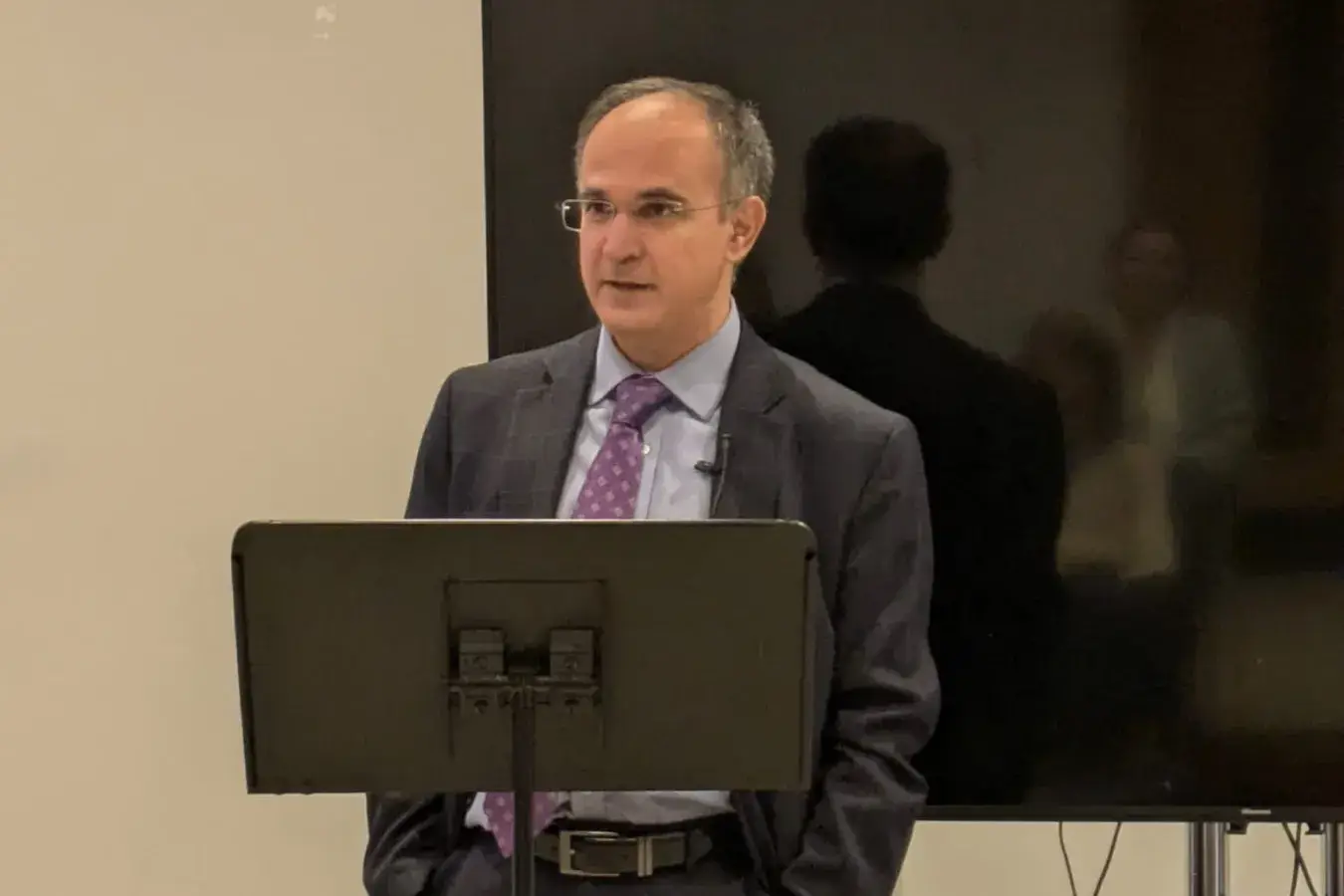
The following is the full text of my talk delivered at the 13th Annual Iftar at Alyth Synagogue in North London on 8th March. It was offered in the moments before Jewish, Christian, and Muslim guests broke bread together at Iftar — an occasion made particularly poignant by a broader climate in which conflict had created an atmosphere of suspicion and unease. I endeavoured to speak candidly, while remaining true to my humanist sensibilities.
Altyh Iftar Event | 8 March 2026
Bismiallah-ir Rahman-ir Rahim
Rabbi Colin Eimer,
My fellow brothers and sisters in humanity and in faith,
Thank you for inviting me back to Alyth. To speak at what is now the thirteenth annual Iftar here feels a little like being invited to celebrate a birthday of a friendship. Thirteen years of coming together to talk, to study, and to eat – that is already a kind of light in the world.
And you describe it beautifully in your invitation: over these years, friendships have grown. That, to me, is not a side-effect of this evening; it is its deepest purpose.
You have chosen for us this year a theme that could not be more timely: “Finding light in the darkness.” We do not need to look very far to see what the darkness is. Our Muslim and Jewish communities, here and worldwide, are living through a time of fear and anxiety, with rising Islamophobia and antisemitism, and with images of conflict that wound us daily.
Darkness is not just the events themselves. Darkness is also what begins to happen inside us:
when fear hardens into suspicion,
when grief turns into bitterness,
when we are tempted to give up on the possibility of understanding one another,
when we retreat into our own communities and no longer risk meeting face to face.
Last year when I was here, I spoke about friendship – about the courage of recognising and even cherishing our differences without trying to erase them. Tonight I want to suggest that darkness often begins precisely where friendship is absent. And conversely, that light appears where friendship is actually practised, not just praised in speeches.
Our Jewish and Muslim traditions both speak about light in powerful ways.
In the Qur’an, there is a verse many of you will know, from Surah al‑Hujurat:
“O humankind, We created you from a single male and a single female, and We made you into nations and tribes so that you may know one another.”
This verse reminds us that human diversity—different nations, tribes, cultures, even different paths of faith—is not itself the darkness. It is part of the light of creation. The problem is not that we are different; the problem is when we refuse to “know one another,” when we allow difference to become a pretext for contempt or violence.
Another Qur’anic verse speaks of light even more directly. In Surah an‑Nur, 24:35, we read:
“God is the Light of the heavens and the earth.”
And then the Qur’an gives a beautiful image: a niche in a wall, containing a lamp, the lamp enclosed in glass, the glass shining like a star. It speaks of “light upon light.” Commentators have read this in many ways, but one simple lesson is that divine light does not just shine “somewhere out there.” It needs niches and lamps – places where it can be received, reflected, protected.
In dark times, we are invited to become those little niches for light – in our families, our communities, and perhaps most importantly, between our communities.
Our Jewish cousins know this language of light very well. The very first divine word in the Torah is “Let there be light.” The lighting of Shabbat candles at the end of the week, the small defiant flames of Chanukah in a time of oppression – these are all ways of saying: even a small light has meaning in a large darkness.
So when we talk tonight about “finding light in the darkness,” we are not just using a nice metaphor. We are asking: how, concretely, do we become those little lamps for one another?
Here I want to bring in another strand that is important in my own work: hope .
Some years ago, in a different context, I spoke about the “Power of Hope,” drawing on words of His late Highness Prince Karim Aga Khan, the 49th Imam of the Shi‘i Ismaili Muslims. He once spoke of hope as “the trampoline of progress” – a force that pushes us up even when gravity seems to pull everything down.
Hope is not the same as easy optimism. Hope is not saying “everything will be fine” when everything clearly is not fine. Hope is a discipline. It is the decision, again and again, not to surrender to despair, and not to declare the future closed.
The philosopher Karl Popper, whom I have worked on, argued that the future is fundamentally open. We do not have access to a script in which everything is already written. For him, this was not just a technical philosophical point; it was profoundly ethical. Because the future is not fixed, our choices matter. What you and I do today – the friendships we cultivate, the hatred we refuse, the institutions we build – genuinely shapes what becomes possible tomorrow.
In times like ours, this is already a form of light: to believe that our actions, even small ones, are not meaningless.
The Qur’an also gives us a sense of this when it tells us, “Help one another towards goodness and piety” (5:2).
We do not walk into the darkness alone. We support one another in doing good.
This brings me back to friendship as one of the most beautiful lamps we can place between us.
Persian poetry, which is my other great love, is full of images of friendship as light. Hafez, the great 14th‑century poet from Shiraz, speaks of planting the tree of friendship and uprooting hostility. The gardener of the heart, he suggests, must constantly remove the weeds of resentment and plant the seeds of love.
Rumi, whom so many Muslims and non‑Muslims cherish, wrote a famous line:
“The lamps are different, but the Light is the same.”
We could say tonight: the Muslim and the Jew may hold different lamps – different rituals, different sacred languages, different historical memories – but the light that calls us to compassion, to justice, to mercy, is of one source.
And then there is Sayeh, Houshang Ebtehaj, the modern Iranian poet whose work I brought here last year. In one of his poems, he reflects on conflict and says, in essence: when we fight each other, something far more precious than victory or defeat is at stake. Humanity itself vanishes. Even the victor is defeated if he has forgotten the human face of his enemy.
That, for me, is a deep description of darkness: a condition in which I can no longer see the human being in front of me, in which the other becomes only an abstraction, a slogan, a threat.
So if we are serious about “finding light in the darkness,” it is not enough to talk about light in the heavens. We must also ask: what renews our sight, so that we see each other again as persons and not as symbols?
One answer, I think, is very simple and very difficult: we must keep meeting. We must keep eating together. We must keep listening, especially when it is uncomfortable.
From the perspective of my own Shi‘i Ismaili community, the response to darkness has never been to wait for a perfect utopian future. Under the guidance of the Imam, the Ismaili Imamat has tried, in modest ways, to build institutions of light: schools, universities, hospitals, cultural centres, places where people of all backgrounds can seek knowledge and health and dignity.
This is hope in practice, not in theory. It is a way of saying: even in a broken world, we can act as if light is real, as if human beings can live together with some measure of justice. We may not see perfection, but we can refuse to cooperate with despair.
And that, to me, is very close to what you have been doing here at Alyth for thirteen years. This Iftar is not just an event in the synagogue calendar. It is a small, stubborn piece of evidence against the story that Jews and Muslims must be enemies. It is a yearly act of resistance against the darkness of suspicion.
So perhaps “finding light in the darkness” tonight means something as simple, and as demanding, as this:
To decide that we will not reduce each other to what we see on the news;
To decide that the person sharing the Iftar table with me is not an abstract “Muslim” or “Jew” but a neighbour;
To decide, to borrow the Qur’an’s language, to know one another.
Let me end with a very small, practical invitation.
Before you leave tonight, I invite you to seek out one person whom you do not know, ideally from the “other” community – someone whose accent, or dress, or background is different from yours – and to ask them a simple human question: “How has this last year felt for you?” And then to listen, not in order to reply or to argue, but simply to understand.
If we do that, even a little, we have already lit a few more lamps in this room.
May we all, in our different ways, be small niches for that “light upon light” the Qur’an speaks of. May our traditions, our prayers, our study and our shared meal tonight help us to see one another more clearly, to protect one another more bravely, and to hope more stubbornly.
And so, as we sit together in this sacred space, let our hearts turn as one to those who walked before us – the prophets we cherish across our traditions: to Mūsā, Kalīm Allah, who heard the Divine voice and brought us the law of justice; to ʿĪsā, Rūḥ Allah, the spirit of God’s mercy who taught us to love our neighbours; and to Mohammad, Ḥabīb Allah, the beloved who called us to compassion and unity.
May their blessings rest upon this table, upon these friendships, upon this fragile and precious light we are building together in the darkness.
Thank you.
Leave a Reply