
On the mast at Kuhestak, the map that put Tehran under a blast radius, and the test Iran International will not take
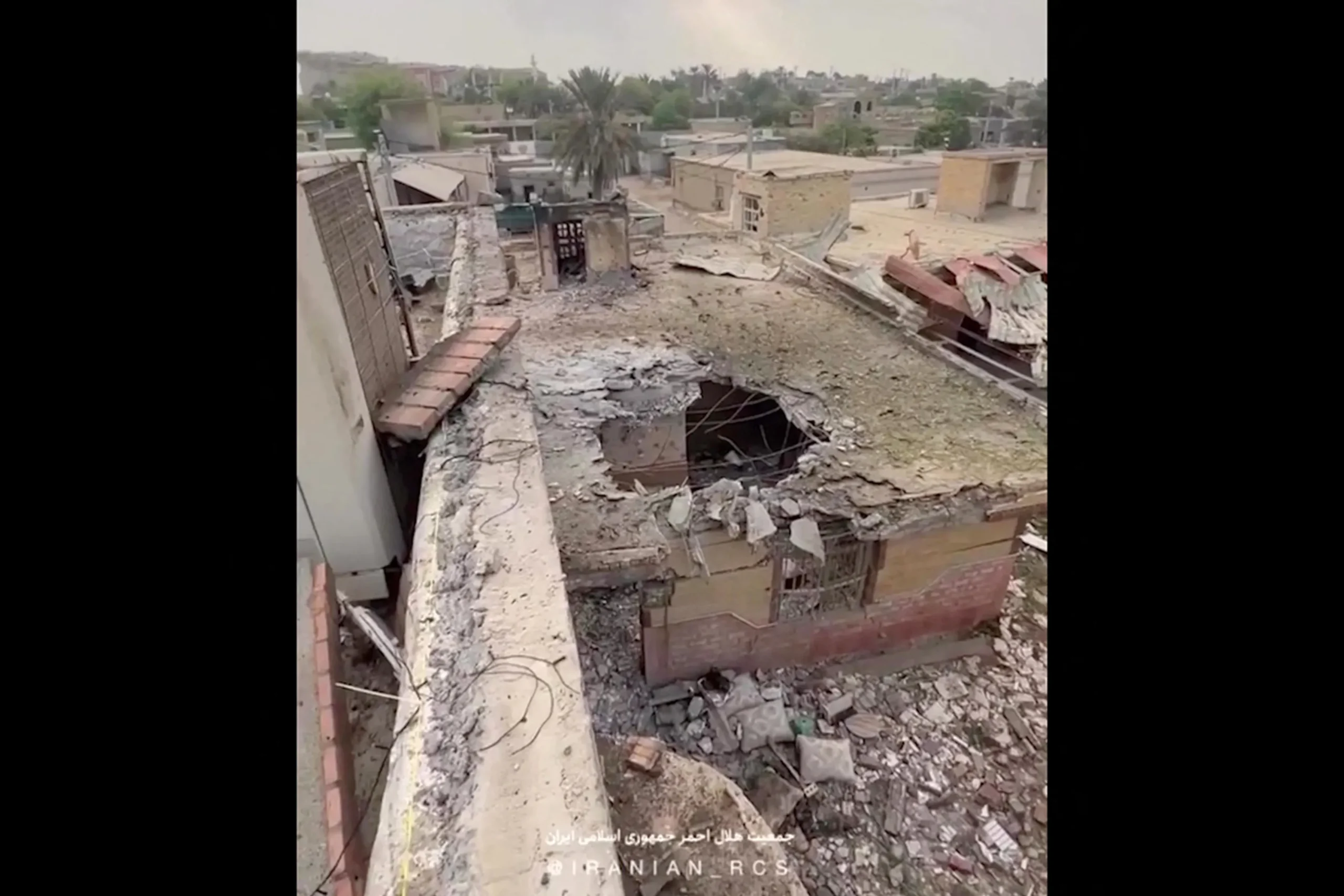
A telecommunications mast stood near the shoreline at Kuhestak, in Sirik county, on the Hormozgan coast. On the evening of 1 September it was struck and came down across the road. A few paces away, in a private house, a wedding was in progress. A missile went through the roof and left a hole a metre and a half deep in the ground beneath it.[1]
The Hormozgan governor’s office named four of the dead. Amir Ali Karimi, four years old. Mohammad Malahi, sixteen. Kolsoum Malahi and Zarkhatoun Taheri, both forty-three. More than sixty were wounded.[2] The father of the bride told state television that everyone in the house was a civilian. A woman filmed at the scene, her hands bloodied, said the building was nowhere near a military site. US Central Command said it was aware of reports of civilian casualties originating from Iranian state media, and that the American military never targets civilians, unlike the IRGC.[3]
That is the ground. This essay is about the people who spent eighteen months preparing it.
A familiar reference point
In the same days a still from Iran International began circulating. A street map of Tehran. Two rings on it, blue inside yellow. A Little Boy casing propped beside the legend, fifteen kilotonnes. Then a second frame, pulled wider, the yellow now swallowing Karaj and Islamshahr and reaching towards Qazvin, Saveh, Qom, Semnan and Amol, with a Tsar Bomba standing next to it.
The channel answered twice. Mehdi Parpanchi called the circulation a malicious, out-of-context misrepresentation of an anti-war educational report on Indo-Pakistani tensions and Russian nuclear rhetoric.[4] Newsha Saremi, who presented the segment on Titr-e Avval and dates it to 24 April 2025, said the purpose was to let an Iranian audience grasp the real scale of a nuclear explosion, and that tools such as NUKEMAP model hypothetical detonations over cities everywhere.[5]
Read the defence again, because it concedes the fact. Nobody alleged that the segment predicted a strike on Iran. The allegation concerns the choice. A programme about the India–Pakistan border drew its illustrative blast radius over Tehran, Karaj and Islamshahr, and named the towns as they would be named on an evacuation map.
The NUKEMAP comparison collapses on contact. NUKEMAP is a tool: the user picks the city, and the picking is the user’s business.[6] A broadcast picks for its audience. That is not a technical convenience. It is an editorial decision, and editorial decisions are answerable.
Try it with Tel Aviv
There is a test here, and it is not rhetorical. Could Iran International have run the identical segment over a map of Israel? Rings across Tel Aviv, Haifa and Ashdod, a bomb casing in the corner, a presenter explaining that this is only to help the audience appreciate scale.
Everyone already knows the answer, which is what makes the question worth asking. The issue was never whether the graphic was educational. It is why one city is available as a teaching aid and another is unthinkable.
I have pressed this before on numbers instead of maps. When Morad Vaisi published his count of Iran’s dead I called the work honourable, and I stand by that sentence; it was performed inside a frame that could not hold it. The same channel carries both. Institutions are not monoliths, and saying so is not a concession. It is the reason a pattern has to be shown rather than asserted. I have also written about the sleight by which a nation’s grid, ports and bridges become a regime’s assets and therefore fair game. The mast at Kuhestak is that argument arriving with a body count.
Truman plus
On 6 April, Ali Hossein Ghazizadeh of Iran International posted eleven words. Trump or Truman Plus? Maybe this is the ultimate solution to defeat the devil. Two hundred and ten thousand views.[7]
Truman is not an ambiguous reference.
This week Yasmine Pahlavi put up an Instagram story. Japan, eighty years after two nuclear bombs, set against Cuba after seventy years of socialism. A lit skyline above. A collapsing terrace below.[8]
Sina Toossi had earlier deleted a post that misidentified the Iran International segment, corrected himself, and kept the charge standing. My own reply at the time was that the misidentification was beside the point. If Iran had done exactly the same thing, what would the reaction have been? Nobody has answered that.[9]
Sleep, if you are far from the mast
On the night of 1 September an account followed by hundreds of thousands inside Iran was asked whether it was safe to sleep. Vahid Online replied that if you are at some distance from the radars and the telecommunications masts in the south of the country, you can. He was thanked, and wished continued good news.[10]
At Kuhestak the mast came down, and a four-year-old died in the house beside it.
What he knew, I cannot say. What he published is on the record: a proximity rule for staying alive, issued to civilians, in the register of a public service announcement. That is not journalism. Journalism does not arrive with a target radius attached.
What the law does not ask
None of this is softened by the record of the Islamic Republic. Not the scaffold that went up in Isfahan. Not the hundred names compiled in Tehran and the accusation waiting at the other end of the flight. Not the machinery of humiliation that has made the Nazi analogy feel plausible to Iranians reaching for it from abroad. The two machines that manufacture Iran are not equivalent and I have refused to pretend otherwise: one costs liberty, the other costs lives.
The law, though, does not ask who is speaking. Distinction and proportionality are not prizes for good conduct. They bind the striking party irrespective of the character of the government being struck, and Article 51 of Additional Protocol I does not lapse because a state is odious.[11] A wedding is not a dual-use object. A mast in a residential town on a coastline is a hard case at its most generous, and the hardness is not dissolved by the claim that anything serving a state is infrastructure. Follow that claim and the air is infrastructure too. Minab and Lamerd already showed where the claim ends.[12]
Iran’s foreign ministry said this week that the normalisation of bombing is more dangerous than the bomb.[13] The sentence is true. It comes from a state with no standing to say it. Both of those hold, and truth has never required clean hands; it requires evidence.
So the demand is narrow. Not silence about the Islamic Republic. Not affection for a government the diaspora has every reason to loathe. Criticism was never the thing under objection here. Only this: that a channel reaching millions stop treating an Iranian city as the neutral default for a blast radius, and that anyone broadcasting a survival rule to civilians say where he got it.
The screenshot was never the offence. It was the receipt.
Image: screengrab from footage released by the Iranian Red Crescent Society on 2 September 2026, showing what it says is the aftermath of a US strike on a wedding ceremony in Sirik county, Hormozgan province. Credit: Handout / Iranian Red Crescent via AFP.
[1] Maziar Motamedi, ‘What do we know about the fatal US bombing of a wedding in Iran’s Sirik?’, Al Jazeera, 2 September 2026.
[2] Iranian Red Crescent Society statement of 2 September 2026, reported in Al Jazeera and by Frud Bezhan and Roya Maleki, ‘What we know about Iran’s claims of US strike hitting wedding party’, RFE/RL Radio Farda, 2 September 2026. Casualty figures differ between sources: the Red Crescent gave five dead and more than fifty wounded, the Sirik county governor sixty-three wounded, IRNA sixty-eight, and the Hormozgan governor’s office four named dead and more than sixty wounded.
[3] Tim Hawkins, spokesperson, US Central Command, quoted in Motamedi, Al Jazeera, 2 September 2026.
[4] Mehdi Parpanchi (@Parpanchi), post on X, x.com/Parpanchi/status/2095229499210338713. The post links the full segment at youtube.com/watch?v=bqGToQOxur4.
[5] Newsha Saremi (@NewshaSaremi), post on X, x.com/NewshaSaremi/status/2095229676289401261. Saremi dates the segment to 24 April 2025; the channel’s own promotional post carrying the material is dated 4 May 2025, as is Parpanchi’s account of publication.
[6] NUKEMAP, Alex Wellerstein, nuclearsecrecy.com/nukemap/.
[7] Ali Hossein Ghazizadeh (@Alighazizade), post on X, 6 April 2026, 210,000 views. Screenshot on file.
[8] Yasmine Pahlavi (@yasmine.pahlavi), Instagram story, September 2026. Screenshot on file. The story sets a Tokyo skyline captioned ‘Japan 80 years after two nukes’ against a Havana street captioned ‘Cuba after 70 years of Socialism’.
[9] Sina Toossi (@SinaToossi), post on X, 2 September 2026; Daryoush Mohammad Poor (@dariushm), reply, 3 September 2026.
[10] Vahid Online (@Vahid), post on X, 2 September 2026, in reply to @shisheshekaste. The exchange is timestamped 00:16, 2 September 2026. Screenshot on file.
[11] Protocol Additional to the Geneva Conventions of 12 August 1949, and relating to the Protection of Victims of International Armed Conflicts (Protocol I), 8 June 1977, arts. 48, 51 and 57. The United States is not a party to Protocol I but accepts the principle of distinction as customary law.
[12] On Minab and Lamerd, see Motamedi, Al Jazeera, 2 September 2026. Investigations by The New York Times, the BBC and Airwars attributed the Lamerd strike to a US Precision Strike Missile; CENTCOM’s commander stated that the Minab school stood on an active IRGC cruise missile base.
[13] Esmaeil Baghaei, spokesman, Iranian Ministry of Foreign Affairs, post on X, quoted in Motamedi, Al Jazeera, 2 September 2026.
Leave a Reply