
On Radio Farda’s Pārāgrāf-i Avval, the Madani–Bayat correspondence, and the part of Iran that no one has counted
Radio Farda’s programme Pārāgrāf-i Avval, presented by Muhammad Zarghami, put the correspondence between Saeed Madani and Asef Bayat to Jalal Idjadi and to me. The exchange has run in Naqd-i Iqtiṣād-i Siyāsī since Urdībihisht 1403, begun while Madani was held in Evin. Madani calls the present condition a national trauma. He sets the memory of the Dey killings beside inflation, poverty, unemployment, and the erosion of the middle class. He cites at least 10,538 people detained, most of them between eighteen and thirty, from households that were poor or had lately stopped being comfortable, without steady work, with secondary schooling or less. He points to some twelve million young Iranians neither employed nor studying.
The presenter asked whether we were watching a change in the social condition itself. I wanted to begin somewhere less satisfying: with what we do not know.
The zone with no data
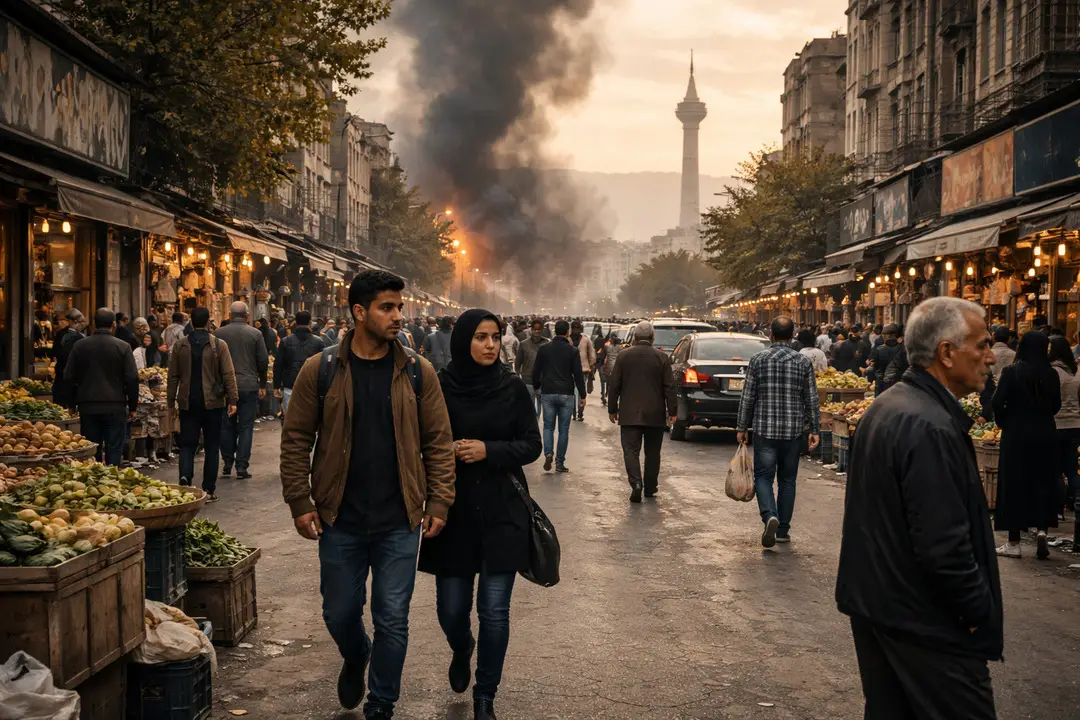
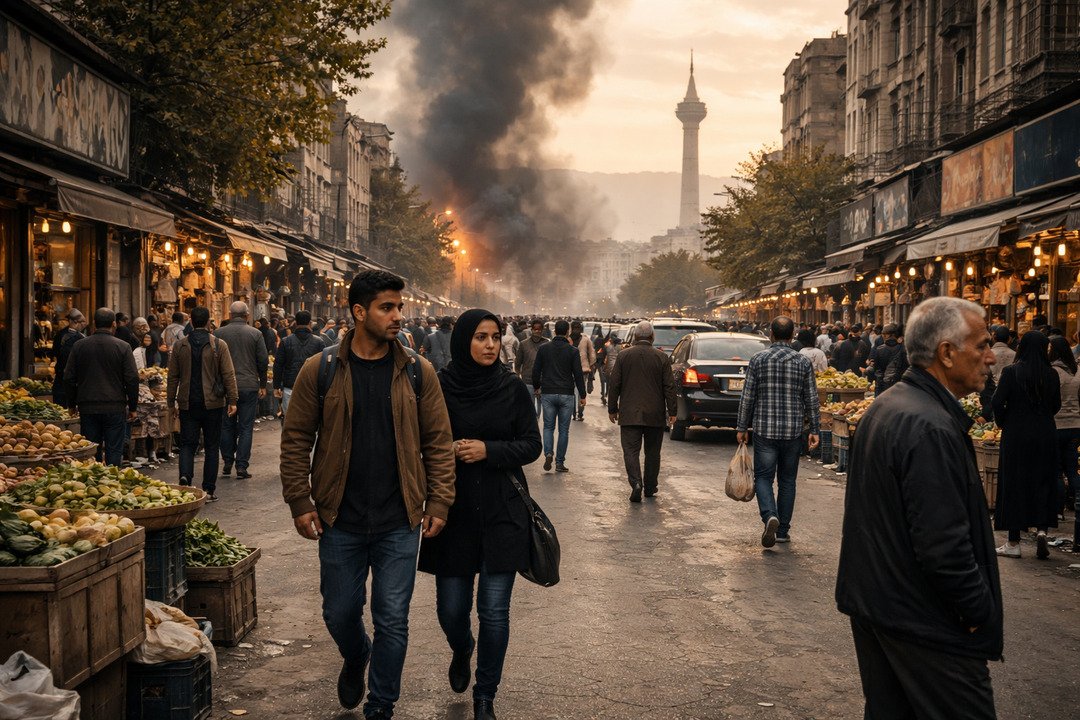
Against the picture the media keep reproducing, what is happening in Iran has no two hard poles, the opposition at one end and the Islamic Republic at the other. Between them lies a grey zone about which we hold almost no dependable data. It vanishes in the din of social media, in the bulletins, and in the accounts that the government and the opposition each circulate about themselves.
I mean this as a statement about evidence. We do not know the size of that middle. We do not know what it wants, what it fears, or what it would accept. Almost every confident projection of Iran’s political future rests on a population nobody has counted and few have tried to hear. The projections get made anyway, and they get made loudly. A politics built on an unmeasured majority is not analysis. It is ventriloquism with a large cast.
A thousand and one errors
The first share belongs to the Islamic Republic, and it is not a small one. A thousand and one errors, and the suffering has landed almost entirely on people who had no hand in any of them. The bond between state and nation is broken. Foreigners did not break it. Look at the turnout that elected Masoud Pezeshkian, a nation declining, in the one language still available to it, to lend the establishment its name. The killings of Dey belong to the regime. No sanction pulled those triggers. No foreign broadcast wrote those orders. Men in that state’s uniform, under that state’s command, shot people in Iranian streets, and there is no arithmetic anywhere in this essay that shifts that weight off them.
One correction to the way this is usually described. The tyranny is not a religious species. Calling it Islamic totalitarianism sends the bill to the wrong address. Despotism grows out of egoism, out of a man’s conviction that his own survival is the highest good, and it has worn every costume history keeps in stock: secular, monarchical, revolutionary, clerical. SAVAK managed without theology. Blame the doctrine and you will still be standing there, puzzled, when the next apparatus arrives in a different suit.
Two blades
Madani is right that the middle class is the question. That class has been under severe pressure for a decade and savagely so for the past two or three years. The damage has two authors. The Islamic Republic is one. Iranians outside Iran are the other, and by that I mean the opposition together with the American and European governments whose policies it has spent years soliciting.
Sanctions are the clearest instrument. Everyone now knows what they fail to do. They do not reach the structures of power. They do not touch the machinery of repression. What they reach is ordinary people, and what they achieve is the removal of the middle class from any capacity to act, leaving civil society paralysed. This is a case I have set out at length before, and I will not rehearse it here.
The consequence deserves more attention than the argument. If the middle class is what carries non-violent civic action, and that class has been ground down across a decade of sanctions, inflation, and emigration, then the non-violent road has been narrowed, year upon year, by exactly the people who insist most loudly that they wish to travel down it. Those who lobbied for maximum pressure while calling for a peaceful transition were asking for two things that cannot both arrive. The middle sits between the two blades of a pair of scissors. Both blades are held by people who insist they are cutting for its benefit.
The prince who promised
Now to the man himself, because the courtesy has gone on long enough.
Reza Pahlavi told Iranians that help was coming. He said it for years, in every register available to him: ministers half-appointed, a transition planned, a throne implied. Reza Shah III, governing a country he has not set foot in, with a cabinet made of air. The whole construction has advanced by riding on American and Israeli missiles. He went to Israel, has said with some pride that he pressed there for strikes, and then watched his own circle rebrand the bombardment that followed as ‘humanitarian military intervention’, a phrase that ought to have finished a political career and instead drew applause. His wife thanked Benjamin Netanyahu. He has addressed Senator Lindsey Graham in print as ‘Uncle Lindsey’. At monarchist rallies the Lion and Sun goes up beside the flags of the United States and Israel and nobody in the crowd finds this odd. Donald Trump, the patron on whom the entire hope was staked, is reported to have called him a ‘loser prince’ and incompetent behind closed doors.
People died on that promise. That is the sentence that matters. Young Iranians walked into the street believing the cavalry was over the hill, because a man with a famous name and a large platform had told them so for a decade. The regime shot them. The regime answers for the shooting, first and always. The man who told them rescue was on its way answers too. He knew he could not deliver it. He knew exactly where they would be standing when it failed to arrive. And when it failed to arrive, he was elsewhere, safe, giving another interview.
Then there is the apologetics for the bombing. Hospitals, bridges, universities, refineries, and we were told that only the regime was being hurt. The Revolutionary Guards breathe Iranian air. On this reasoning we should poison the air.
What was done to a women’s movement
Woman, Life, Freedom came from inside Iran, from women, against a violence done specifically to women. It was theirs. The Georgetown coalition took it, emptied it, and handed back Mard, Mīhan, Ābādī – man, homeland, prosperity. A women’s rising, re-sloganed into masculinity. The same networks then spent months aiming gendered abuse at any woman who declined to fall into line. People call this an opposition. It was a repossession.
Shouting from a studio
My co-panellist on the programme, Jalal Idjadi, spoke of unconventional activism and of armed action inside the armed forces. I said on air what I will say here. This is close to the most irresponsible thing a person can broadcast from a European capital. It places unarmed people in front of loaded rifles and costs the speaker nothing at all. The register is familiar to anyone who sat through the Mujahedin-e Khalq broadcasts of the eighties – the shouting, the slogans, the abuse, the total absence of anything a sociologist would recognise as an observation.
The numbers go the same way. Idjadi spoke of 40,000 killed. Morad Vaisi of Iran International, the outlet that did most to put the inflated figures into circulation, has since said that the names reaching him come to about 3,500. Every one of those 3,500 is a catastrophe with a family attached to it. Multiplying them by ten honours none of them. It trains an audience to disbelieve the true figure when it finally arrives, which is a service to the state, performed free of charge by people who believe they are fighting it.
The lesson nobody has taken
Something did shift during the war. Among the Iranians who had spent years assuming that bombing would arrive from somewhere, land on the correct buildings, and carry off the government while leaving them and their own families untouched, the first explosions put an end to the vocabulary of precision. In such a war the people who die are ordinary. Those inside the corridors of power, and those who run the machinery of repression, are harmed last. The recognition has spread. It has not gone deep.
The political establishment has taken no lesson at all. It has instead claimed credit for something that was never its own. Iranians stood against a politics of death and insisted on living, and that disposition belongs to them. Mousavi has said so. Khatami has said so. Pezeshkian and Rouhani have said so. Each has spoken as though the sentiment were the system’s achievement. No government cooperates with its own undoing, and this one has been consistent on the point. Meanwhile the trajectory runs day by day towards exhaustion. Anyone who looks carefully at where this is heading should be frightened by the answer.
The share
Attribution is the discipline this moment asks for. When we say a situation is the product of one force, we are usually reporting a wish. Wishes have to be brought down to the ground of fact.
Everyone holds a share in this ruin. The share belonging to the Islamic Republic is neither small nor forgivable. America holds one. Israel holds one. So do you, and so do I. A careless sentence is a share. A mistaken analysis is a share. False hope offered to people who then act on it is a share. Anyone who told Iranians from abroad that a miracle prescription existed, and then sent them into the street as cannon fodder, answers for their blood until the last day.
Consider a parent who knows there are thugs in a certain quarter. They know exactly what those men do: the beatings, the broken bodies, the rape. They send the child there anyway, with instructions to go and sort them out. The child is killed. Nobody would hesitate over that parent’s responsibility. We hesitate constantly over the political version of the same act, and the hesitation is a courtesy we extend to ourselves. Shortcuts have failed this country before, and those who proposed them have never once paid for the failure.
Where authority sits
One further point, which I made on air and will repeat. Those of us living outside Iran do not wake up uncertain whether there will be bread at the bakery. Our bread has not gone up tenfold. We are not in the position of the people we discuss, and anyone speaking about Iran from outside it should do so with far more caution than is customary.
Madani’s observations carry more weight than mine. He is there. He has paid for being there, and he is paying still. That ranking includes me, and I would not have it otherwise. The diaspora has spent years mistaking its volume for its standing.
There is no sudden overthrow that ends in a stable democracy. There is patience, restraint, slow work, and the labour of talking to people you cannot stand. Neither side of this can eliminate the other. We will have to learn to speak, and to live, alongside one another, dislike and all. The grey zone we cannot measure is where that will be settled, and it has never once asked us for a prescription.
Leave a Reply