
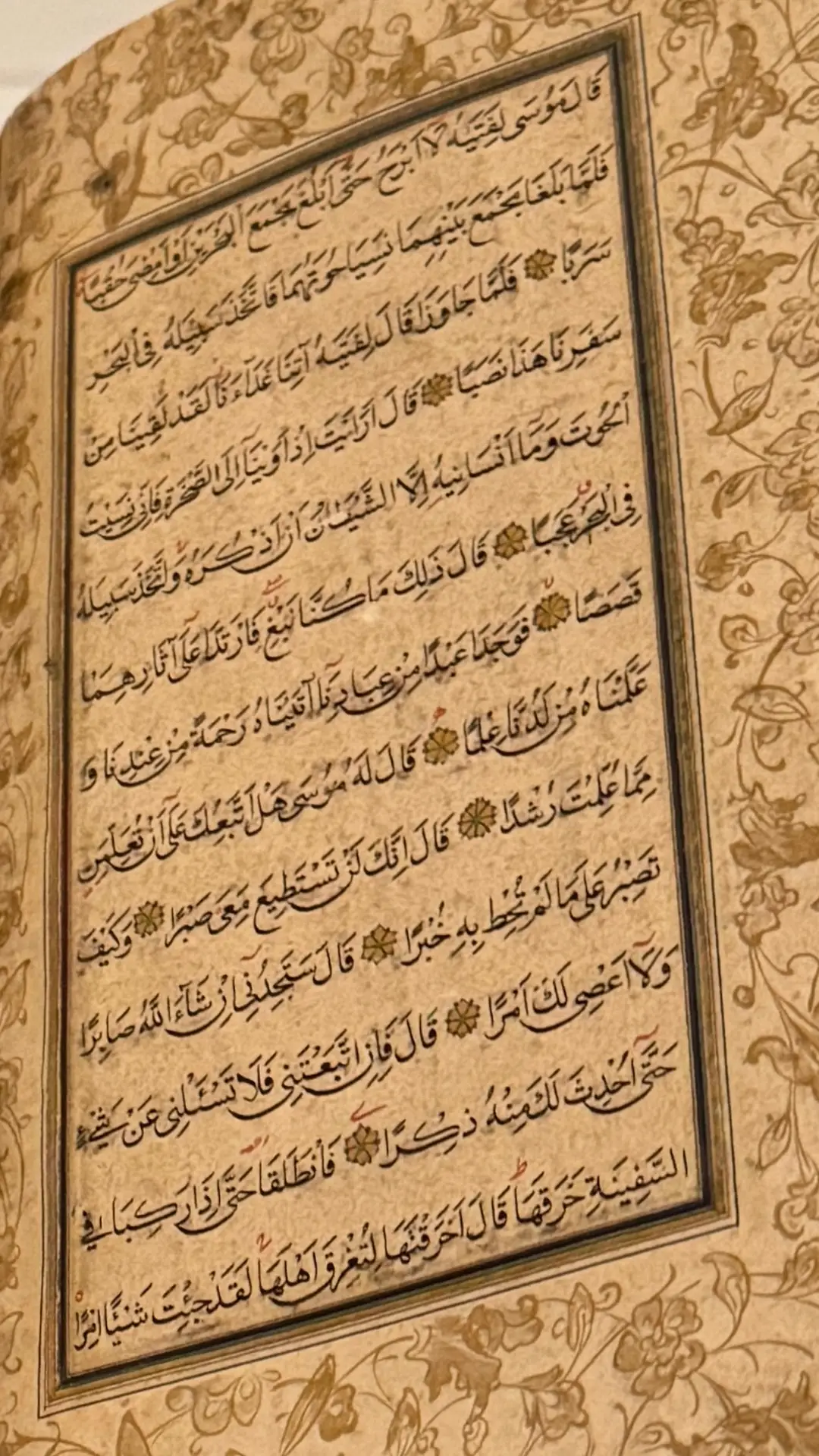
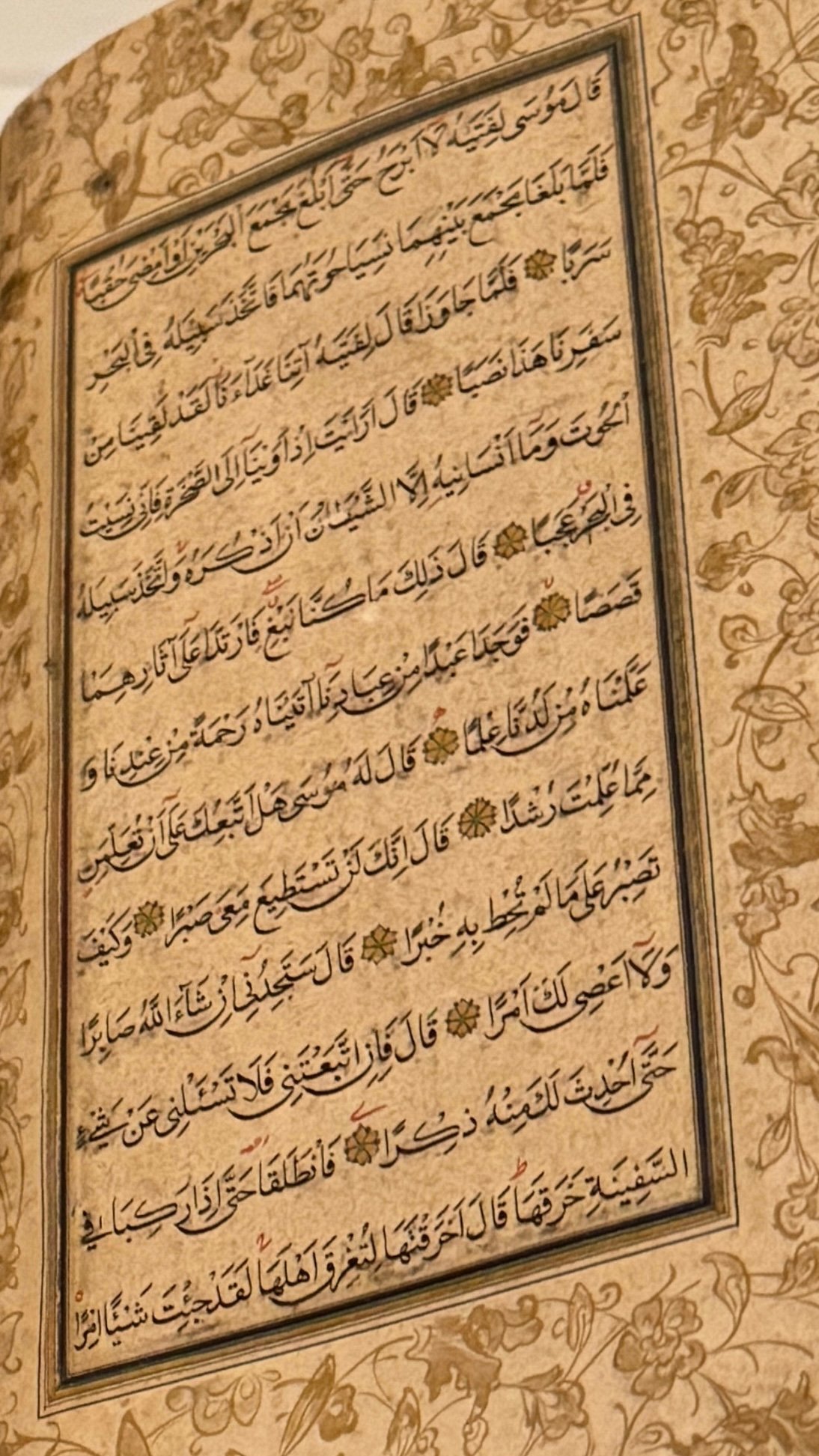
Image: folio from a manuscript of the Quran, Aga Khan Museum, Toronto
An argument is circulating, and it deserves a straight answer. It runs like this. A Muslim intellectual, pressed about the crimes of the Islamic Republic, replies that there is no such thing as Islam, only Muslims. His interlocutor finds the reply evasive and comes back in three moves. First, the distinction is incoherent: if there is no Islam, there can be no Muslims either, since a Muslim is by definition a follower of Islam. Second, the historical record is full of crimes committed by Muslims, and the young men executed this year in Iranian city squares, at the hour of the dawn call to prayer, were killed by people who pray. Third, the distinction is therefore an alibi, and those who make it end up standing beside the executioners instead of beside the executed.
That is the argument at its strongest, with the insults stripped out. It fails, and it fails for reasons that have nothing to do with theology. One can see the failure without settling a single question about revelation.
Two senses of one word
Begin with the charge of incoherence. It turns on an equivocation. In the first sense, Islam names a revelation, a scripture, a vast body of commentary, a set of practices and centuries of history. That exists. Nobody denies it. In the second sense, Islam names an agent, something that wants, decides, orders and kills. It is the second that is being denied. A text does not convene a court; a doctrine does not sign a warrant at four in the morning. Human beings act, and they act on their understanding of texts, an understanding shaped by their training, their interests, their century and the institutions that pay them. To say that we have Muslims is to say that between revelation and deed there always stands an interpreter, and that the interpreter has a name, a date and an address.
This is no special pleading on behalf of one religion. It is the general condition under which anything held sacred enters human affairs. I have argued for years that we should speak of Muslim societies and Muslim civilisations in the plural, because what we are looking at is an array of interpretations, no one of which can claim to be the faith itself without also claiming access to absolute truth.[1] Asef Bayat framed the operative question well: the issue is never whether Islam is compatible with democracy, it is under what conditions Muslims might make them compatible.[2] That question returns agency to the people who actually exercise it.
The second move fails differently. It reads the character of a doctrine off the conduct of some of its adherents. Ask what would count as evidence against that reading. If atrocities committed by Muslims tell us what Islam is, while the hospitals, the algebra, the poetry and the jurisprudence built by Muslims tell us only what a few individuals happened to achieve, then the thesis has been sealed against refutation in advance. An explanation that cannot fail explains nothing. It is a mood with footnotes.
Who is left to be tried
The point is not that the executioners are insufficiently Muslim, but that being Muslim underdetermines what they did. Millions who share their creed did not build that scaffold, and some of them died on it.
The suspicion behind the objection is that the distinction excuses. The opposite holds. Reifying a religion is the most generous gift available to the men who run the gallows. If Islam hanged those young men, then no particular person did, and there is nobody to name, summon or convict. Identify the interpreters and you recover a judge, a prosecutor, a statute, a ruling, a chain of command and a date. Responsibility becomes assignable. This is the practical yield of what looks like a merely methodological remark, and it is why the alternative, whatever its emotional force, leaves the victims with nothing.
A community with reasons to know better
The Ismaili Imamat has been making this argument in public for half a century. In 1979 the late Aga Khan IV was asked on BBC radio about Islamic law and fundamentalism, and his answer began by asking where one starts. The Qurʾān, he said, is not a body of law; what is called Islamic law today is a compilation of views by jurists who lived long after the revelation.[3] In 1994 he told a French magazine that a billion believers in 30 to 40 countries speaking 500 languages and dialects do not constitute a single entity in which the faith is interpreted and practised in one manner, and that the West habitually confuses political ambition with religion. He offered the obvious comparison: the campaign of the IRA in England did not make Catholics dangerous.[4] At Évora in 2006 he made the epistemological point directly, warning that religious feeling curdles when it turns into self-righteousness, and locating the remedy in a recognition of ‘our own creaturehood, and thus our human limitations’. In that recognition, he said, lies our best protection against false prophecies and divisive dogmatism.[5]
Read together, these are a doctrine of fallibility. Revelation is stable; our grasp of it is not. That is exactly the ground on which the disputed distinction rests, and it is not a recent improvisation. The Ismaili discipline of taʾwīl has always placed fallibility on the side of the receiver and never on the side of what is received.[6]
Now notice what the Imamat has not done. Political Islam has furnished a century of scandal, and any Muslim community could buy a quantity of Western respectability by announcing that it is something other than Muslim. That road is open. It is well paved and well paid. The Imamat has never taken a step along it. The Constitution ordained in 1986 opens with the shahāda and affirms the Qurʾānic revelation as universal and eternal.[7] The Fatimid forebears of this tradition founded al-Azhar and the Dār al-ʿIlm and treated knowledge as service to the whole of creation. The institutions built by the last Imam are Muslim in inspiration and non-denominational in operation, guided by a policy of replacing walls that divide with bridges that unite.[8]
There is a reason a community formed in this way does not argue from the deeds of some to the essence of all. It has been on the receiving end of that inference for a thousand years, from the heresiographers who wrote it out of the faith to the European legend that turned its name into a common noun for murderer. Ismailis know what this argument feels like from inside the accusation.
The executions were real. The courts that ordered them were real, the statutes were drafted by identifiable men, and the signatures on the warrants can be read. That is the whole point of insisting on interpreters. Grief for the dead requires no indictment of a billion people, and it is not served by one. An argument that asks a Muslim to disown his faith before his objection to tyranny will be counted is not an argument about Iran. It is a loyalty test with the sign reversed.
[1] Daryoush Mohammad Poor, Authority without Territory: The Aga Khan Development Network and the Ismaili Imamate (New York: Palgrave Macmillan, 2014), pp. 32–4.
[2] Asef Bayat, Making Islam Democratic (Stanford, CA: Stanford University Press, 2007), p. 4; discussed in Mohammad Poor, Authority without Territory, p. 34.
[3] Aga Khan IV, interview with Michael Charlton, BBC Radio 4, London, 6 September 1979.
[4] Aga Khan IV, interview, Paris Match, 15 December 1994.
[5] Aga Khan IV, address to the Évora University Symposium, ‘Cosmopolitan Society, Human Safety and Rights in Plural and Peaceful Societies’, Évora, Portugal, 12 February 2006.
[6] Daryoush Mohammad Poor, ‘The Twin Wisdoms: On the Reconciliation of Faith and Intellect in a Cosmopolitan Age’ (unpublished essay, 2026); and my lectures at Duke, Columbia and Simon Fraser universities, https://youtu.be/lzyFRcJmK0M and https://www.youtube.com/playlist?list=PLqVA7iD8RATOzDs44UjO3tArmrhArtzU4.
[7] The Constitution of the Shia Imami Ismaili Muslims, ordained 13 December 1986, amended 11 July 1998, Preamble (A).
[8] Aga Khan IV, acceptance remarks, University of Évora honorary doctorate, Évora, Portugal, 12 February 2006.
Leave a Reply