
On the Nazi analogy, the Iranians who reach for it from abroad, and the state that made it plausible
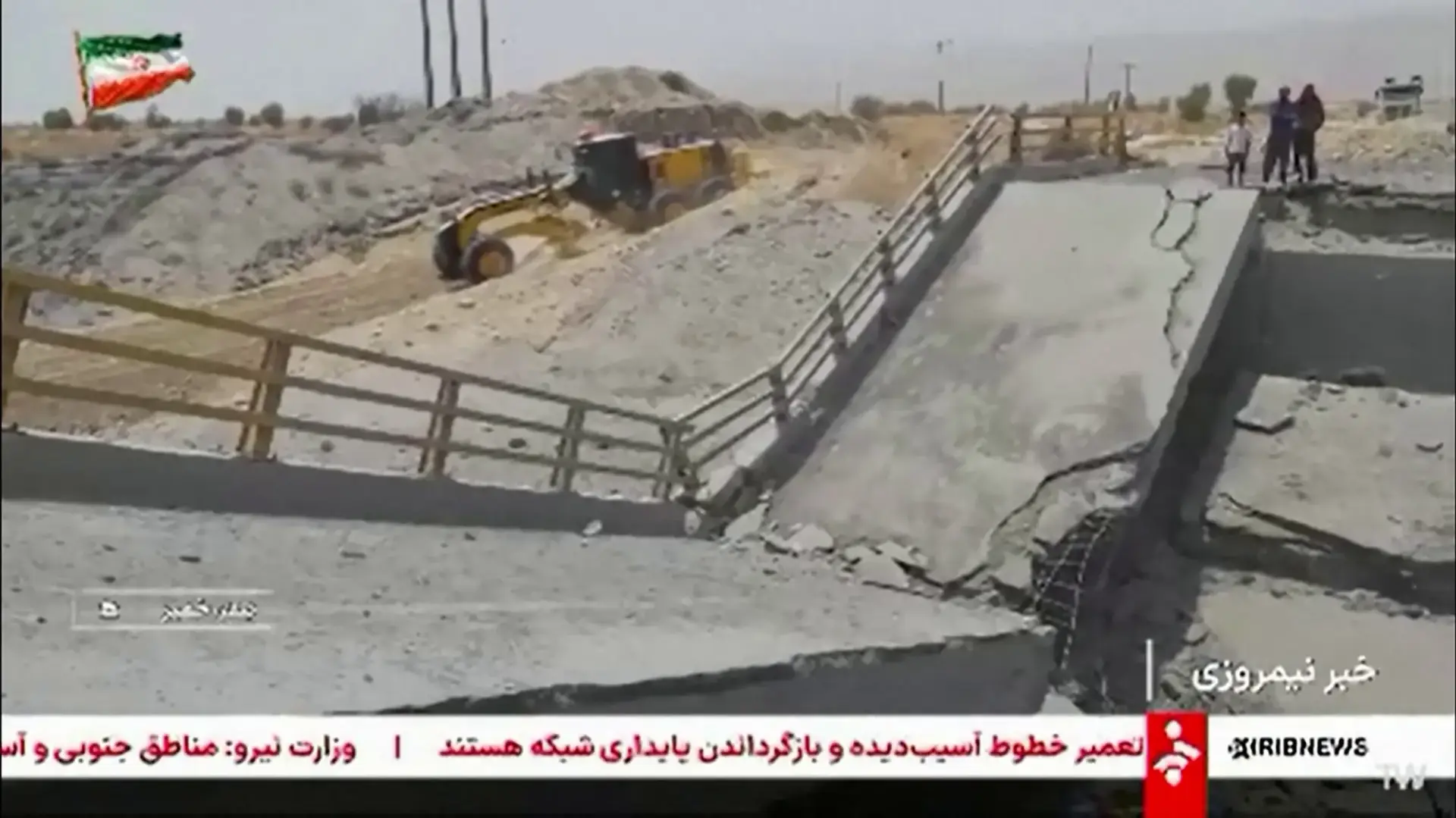
Aftermath of overnight US strikes on a bridge in Bandar Khamir county, near the Strait of Hormuz, 17 July 2026. Screengrab from footage broadcast by Iran’s IRINN state television, made available via AFPTV. Credit: AFP / IRINN, via Al Jazeera.
The strikes resumed on 6 July. Bridges in Hormozgan. A pumping station at Jask, and twenty villages left without water. By Sunday it was the ninth consecutive night. And across my timeline, from Toronto and Stockholm and Los Angeles, one sentence keeps arriving with the confidence of a proof: they are the Nazis, and nobody negotiates with Nazis.
I want to take that seriously. Taking it seriously is the fastest way to show what it does.
What the Analogy Skips
Germany was invaded because Germany invaded. Poland first, then France, then the Soviet Union. The Allied campaign answered a conquest. It was never a remedy for domestic tyranny, and the record on that point is humiliating: while the camps were being built and the race laws passed, the world’s considered response was Munich. Nobody bombed Berlin in 1935 to save anyone.
Iran has invaded no one. The war of 28 February opened in the middle of live negotiations, with the assassination of a head of state on his own soil.
The resistance point runs backwards too. The officers of 20 July 1944 acted inside Germany. The White Rose printed leaflets in Munich. None of them petitioned anyone to flatten Hamburg. And the flattening, when it came, is the part historians still cannot agree was worth the cost – except on one finding, which is that a terrorised population closes around the state being bombed. We have just watched it happen here. A leadership was decapitated in February and a successor was seated within nine days.
Then there is the ending. Whoever invokes 1945 is invoking unconditional surrender, foreign occupation, and forty-five years of partition. That is what the analogy promises. Anyone using it should say so aloud.
The Word Doing the Work
I argued in June that ‘proxy’ does the work thinking is supposed to do. ‘Hitler’ is the same instrument turned the other way, and it runs on the same mechanism: assert that the outcomes resemble each other, skip the demonstration that the machinery does, and arrive at the verdict you brought with you.
Let me add what I did not say clearly enough in March. This is not carelessness among people who ought to think harder. The analogy is supplied. It has an infrastructure, and that infrastructure has budgets and editorial lines – Persian-language satellite channels financed from well outside their own audiences, amplified by Israeli, American and Gulf outlets whose governments are in live confrontation with Tehran. One of them has a documented Saudi origin in UK corporate filings. In March I asked the diaspora to be more honest with itself. That misdescribes the problem. You do not reason someone out of a conclusion that is being delivered to them nightly.
The Other Half
Now the harder part, and I will not soften it.
The analogy is false. The conditions that make it feel true were manufactured in Tehran.
I set out the ledger of Ali Khamenei’s leadership in an earlier essay and I stand by every line of it. Forty-seven years produced a system in which one man’s judgement displaced every institution capable of correcting it; in which loyalty outranked competence in each appointment that mattered; in which a former prime minister and a former speaker of parliament were confined for fourteen years without charge or trial. The standing answer to a crowd in the street was a bullet. In January the answer was given again, and credible monitors put the dead at no fewer than seven thousand.
Add decades of sanctions, which are not a separate story. They crushed wage-earners and the sick. They enriched whoever controlled the scarcity. And they handed the state a permanent alibi for failures it authored on its own.
So here is the sentence that cuts both ways. A government that spends half a century teaching ninety million people that nothing can be changed by lawful means has manufactured the audience for the analogy it now denounces. Despair is no argument for invasion. It is an explanation, and the men who produced the despair do not get to look surprised at what grew in it.
What Is Actually Being Prescribed
Say the whole sentence, then. The sentence is: I want a foreign air force to do to my country what was done to Germany, I accept the arithmetic of graves that follows, and I stand at no risk myself.
Some who say it have lost family to this state and have earned their fury. I have argued against the Islamic Republic for years and paid for saying so. What I will not accept is a shortcut through somebody else’s history standing in for thought about my own country.
Germany’s ending is not available to us. What is available is slow and unglamorous: a settlement with the state that exists, and then the argument with it, conducted by Iranians, on Iranian ground, in a country still standing.
Nobody was ever liberated by the bombing of their own house.
Leave a Reply