
On Assal Rad’s Don’t Say Palestine, the memo that told reporters which words to avoid, and the test the book does not set for itself
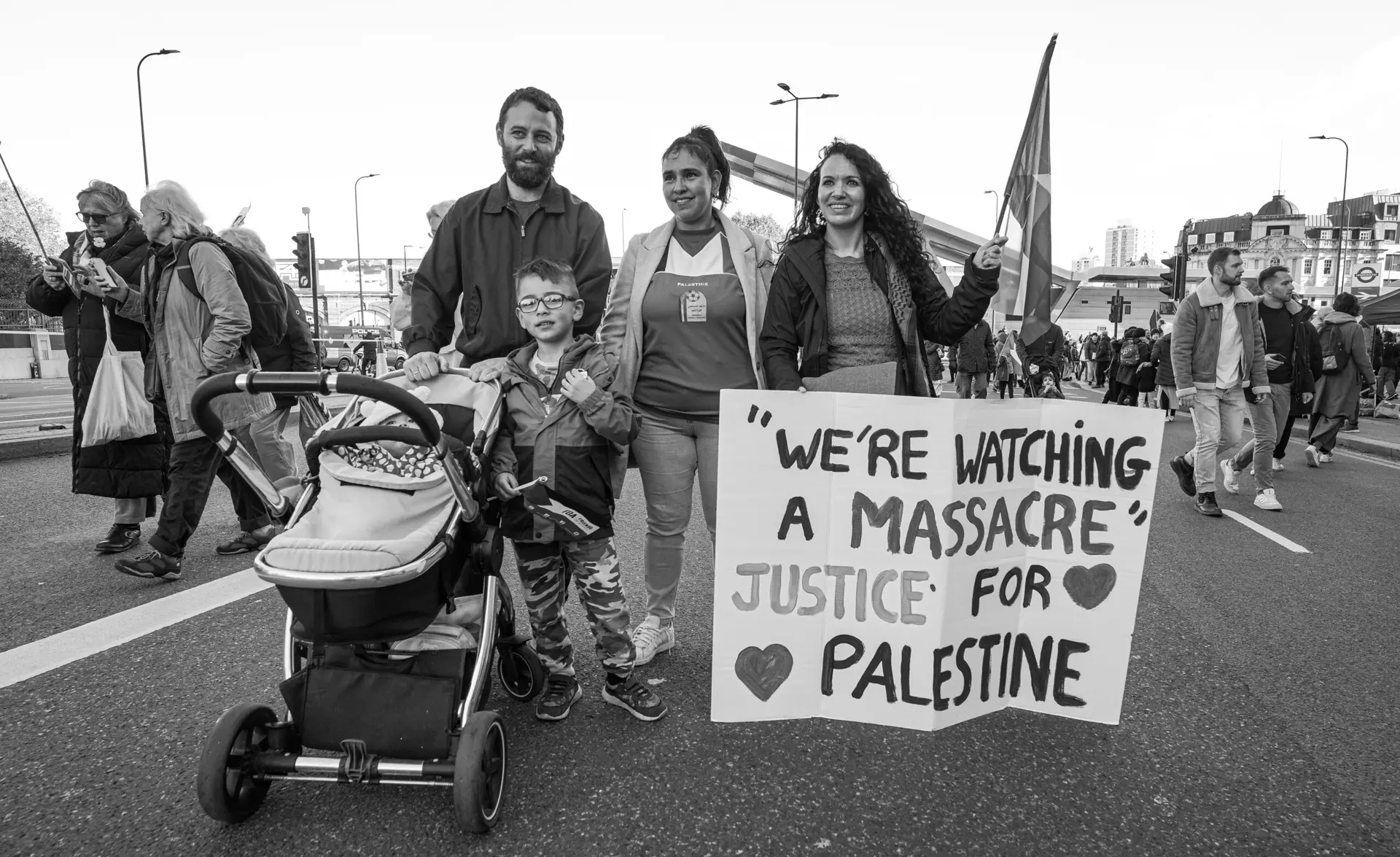
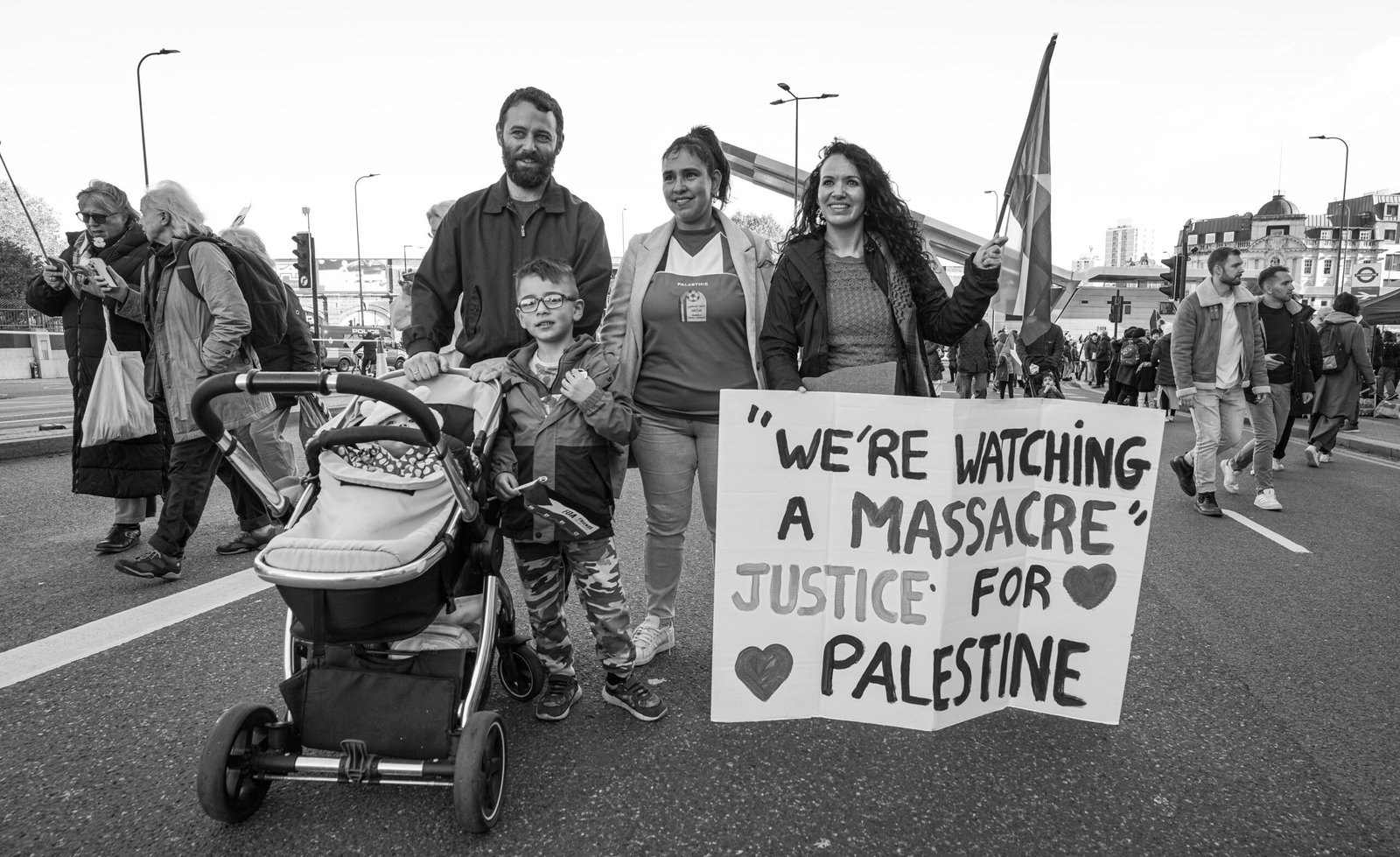
On 11 November 2023, on the march from Hyde Park to the American embassy, a family stood in the road holding a sheet of card. Someone had written on it by hand: ‘We’re watching a massacre.’
Two months later The Intercept published Adam Johnson’s count of more than a thousand articles in the New York Times, the Washington Post and the Los Angeles Times. The strongest words English has for killing – slaughter, massacre, horrific – were being used almost only of Israelis killed by Palestinians.
A family with a marker pen reached for the word. Three newspapers, with standards editors and a century of prestige between them, kept it for other people’s dead. Assal Rad’s Don’t Say Palestine (Vintage, 2026) is a book about that gap.
Corrections, not semantics
Rad is a historian of the modern Middle East. She began in May 2021 by screenshotting a headline about Palestinians being pushed out of their homes in East Jerusalem, striking out the word ‘evictions’ in red, and posting it back with the missing facts restored. She has been doing it ever since. She insists the work is not about catching newspapers in clumsy phrasing. Her claim is that the phrasing is policy.
She can prove it, and this is the part of the book that will survive every argument about its title. On 15 April 2024 The Intercept published an internal New York Times memo, written by the paper’s standards editor and its international editor with their deputies and first circulated in November 2023. It restricted ‘genocide’ and ‘ethnic cleansing’. It told reporters to avoid ‘occupied territory’, to use ‘Palestine’ only in very rare cases, and not to call the refugee camps refugee camps. The same document was content that ‘terrorist’ was accurate for 7 October.
That asymmetry, sitting inside a single memo, is worth more than a hundred pages of inference. A newsroom that has thought hard enough about language to ration it in one direction cannot afterwards describe the rationing as neutrality.
The test she passes
I have argued in these pages that a media pattern has to be shown and not asserted, and that the way to show it is to run the same story past the same desk with the actors swapped. Rad runs that test again and again, and she wins it.
Russian blockades were reported as starvation used as a method of war. Israeli blockades were a hunger crisis. Ukrainians in headlines were killed. Palestinians were found dead, or lifeless, with nobody named as having made them so. In March 2024, when more than 31,000 Palestinians had already been killed, Pew found that only about half of Americans could say whether more Palestinians or more Israelis had died. Rad sets that beside an earlier poll in which more Americans believed Iran had nuclear weapons than believed Israel did. The public was not lazy. It was accurately informed by the sources available to it.
She is careful with her own numbers, which matters more than she may realise. She gives the official Gaza toll as 71,660, says plainly that it is an undercount, notes the epidemiological work pointing far higher, and then goes on citing the figure she can source. That is how somebody counts who expects to be checked.
Where I would press her
The question worth asking of any book is what could show it wrong, and here Rad leaves a door open she did not need to leave.
Her frame is Herman and Chomsky’s propaganda model, and it explains bad coverage beautifully. The difficulty is what it does with good coverage, of which her own book is full: Haaretz breaking the story of soldiers firing on people queuing for food; +972 Magazine taking apart the animations the Israeli army handed to newsrooms; the New York Times investigation that contradicted an Israeli account of a hospital strike, a week after the first wave of reporting had swallowed it. If damning coverage confirms the model and honourable coverage is filed as an exception, the model cannot lose. A claim that cannot lose has stopped working.
The stronger argument is in her hands and she does not quite close her fingers on it. It is an argument about tempo. The first cycle sets what the public will believe. The correction comes later, quieter, to a fraction of the audience. She writes it herself, almost in passing, when she observes that the corrections arrived too late and too softly to shift a frame already set. That is a claim about sequence, and sequence can be counted. Somebody should count it.
The second thing I would ask of her is what I ask of myself. Say in advance what would change your mind. Name the study, the leak, the finding that would make you revise. Without it, even the best-assembled file reads to an unpersuaded reader as the work of somebody who knew the verdict before the evidence.
The same wound from the other side
I have written about the opposite failure. When a Farsi channel put the Iranian dead at more than thirty thousand and the verified figure came in near eleven hundred, the inflation honoured nobody. It manufactured indifference and handed the Islamic Republic a gift. Rad documents the mirror image: deaths reported without a killer, famine reported without a policy. Reverse the direction and the machinery is the same. A number is made to carry a political load it was never gathered to carry, and the people who pay are the dead.
That is why this book reaches past its subject. Having objected when a diaspora channel drew a blast radius over Tehran and called it education, I cannot decline to notice when English-language papers lay a passive verb over Gaza and call it caution. A discipline that runs in one direction is not a discipline. It is a preference wearing the costume of one.
The record
On the naming, the record is not in dispute, whatever the front pages did with it. The International Court of Justice ordered provisional measures in January 2024 requiring Israel to prevent acts of genocide. Amnesty International reported in December 2024. Human Rights Watch followed weeks later on the deliberate deprivation of water. The International Association of Genocide Scholars resolved on 31 August 2025 that the legal threshold was met, and the United Nations Commission of Inquiry chaired by Navi Pillay concluded on 16 September 2025 that Israel had committed genocide in Gaza. Rad’s charge is not that the press disagreed with these findings. It is that the press reported findings as accusations and denials as balance.
Two of her sentences will stay with me. One is plain: ‘If we call it a war, we invite ambiguity.’ The other is the sentence every editor should read twice: ‘Subtlety can be more pernicious, especially when it operates under the banner of objectivity.’
Argue with her frame. Test her tempo claim. Ask her for the evidence that would move her. The file she has built is not going anywhere, and neither is that piece of card on the road to the embassy, carrying the word the papers kept for other people’s dead.
Image: marchers on the demonstration from Hyde Park to the American embassy, London, 11 November 2023; the handwritten placard reads ‘We’re watching a massacre’ / ‘Justice for Palestine’. Photograph: Alisdare Hickson, via Flickr and Wikimedia Commons, CC BY-SA 2.0.
Leave a Reply