
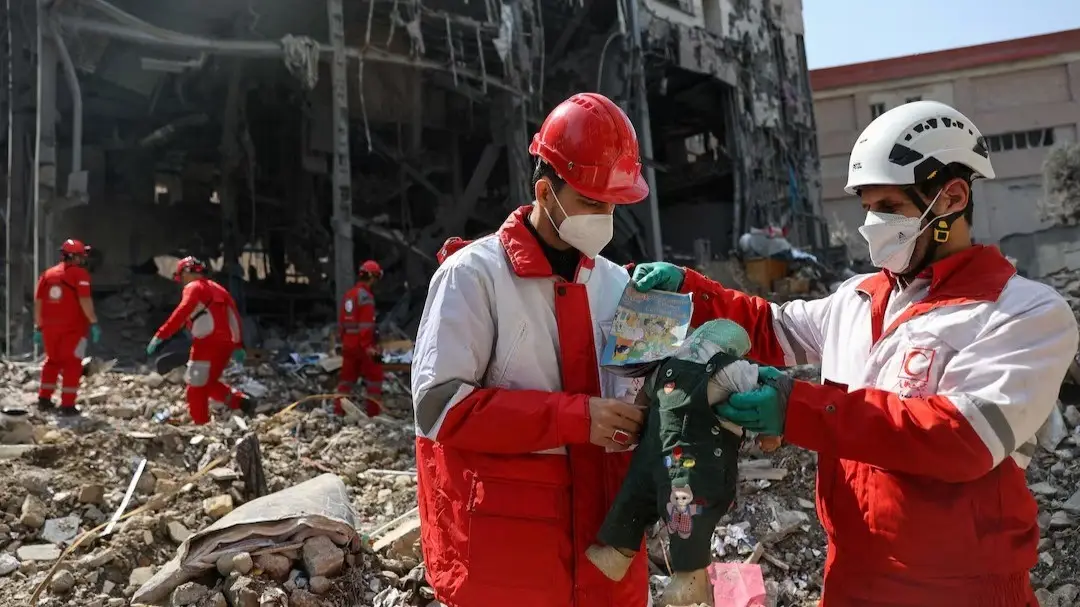
Image credit: Photo by Iranian Red Crescent / UPI
A Witness Account from the Interior of a Nation at War
By Ali Abdi, revised narrative by Daryoush Mohammad Poor
“The truth is that the beginning of this path lies not outside us, but within us.”
— Ali Abdi
◆ ◆ ◆
I. The Landscape of the First Days
It is the first days of Farvardin, the opening of the Iranian new year, the season that ought to carry with it the promise of renewal, and I have come to Tehran to buy a book.
What I find is apocalyptic. The streets are dark and lifeless. An overcast sky, thick with smoke, presses down upon a city that seems to have withdrawn into itself. The passersby I encounter are troubled and sorrowful, not panicked, but laden with a grief that has already settled into the body. A few bookshops around Enghelab Square remain open, holdouts of a cultural ecosystem that has survived revolution, war, and four decades of political turbulence, but may not survive this.
There is a sharp smell of sulphur in the air. Someone points southward and says they have bombed somewhere in the southern districts. A thick black column of smoke has risen into the sky from the direction of Shahr-e Rey.
On Keshavarz Boulevard, I encounter a scene: several men in black carrying Kalashnikov rifles, and a group of people handcuffed to the railings in front of a building, flashlights being shone into their eyes as they are interrogated in the open street. The atmosphere is heavy and terrifying. One of the armed men approaches me from behind and warns that if I do not walk faster, I too will be arrested.
There is none of the usual liveliness of Laleh Park. The food stalls along the boulevard have vanished; neither the park market nor the kiosks are open; and in the darkness, there is no sign of Tehran’s famous cats.
In Valiasr Square, however, I find something else: around a thousand people gathered, carrying Iranian flags. A giant television screen has been erected on one side of the square, and the voice of Mohsen Chavoshi fills the air with the hymn “Hasbi Allah.” A maddah chants in praise of the valour of the first and third Imams, and the crowd chants along with him.
A man climbs onto the platform and speaks of a friend who had been stationed behind a missile launcher and whose two hands were amputated in the hospital. He speaks of another friend: “He was martyred last night. The son of that martyr was born just a few hours ago.”
Most of those gathered in Valiasr Square are women. At least two of them are not wearing hijab. Here, in the midst of a nationalist gathering suffused with religious symbolism, under the watchful apparatus of a state that has made the compulsory hijab a cornerstone of its ideological identity, women are present, unveiled, mourning, resisting, bearing witness.
For twenty-seven days, Iran has been under bombardment by the wicked forces of the world. For more than forty years, Benjamin Netanyahu had wanted to bomb Iran, and in his resignation letter the previous week, the head of the U.S. National Counterterrorism Center wrote that the Israel lobby had dragged Trump into this war. The figures are staggering: one hundred thousand residential and commercial units damaged across Iran; three hundred medical and emergency facilities destroyed or rendered inoperative; five thousand Iranians dead; millions in Iran, Gaza, and Lebanon driven from their homes. And the environmental, psychological, and economic wounds of war remain to be fully felt.
Netanyahu and Trump are the embodiment of human wickedness in the contemporary world: racist, deceitful, greedy, and complicit in the slaughter and suffering of children. Their ultimate aim is to weaken Iran under the banner of “fighting the regime.” Israel was opposed to a strong Iran even before the 1979 Revolution. For fifty years, regardless of which government has been in power, American sanctions have been imposed on the Iranian people. It was the U.S. president who tore up the JCPOA before the cameras, not Iran.
◆ ◆ ◆
II. The Wound Before the War
Before the bombardment began, I was in Isfahan, speaking with a friend I had met through cycling around the city.
He had been arrested on the eighteenth of Dey and had spent a month in Dastgerd Prison. What he told me was a story of institutional cruelty so meticulous in its indifference that it achieved a kind of administrative horror. Two of his cellmates were brothers in their twenties. The younger had asthma. Their mother went to the judge several times, pleading that her son needed medication. The judge refused. The younger brother grew weaker by the day, but the authorities paid no attention. Until, in the final week of his detention, in the crowded and stressful environment of the prison, he fell unconscious. The officials took him to the hospital. The next night, news came that the boy had died.
My friend spoke of the grief that settled over Dastgerd Prison with that news. It descended and stayed. It had nowhere to go.
I then visited a hospital in Isfahan for my father’s surgery. There I encountered another acquaintance who had come for his wife’s treatment. He told me about his sister and brother-in-law, who, on the nineteenth of Dey, were crossing the street when the brother-in-law was shot and killed before his sister’s eyes.
For nine days, the authorities refused to release the body to the family. They offered two choices: pay a substantial sum to retrieve the corpse, or sign a document stating that the deceased had been a supporter of the government and was a martyr. In the end, under psychological pressure, the boy’s mother agreed to sign. The acquaintance told me that his sister still suffers from a speech impairment.
The family was not only bereaved; it was coerced into narrating its bereavement in the regime’s language. The murdered son was transmuted into a “martyr,” a term that, in the Islamic Republic’s lexicon, denotes a defender of the state, not its victim. The mother’s signature was extracted as an act of narrative violence: the state seized control of the story of her son’s death and rewrote it as a story of loyal sacrifice. And the sister, who watched her brother-in-law fall in the street, has lost the capacity for speech. The body registers what language cannot contain.
◆ ◆ ◆
III. Against the Tyranny of Binaries
The media, from Iran International to state television, generally construct binary narratives. They portray two groups of Iranians in opposition to one another so that a story of good versus evil can take shape, and each side comes to see the other as its enemy: pro-regime or anti-regime, pro-war or anti-war, religious or secular.
These binaries are simplifications of a complex social reality. Most of Iran’s population belongs to neither end of these spectrums.
A free Iranian stands against oppression. It makes no difference whether the oppressor is foreign or domestic, whether oppression is carried out in the name of religion or in the name of human rights. A free Iranian stands against discrimination. It makes no difference whether discrimination comes from a racist European or a prison officer, whether it is the product of colonialism or despotism.
A mother whose soldier son has been killed behind a missile launcher, and a mother whose son was killed on the nineteenth of Dey, experience a similar suffering in their humanity. A soldier who has lost both hands behind an air-defence system, and a protesting farmer in Isfahan who lost his eyes to pellet shots, are equally deserving of empathy and care.
Families who spent the moment of the New Year at the martyrs’ cemetery share common experiences with the families of those killed in the Ukrainian plane crash. Kian Pirfalak and the schoolgirls of Minab are equally worthy of attention and mourning.
Our collective well-being depends on bringing these ordinary people closer together. The Iranian phoenix rises from their coming together. To come closer together, we need to become familiar with each other’s lived experiences. This requires listening. Listening is an act of selflessness. And selflessness does not emerge from anger and resentment.
If Iranian society is to pass through this crisis without falling victim to endless violence between people, there is no path but connection with those other ordinary people, that is, stepping out of one’s own epistemic cave, leaving behind self-made tribes, and walking toward those who hold a different worldview, yet share with us in being human, being Iranian, and being Muslim.
The truth is that the beginning of this path lies not outside us, but within us.
◆ ◆ ◆
IV. The Universal Gesture
In these days of war, when Red Crescent workers pull someone from beneath the rubble, they do not ask about that person’s political or religious beliefs. Their service is universal, without favour, without discrimination, effective, and directed toward the preservation of all Iranian lives.
They are among the best practical examples of how to break the prevailing binaries.
The rescue worker does not ask whether the body beneath the rubble belongs to a supporter of the state or an opponent of it. In that refusal, that stubborn refusal to sort the wounded into categories of deserving and undeserving, lies the possibility of a different Iran. Not an Iran liberated by bombs or by the fantasies of exiles who will never bury the dead their strategies produce, but an Iran reconstituted from below, by those who remained, who listened, who extended their hand without first checking the credentials of the one who needed it.
◆ ◆ ◆
Endnotes
[1] Farvardin: The first month of the Solar Hijri (Iranian) calendar, beginning at the vernal equinox (typically 20-21 March). The Iranian New Year, Nawruz, falls on this date.
[2] Enghelab Square: Formerly Shah Square, renamed after the 1979 Islamic Revolution. Located in central Tehran near the University of Tehran, it is the city’s primary cultural and intellectual hub.
[3] Shahr-e Rey: One of the world’s oldest continuously inhabited settlements, identified with ancient Rhages. Today a densely populated, largely working-class district in the southern Tehran metropolitan area.
[4] Keshavarz Boulevard: A major east-west artery in central Tehran, connecting Enghelab Square to Valiasr Square and bordering Laleh Park.
[5] Laleh Park: One of Tehran’s largest public parks, situated along Keshavarz Boulevard.
[6] Valiasr Square: A major intersection in central Tehran where Keshavarz Boulevard meets Valiasr Street.
[7] Mohsen Chavoshi: One of Iran’s most popular singers and songwriters.
[8] “Hasbi Allah”: An Arabic-Qur’anic phrase meaning “God is sufficient for me” (Qur’an 9:129).
[9] Maddah: A practitioner of maddahi, the traditional Shi’i art of devotional vocal performance.
[10] Dey: The eighteenth and nineteenth of Dey (roughly early January) refer to a period of widespread popular protest and violent state crackdown that preceded the outbreak of war.
[11] Dastgerd Prison: A major detention facility in Isfahan province.
[12] JCPOA: The Joint Comprehensive Plan of Action, a 2015 multilateral agreement in which Iran accepted constraints on its nuclear programme in exchange for sanctions relief. The United States unilaterally withdrew in May 2018.
[13] Isfahan: A city in central Iran renowned for its Safavid-era architecture. The Persian proverb “Esfahan nesf-e jahan” (“Isfahan is half the world”) testifies to its historical stature.
[14] Iran International: A London-based Persian-language satellite television network.
[15] Ukraine International Airlines Flight 752: A passenger aircraft shot down by Iranian air defences shortly after take-off from Tehran on 8 January 2020, killing all 176 on board.
[16] Kian Pirfalak: A nine-year-old boy killed during the 2022 “Woman, Life, Freedom” protests in Iran.
[17] Schoolgirls of Minab: Over one hundred schoolgirls killed on 28 February 2026 in U.S. airstrikes on Minab, a city in Hormozgan province in southern Iran.