
Introduction
In my previous assessments of Reza Pahlavi’s political project, published on this blog during the 2026 US–Iran conflict, I employed polemical and emotionally charged language—characterizing Pahlavi as driven by a personal “vendetta with a flag” and deploying the postcolonial epithet “comprador intellectual” to describe his supporters. An independent methodological review of my work found that these critiques, while intellectually sophisticated in their theoretical apparatus, suffered from systematic source omissions, rhetorical overreach, and unfalsifiable framing, arguing that some aspects of my assessment are compromised unless they can be revisited rigorously. As a critical rationalist, my commitment is to constantly subject my own claims to rigorous falsification. This essay represents that process: I have critically assessed my own arguments, exposed them to refutation, and collected the evidence that either corroborates or challenges my initial positions. This is not a defense but a test—a deliberate attempt to see whether my core concerns about Pahlavi’s leadership can withstand methodologically rigorous scrutiny when stripped of polemical rhetoric. I remain open to any further criticism and refutation.
This essay therefore sets aside rhetorical devices in favor of documented evidence, inline citations, and verifiable claims. My central argument is straightforward: Pahlavi’s leadership of the Iranian opposition poses measurable dangers to Iran’s future, not because of who he is, but because of what the evidence reveals—a chief strategist embedded in a neoconservative think tank aligned with foreign military interests, a social media support base substantially manufactured by Israeli intelligence operations, and a pattern of contradictory public statements that undermine his credibility as an independent leader. Each claim that follows is accompanied by its source.
The Ghasseminejad Factor — Architect of a Foreign-Aligned Agenda
Saeed Ghasseminejad occupies a unique and consequential position in Iranian opposition politics. He serves simultaneously as Senior Advisor on Iran and Financial Economics at the Foundation for Defense of Democracies (FDD), a Washington-based neoconservative think tank, and as the chief architect of Reza Pahlavi’s political transition plan. Pahlavi himself confirmed this role, stating that Ghasseminejad “has been leading the process to select individuals for a transitional government” (Times of Israel, January 2026). As Project Director of the Iran Prosperity Project at the National Union for Democracy in Iran, Ghasseminejad prepared a 200-page blueprint for replacing the Tehran regime, encompassing a referendum on constitutional monarchy, elections for a constitutional assembly, and subsequent parliamentary elections (Israel Hayom, January 17, 2026).
The FDD’s website documents Ghasseminejad’s institutional role. The organization was a prominent opponent of the JCPOA nuclear agreement, advised the Trump administration on Iran strategies, and has received funding from pro-Israel donors including Sheldon Adelson and Bernard Marcus. Iran sanctioned FDD and its CEO in 2019, viewing it as an instrument of hostile foreign policy. FDD publications have contemplated scenarios involving “the destruction of Iran’s conventional military capabilities and the killing of key Iranian leaders, including Khamenei and numerous military commanders” (FDD Long War Journal, 2026). This is the institutional home of Pahlavi’s chief strategist.
Ghasseminejad’s own statements go further than his institution’s published analyses. On April 8, 2026, he tweeted: “If the US decides to put boots on the ground, the regime’s ground forces will collapse pretty quickly. What we saw in the rescue operation showed a ground force that is both incompetent and demoralized.” This constitutes an explicit endorsement of a US ground invasion of Iran by Pahlavi’s most senior advisor. On April 13, 2026, he welcomed a naval blockade: “Great to see that President Trump has asked the US Navy to impose a blockade. This should have happened long ago.”
Perhaps most troublingly, Ghasseminejad has employed language that dismisses civilian casualties. On April 10, 2026, he wrote: “When they get killed, human rights organizations count them as minors and civilians. These ‘children’ have killed thousands of Iranians so far and they will kill more.” Placing “children” in scare quotes while dismissing human rights documentation represents a deeply problematic stance for someone designing a country’s democratic transition. He has also labeled Pakistan the “HQ of Sunni terrorism,” characterizing an entire nation of 230 million people with inflammatory rhetoric. The conflict of interest is structural: an employee of a think tank funded by pro-Israel donors and aligned with neoconservative US foreign policy priorities is simultaneously selecting personnel for a future Iranian government. As critic Jessica Emami argued in the Times of Israel, this dual role demands his resignation from the transition planning role.
Israeli Influence Operations and Manufactured Consent
Two major investigative reports published in 2025–2026 documented the extent of Israeli involvement in manufacturing support for Pahlavi’s political project. The first, published by Al Jazeera on January 15, 2026, analyzed the #FreeThePersianPeople hashtag campaign using Tweet Binder data analytics. The investigation found that 94 percent of 4,370 analyzed posts were retweets generated by a small network, while only approximately 170 accounts produced original content—yet the campaign reached over 18 million users. This massive disproportion between content sources and reach is the signature of astroturfing, not organic activism.
The campaign’s narrative was pre-packaged: it reframed Iranians’ economic and social grievances into a geopolitical binary (“The People vs. The Regime,” “Freedom vs. Political Islam”) and promoted Pahlavi as the sole political alternative. Israeli government figures participated directly—Minister of National Security Itamar Ben-Gvir posted in Persian calling for “the fall of the dictator,” and former Prime Minister Naftali Bennett’s tweets were widely circulated within the network. Al Jazeera concluded that the campaign was “not a spontaneous digital expression of internal Iranian anger” but “a politicized information operation constructed outside Iran and led by networks linked to Israel.”
The second investigation, published by Haaretz on October 3, 2025, in collaboration with the Citizen Lab at the University of Toronto, provided even more granular evidence. Based on five sources with direct knowledge of the project, the investigation revealed that a large-scale digital influence campaign in Persian was operated out of Israel, funded by a private entity receiving government support. Native Persian speakers were recruited to operate hundreds of fake accounts on X and Instagram, posing as Iranian citizens. AI tools generated content including deepfake videos—one titled “Next Year in Free Tehran” depicted Netanyahu, Gila Gamliel, Pahlavi, and their spouses walking through Tehran’s streets.
The most damning evidence concerns the Evin Prison strike of June 23, 2025. At approximately 11:15 AM, Israel struck Tehran’s Evin Prison. By 11:52 AM—before Iranian media had reported the attack—network accounts began posting about “explosions in the prison area,” designed to appear as eyewitness reports from nearby residents. A fabricated video of the explosion was distributed; the New York Times later confirmed it was not authentic footage. Citizen Lab concluded: “We believe that while it is technically possible, it is highly unlikely that any third party without advance knowledge of the IDF’s plans would have been able to prepare this content and post it in such a short window of time.” Additional disinformation included a fake BBC Persian news report about senior Iranian officials fleeing the country, which BBC Persian confirmed it never published. This was the apparatus that Pahlavi pointed journalists toward when he said, “Don’t take my word for it, search on social media… The answer is right before your eyes”—social media that was being systematically manipulated by Israeli intelligence operations.
Contradictions in Pahlavi’s Public Positions
A chronological examination of Pahlavi’s public statements reveals contradictions that extend beyond normal political evolution into territory that raises fundamental questions about credibility. The most consequential concerns foreign military intervention. In April 2024, Pahlavi declared military action against Iran a “red line” (NCRI report). By February 2026, he told ABC News that he supported a “targeted attack” on Iran’s nuclear facilities and repressive apparatus, characterizing this as “humanitarian intervention to protect more lives.” On Fox News on February 28, 2026, he described US–Israeli strikes as “aid” to help Iranians topple the regime. Yet just weeks earlier, on January 6, 2026, he told the Wall Street Journal: “I don’t think it’s a matter of any kind of outside intervention, either a military or a special ops kind, because I think the regime is collapsing” (Jerusalem Post).
The monarchy question presents a parallel ambiguity. Pahlavi consistently states that the future form of Iran’s government must be decided by referendum (POLITICO). He has said, “I really don’t have any expectations because I think the most honorable label is no label… I am Reza Pahlavi” (Reddit, r/NewIran, April 2023). Yet he has never disavowed the possibility of monarchical restoration, his supporters chant royalist slogans at demonstrations, and the Israeli-operated social media campaign documented by Haaretz used the hashtag #KingRezaPahlavi. Meanwhile, his transition plan—authored by Ghasseminejad—pre-designates Pahlavi as head of the transitional government, with Ghasseminejad himself selecting its members. Critics, including a Times of Israel blogger, described the plan as creating “a vast power vacuum during the transition” while concentrating decision-making authority in the hands of an FDD employee.
On foreign government relationships, Pahlavi’s 2023 Israel visit—facilitated by then-Intelligence Minister Gila Gamliel, who referred to him as “the Iranian crown prince”—occurred against the backdrop of what Haaretz would later reveal as an Israeli intelligence operation to manufacture support for his political project. As Israeli analyst Raz Zimmt of the Institute for National Security Studies observed, most Iranians want change but “are dreaming about leading a normal life, not the restoration of the monarchy,” and Israel’s open alignment with Pahlavi “reinforces Ayatollah Khamenei’s narrative that Israel and the U.S. want to turn Iran back into a monarchy and client state.” Publicly observable developments also suggested a pattern of fraying alliances: Masih Alinejad, Hamed Esmaeilion, and Nazanin Boniadi each took distance from Pahlavi’s political line, while his remaining circle appeared increasingly reliant on a narrower group of hardline advisers.
Why This Matters — The Danger to Iran’s Future
The evidence presented in this essay does not rest on speculation or rhetorical framing. It draws on two major investigative reports (Al Jazeera, Haaretz/Citizen Lab), verified social media statements with URLs, Pahlavi’s own interviews with mainstream outlets, and documented analyses from his chief advisor’s institutional platform. The picture that emerges is of an opposition leader whose political infrastructure is compromised at multiple levels: his chief strategist serves a foreign think tank whose institutional interests may diverge from Iranian welfare; his social media support base has been substantially manufactured by a foreign intelligence operation; and his public positions shift in ways that suggest responsiveness to external patrons rather than internal constituency.
For Iran’s future, the stakes are existential. A transition led by figures selected by an FDD employee, amplified by Israeli intelligence operations, and legitimized through manufactured social media consent would not constitute genuine self-determination. It would reproduce, under democratic branding, the very pattern of foreign-imposed governance that has defined Iran’s modern tragedy—from the 1953 coup to the present. The Iranian people deserve leadership whose independence is not a rhetorical claim but an observable fact, whose advisors serve Iranian interests rather than foreign institutional agendas, and whose popular support is organic rather than algorithmically fabricated. The methodological rigor of this assessment—every claim cited, every source verifiable—is itself the argument: when the evidence is allowed to speak without rhetorical embellishment, the case against Pahlavi’s leadership is stronger, not weaker, than the polemics suggested.
References
Investigative Journalism
Al Jazeera. (2026, January 15). “Network linked to Israel pushes to shape external Iran protest narrative.” Al Jazeera article
Megiddo, G. & Benjakob, O. (2025, October 3). “The Israeli Influence Operation Aiming to Install Reza Pahlavi as Shah of Iran.” Haaretz/TheMarker, joint investigation with Citizen Lab, University of Toronto. Haaretz article
Citizen Lab, University of Toronto. (2025). “Prison Break” report on pro-Israel Persian-language influence campaign. Published in tandem with Haaretz investigation.
Mainstream Media Interviews and Reports
ABC News Australia. (2026, February 27). “Crown prince Reza Pahlavi on US military intervention in Iran.” ABC News article
Fox News. (2026, February 28). “Reza Pahlavi calls US-Israel strikes aid to help topple Iran regime.” Fox News article
The Jerusalem Post. (2026). “Iran’s exiled prince: ‘The real threat is the regime itself.’” Jerusalem Post article
POLITICO Europe. (2025). “Reza Pahlavi: Iran’s exiled prince has a plan for regime change.” POLITICO article
El País (English). (2026, April 6). “Iranians respond to US threats to send them back to the Stone Age.” El País article
Iran International. (2026, February 14). “Pahlavi Urges West To Tighten Sanctions As Iran War Rages.” Iran International article
Social Media Sources (X/Twitter)
Ghasseminejad, S. [@SGhasseminejad]. (2026, April 8). “If the US decides to put boots on the ground…” View tweet
Ghasseminejad, S. [@SGhasseminejad]. (2026, April 10). “When they get killed, human rights organizations…” View tweet
Ghasseminejad, S. [@SGhasseminejad]. (2026, April 8). “As the Islamic Republic of Pakistan, HQ of Sunni terrorism…” View tweet
Ghasseminejad, S. [@SGhasseminejad]. (2026, April 13). “Great to see that President Trump has asked the US Navy…” View tweet
Ghasseminejad, S. [@SGhasseminejad]. (2026, April 10). “As long as the regime exists it will use Iran’s wealth…” View tweet
Critical Analyses and Commentary
NCRI. (2026). “Reza Pahlavi: Foreign Pawn, Regime’s Useful Tool Exposed by Iran War.” NCRI article
Emami, J. (2026). “The agenda behind FDD employee Saeed Ghasseminejad’s ‘Iran Regime Change’ booklet.” Times of Israel Blogs. Times of Israel blog
Atlantic Council. “The hidden friction with Reza Pahlavi and the Iranian opposition.” Atlantic Council article
Malakut Blog. (2025, May 26). “نگونبختی سیاسی رضا پهلوی” (The Political Misfortune of Reza Pahlavi). Malakut blog post
Foreign Policy in Focus. “The Pahlavi Mirage.” FPIF article
Foundation for Defense of Democracies. Team page: Saeed Ghasseminejad. FDD team page
——–
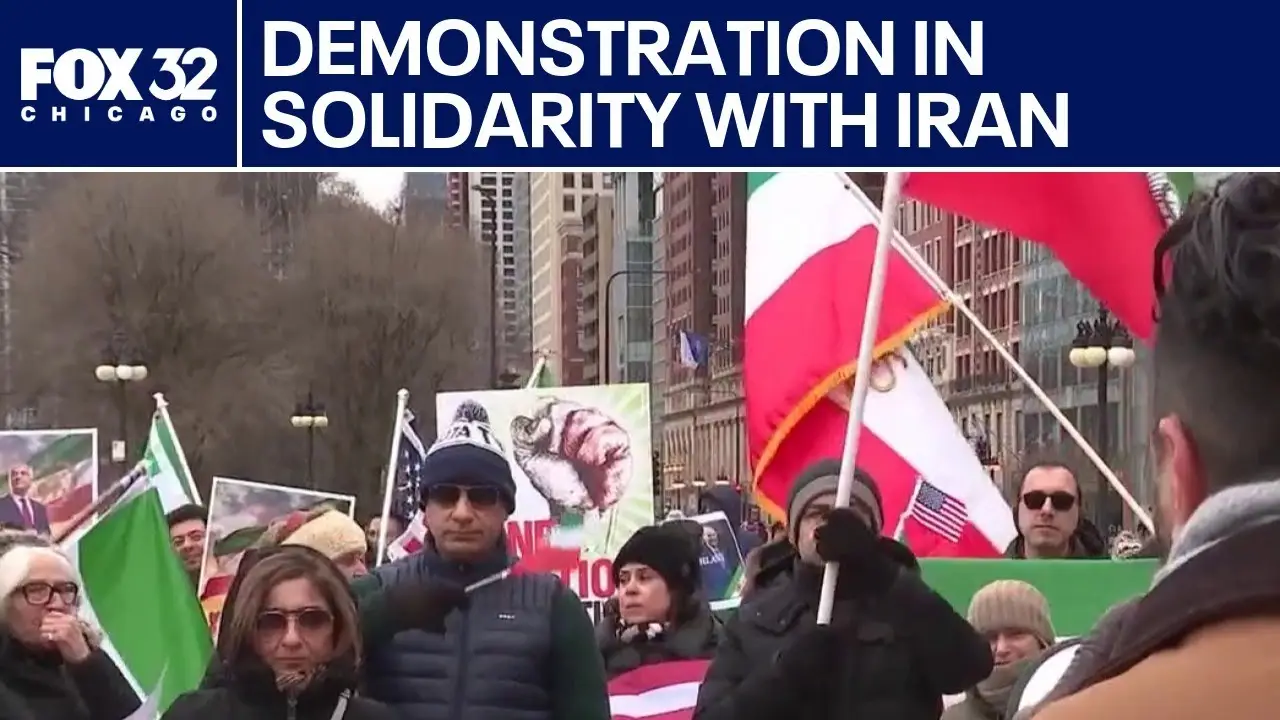
Image: Iranian protest scene — solidarity demonstration for democratic self-determination in Iran. Photo credit: Unsplash (free to use under Unsplash License). Source: unsplash.com/iran-protest