
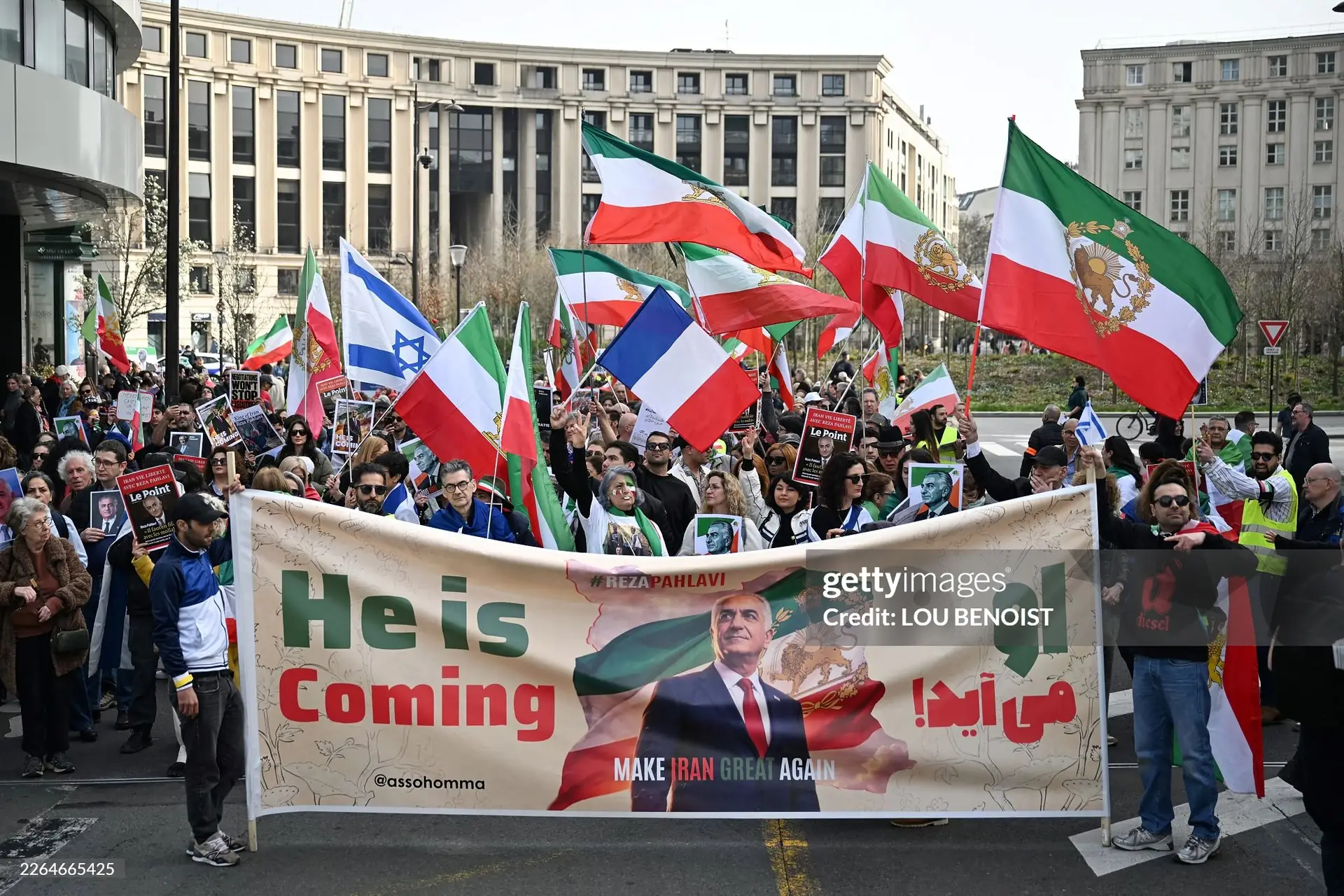

Supporters of Iran’s last crown prince, now key opposition figure, Reza Pahlavi hold a banner reading “He is coming – Make Iran Great Again” and depicting a portrait of Reza Pahlavi during a march for Iran in Paris on March 7, 2026, amid the ongoing war in the Middle East. (Photo by Lou BENOIST / AFP via Getty Images)
Not as a solution for Iran, but as a symptom of a deeper political failure
Reza Pahlavi remains important in Iranian political life — but not for the reasons his supporters imagine. He is important not because he represents a serious path forward for Iran, and not because he has demonstrated the strategic capacity, political discipline, or intellectual clarity required of a transitional leader. He matters for a harsher reason: he is the name of a recurring Iranian temptation.
That temptation is the search for deliverance through symbol rather than structure, through inheritance rather than legitimacy, through projection rather than programme.
For a time, I did not see this clearly enough. In the early phases of the Woman, Life, Freedom movement, I allowed myself to think that perhaps Reza Pahlavi could develop into something useful: not a monarch in waiting, but a limited transitional figure, someone capable of lending visibility to a democratic opening without attempting to own it. That possibility evaporated quickly. What became visible instead was not strategic patience but political vagueness; not principled restraint but chronic ambiguity; not leadership, but the repeated conversion of public attention into hollow expectation.
This is why the question must be framed carefully. Is he important? Yes. Is he relevant in the sense of being genuinely equal to the historic tasks before Iran? Much less so.
The distinction matters. Public importance and political relevance are not the same thing. A figure can be highly visible, heavily discussed, emotionally charged, and still be deeply inadequate to the moment. Indeed, one of the great confusions of exilic politics is the tendency to mistake recognisability for competence, surname for seriousness, and media circulation for moral authority.
Reza Pahlavi endures because he names a vacancy. He occupies the psychological space created when a society, exhausted by tyranny and repeated betrayal, becomes susceptible to symbolic shortcuts. At such moments, names become vessels. People pour into them longing, rage, nostalgia, grief, and the desire for resolution. But a vessel is not yet a vision. And inherited visibility is not the same thing as earned political credibility.
This is where much of the debate has gone wrong. His critics have sometimes dismissed him too lightly, as though he were merely noise. His admirers, by contrast, have persistently inflated him into an answer. Both mistakes obscure the deeper point. Reza Pahlavi is significant neither as mere distraction nor as viable saviour, but as a diagnostic case. He reveals how easily democratic aspiration can be captured by pre-democratic forms of imagination.
That is why he should be examined critically. Not obsessively, and not theatrically, but seriously. A society that cannot accurately describe the figures it elevates will repeatedly misrecognise its own dangers. Naming is not a trivial act. Political clarity begins with the refusal to call things by names they have not earned.
What, then, has Reza Pahlavi actually represented in practice? Above all, an ambiguity that has been politically costly. He has tried, for years, to benefit simultaneously from incompatible constituencies: those who want a constitutional monarch, those who want a republic, those who want merely a famous surname as temporary scaffolding, and those who treat him as dynastic destiny. This ambiguity has often been presented as tactical flexibility. In reality, it has functioned more like evasion. Where a transitional moment demands precision, he has too often offered elasticity. Where democratic seriousness demands institutional language, he has too often relied on symbolic surplus.
The problem is not simply that he has failed to deliver. Many figures fail. The deeper problem is that he has helped sustain a style of politics in which charisma without accountability, inheritance without examination, and prominence without programme can continue to masquerade as national leadership. That style of politics does not prepare a people for democratic transition. It prepares them for another cycle of dependency.
For that reason, the issue exceeds one man. Reza Pahlavi matters because phenomena like him matter. Whenever a wounded public begins to seek rescue in bloodline, myth, or spectacle, it is already drifting away from the habits democracy requires: judgement, scrutiny, institutional thinking, and the discipline of refusing easy substitutes for hard political work.
The proper response, then, is neither hysteria nor indifference. It is diagnosis. He should be treated as a politically consequential symptom — not because he embodies Iran’s future, but because he reveals a persistent weakness in how too many still imagine it.
And until that weakness is confronted, new versions of the same illusion will continue to arise, under different names, with different faces, and with the same costly promise that history can be escaped by handing oneself over to a symbol.