
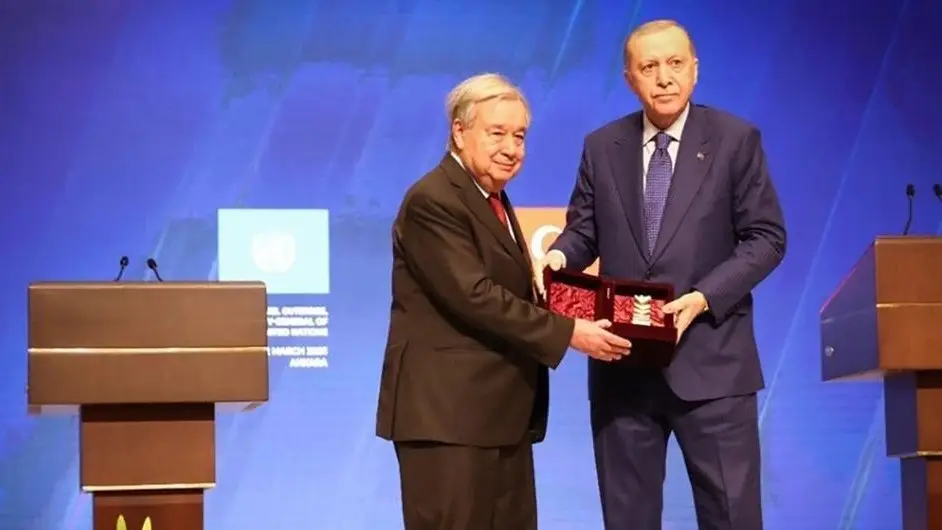
UN Secretary-General António Guterres receives the Ataturk International Peace Prize from President Erdogan of Türkiye in Ankara.
Responding to Critics with Analysis, Not Ideology
The critics demand evidence, baselines, cost accounting, enforcement mechanisms. Fair enough. Here are the direct answers that prove the ceasefire argument stands on analysis, not wishful thinking.
What would invalidate this position? Documented collapse of 25% of Iranian command architecture. Confirmed destruction of 40% of missile production facilities. Verifiable IRGC leadership defections. Iranian proxy forces showing 50% operational degradation. Intelligence intercepts of regime capitulation discussions. Bank runs and bread riots in major Iranian cities.
None of this has materialized. Iranian strikes continue at comparable sophistication. Tehran’s political control remains stable. The proxy network functions. No significant defections. Instead, there are indications of external resupply improving Iranian capabilities. Three weeks in, the trajectory points toward stalemate, not collapse. That’s not ideology—that’s reading evidence without wishful thinking.
Now the full cost ledger. Continuation imposes three to five billion dollars monthly, aircraft and personnel losses, munitions depletion that can’t be quickly replaced. Oil volatility adds ten to fifteen dollars per barrel—thirty to forty-five cents per gallon at American pumps. The CPAC fractures are real: Erik Prince warning of burning warships, Matt Gaetz saying this will make America poorer and less safe, eighteen-year-old Republican voters articulating the strategic dead-end more clearly than administration officials. Each week creates 15 to 20% probability of catastrophic miscalculation: Strait of Hormuz closure, direct Russian or Chinese involvement, nuclear acceleration.
Ceasefire costs? Regional actors might interpret de-escalation as exhaustion. Tehran consolidates current capabilities. Israeli politics face strain. Iranian hardliners claim vindication.
Here’s the asymmetry: continuation costs are immediate, cumulative, and escalatory. Ceasefire costs are primarily perceptual and manageable through strong diplomatic framing and retained military options. If three weeks haven’t significantly degraded Iranian capabilities—and evidence suggests they haven’t—then stopping now concedes little that operational reality hasn’t already conceded. The question is whether to acknowledge that reality now or after another month of mounting costs.
Viable ceasefire terms exist. Seventy-two hour cessation. Mutual return to pre-conflict postures, no deployments within 200 kilometers of contact zones. Iran directs proxies to halt operations; Israel ceases strikes on proxy infrastructure. Iran returns to JCPOA monitoring—IAEA inspectors, cameras at Natanz and Fordow.
Verification through satellite monitoring with US, Russia, China sharing early-warning data, drawing on Cold War confidence-building measures. IAEA weekly inspections. Oman and Qatar monitoring teams. Enforcement through graduated response: minor violations trigger UN emergency sessions; major breaches restore military options with snap-back provisions. Russia, China, US serve as guarantors. Sanctions relief tied to compliance, automatic reimposition for violations. This architecture worked in Camp David, INF Treaty, and Dayton—imperfect but vastly superior to undefined continuation.
The three-week timeline matters because the relevant comparison isn’t Desert Storm or Kosovo against inferior opponents. It’s Vietnam showing futility within six months of 1965 escalation, Soviet-Afghanistan within a year, post-invasion Iraq within four months. Three weeks is sufficient to identify trend-lines. Iranian capabilities aren’t degrading week-over-week. Initial strikes didn’t produce strategic surprise—Iran absorbed them and maintained operations. Washington still hasn’t articulated measurable end-states beyond vague deterrence restoration. The domestic coalition is fraying, not strengthening.
If decision-makers envisioned six or twelve-month campaigns, they should have said so and built political support. They didn’t, which means either the plan was rapid victory that hasn’t materialized, or there was no plan. Neither justifies continuation without fundamental reassessment.
Iranian response to ceasefire offers provides intelligence value regardless of outcome. If Tehran accepts, it signals rational calculation that pause serves their interests—consolidation, demonstration of resilience, or genuine cost pressures. All suggest mutual exhaustion, which produces sustainable ceasefires. If Iran rejects reasonable terms, that forces Washington and Jerusalem to confront whether they can sustain operations long enough to change Tehran’s calculus. Either way, the offer clarifies strategic reality currently obscured by operational drift.
The strongest objections deserve direct answers. “Ceasefire rewards aggression” assumes unprovoked Iranian attack, oversimplifying escalation dynamics. More fundamentally: if operations don’t degrade Iranian capabilities significantly, continuation rewards no one—it wastes resources. Deterrence was demonstrated. Diminishing returns have set in.
“We need more time—victory is achievable” requires proponents to show operational plans and secure political support. Without credible plans and realistic timelines, “give it more time” isn’t strategy—it’s hope masquerading as analysis.
“Intelligence shows Iranian weakness” deserves skepticism given track records: Iraq WMD, Afghanistan government resilience, Russian military competence. Three weeks should have revealed weakness publicly. Absence of visible progress raises reasonable doubts.
“Regional allies demand continuation” confuses allied preferences with American interests. Israel faces existential threats; Gulf states want permanent Iranian degradation. But US interests include avoiding forever wars, preserving readiness for China competition, and preventing oil shocks. Allied preferences are one input, not the sole determinant.
The deterrence collapse scenario is overstated. Deterrence was demonstrated through three weeks of operations showing capability and willingness. Continued operations without clear objectives may undermine deterrence more than structured ceasefire by suggesting strategic confusion. Regional actors assess interests, not symbolism—they accommodated Iran after Afghanistan withdrawal, not after rational de-escalation following demonstrated force.
Opportunity costs are stark. Continuation diverts assets from Indo-Pacific competition with China. Munitions depletion weakens deterrence against China and Russia. Rising oil prices benefit adversaries. Prolonged conflict alienates European allies and lets China position as peacemaker. These are concrete, immediate costs. Ceasefire costs are perceptual and manageable.
History provides clear guidance. Korea 1953 worked: military exhaustion, great-power guarantors, clear lines, both sides claiming victory. Egypt-Israel 1974 succeeded through US mediation and verification. Iran-Iraq 1988 came after mutual exhaustion made continuation unbearable. Bosnia 1995 worked after NATO demonstrated force, combined with credible enforcement.
Failed ceasefires—Syria 2016, Yemen 2022—collapsed because guarantors lacked neutrality, no genuine verification existed, and parties believed military victory remained achievable. The distinguishing pattern: success requires mutual exhaustion, great-power guarantors, verification mechanisms, political cover for all sides, and realism that total victory is unachievable.
Current conditions match the success pattern. Costs accumulate for all parties. Great-power involvement is possible. Technology enables verification. Framing allows victory claims. No side achieved decisive advantage. These conditions produced Korea 1953, not Syria 2016.
The ceasefire argument withstands scrutiny because it rests on rigorous analysis, not ideology. It provides falsifiable standards, accounts for costs on both sides while showing continuation costs are larger, offers implementable terms with historical precedent, engages opposing arguments directly, interprets deterrence realistically, and learns from which ceasefires succeeded.
This is strategic assessment comparing imperfect alternatives honestly. Continuation costs are immediate, cumulative, escalatory. Ceasefire costs are perceptual and manageable. The trajectory points toward deeper entanglement without corresponding gains. The window for structured de-escalation closes as external actors deepen involvement and domestic coalitions fracture.
Every additional week benefits Iran strategically by allowing adaptation, external assistance, and American political exhaustion to compound. The demonstration of force occurred. Credibility is established. The question now is whether leaders can distinguish between demonstrating resolve and persisting in operations showing diminishing returns.
History will judge whether leaders recognized when continuation costs exceeded plausible gains and had the strategic discipline to stop before the trap closed entirely. The time to stop is now—while structured ceasefire with verification and enforcement remains achievable, before the conflict metastasizes into something no one controls.
That’s not defeatism. It’s realism. And in strategy, realism is not optional.