
Get new essays in your inbox
Subscribe to receive the latest critical observations on Iran, politics, and the Muslim world.
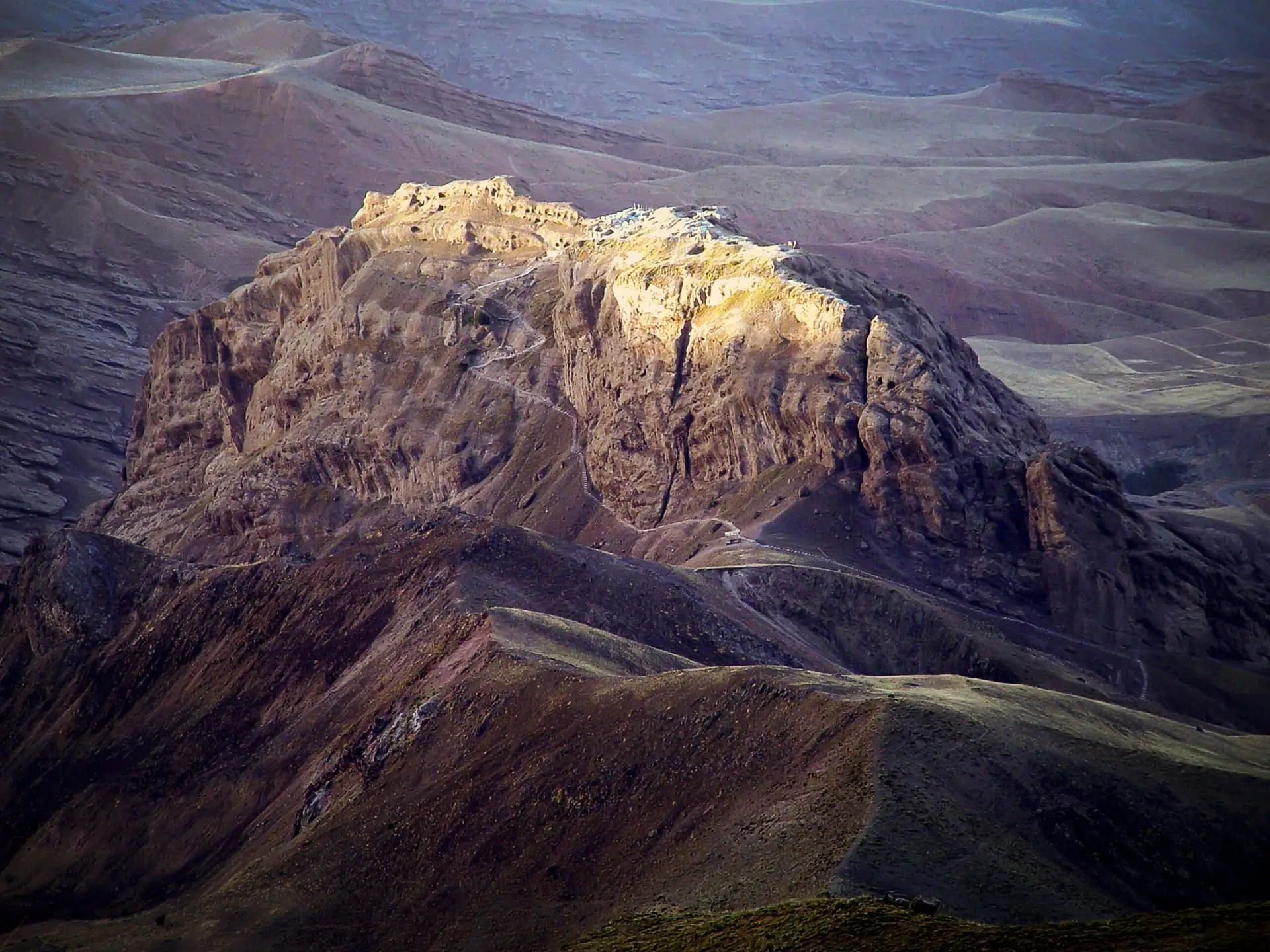
Date: 13/09/2003 | Photo: Mohammad Mahmoudi |Copyright: © ACHB
On the inscription of Alamut, and the inheritance the citation does and does not name
The item took a few minutes. On Sunday, in Busan, the World Heritage Committee inscribed Alamut Castle and six associated fortifications – Lambesar, Navizaršāh, Šams Kelāyeh, Qosṭinlār, Širkūh and Ilān – on the World Heritage List. It is Iran’s thirtieth cultural property. The nomination file runs to volumes and the citation runs to a paragraph, and the paragraph contains a sentence that eight centuries of writing about that rock has declined to write. From the late eleventh century, Alamut served as the political, military and intellectual centre of the Nizārī Ismailis. The fortified network was a refuge and a scholarly and cultural hub, and it sustained the community until the castle fell in 1256.[1]
Intellectual centre. Scholarly hub. Read those words with the polemical record open beside them.
What the record said instead
The rock has a longer career in European prose than in Persian scholarship, and it is a career built almost entirely out of invention. The Crusaders met Nizārīs in Syria and not in Iran, took the honorific of a Syrian leader for a title of legend, and carried home a word. Marco Polo transcribed hashāshīn and Europe acquired ‘assassin’. Farhad Daftary has shown how the legends thickened: each chronicler and envoy took the accounts of his predecessors as the ground for his own additions, until within a century the whole apparatus had passed into circulation as a reliable description of what these people did.[2]
None of this would matter much if the fabrications had stayed in the twelfth century. They did not. In the literature on political violence that swelled after 2001, Robert Pape describes a sect that built an organisation for the planned and systematic use of political murder, sustained by suicide missions; the description is a reconstruction of medieval material out of parts manufactured after September 2001. Gérard Chaliand and Arnaud Blin give nineteen pages to the Ismailis and four to the Zealots, retell the discredited story of Niẓām al-Mulk’s killing, and compare the domestic police and intelligence services of the Seljuq empire with those of the United States.[3]
Set against that, consider Marshall Hodgson, who is the earliest scholar of any standing on this subject and who is nobody’s apologist. Hodgson wrote in 1955 that any discussion of where assassination sat in Nizārī state policy could only be tentative, since murder was common enough among their opponents, and since deeds claimed by the Nizārīs may have been claimed for reasons of their own. That word, tentative, did not survive the crossing into political theory. It was received as settled.[4]
What was made on the rock
Alamut was a place of refuge, in the technical sense the sources give it: a dār al-hijra, a defensible ground on which a community could be gathered and a teaching worked out. The teaching was the doctrine of taʿlīm, and its argument is unusually plain for its period. Is the intellect on its own sufficient for knowledge of God? If it is, then anyone at all may reach that knowledge unaided, and no path can claim to be better than another. If it is not, a teacher is required, and the teacher must be both expert and truthful. What the truthful teacher teaches is not information but tawḥīd, and the Imam of the time is the one who teaches it. Four steps, no Neoplatonic scaffolding, and a conclusion that reorganised everything around it.
Out of that came the rest. The declaration of qiyāmat in 1164, which located the inner ethical content of the ritual law above its outward performance for those who had reached the stage of ahl-i waḥdat, under conditions that were anything but lax. The rearticulation of imāmat by al-Shahrastānī, whose influence on every later Nizārī text is now established. The corpus attributed to Naṣīr al-Dīn al-Ṭūsī and written on that rock or within its orbit: Rawḍa-yi taslīm, Sayr wa suluk, Āghāz wa anjām, Maṭlūb al-muʾminīn, Tawallā wa tabarrā. And a shift in language that has outlasted the doctrine’s obscurity, because it is with these people that Persian, and no longer Arabic, becomes the working language of the Nizārī tradition for the next several centuries.[5]
There is also the poetry, which is the closest thing we have to the self-image of the fidāʾīs. The Dīwān-i qāʾimiyyāt praises men who wore their love as a helmet and their knowledge as armour, who brought light to life like candles through the longing of faith. Belief and hope run through those odes, and there is no trace in them of nihilism or despair. They describe fighting and not ambush. They describe men of no rank distinct from anyone else in the community. Whatever the fidāʾīs were, they were not a secret order, and they were certainly not the drugged automata of Polo’s imagination.[6]
The nomination came from an uneasy quarter
The state that filed this dossier has never been at ease with the people whose centre it is now celebrating. In March 2000, a week after the attempt on the life of Saeed Hajjarian, a reformist newspaper in Tehran ran an essay identifying Ḥasan-i Ṣabbāḥ’s fidāʾīs as the predecessors of the men who had shot him. In May 2014, during a televised argument, a reformist journalist objected that comparing Ayatollah Khomeini with Ḥasan-i Ṣabbāḥ was an insult to Khomeini. One side offered the comparison as praise and the other rejected it as slander, and neither paused to ask whether it had any grounds at all.[7]
So the minister’s language in Busan was worth listening to closely. He called the inscription a symbol of Iran’s civilisational identity and dedicated it to the people of the Alamut valley, whom he named as the true custodians of the site. There is nothing wrong with any of that. It is also entirely compatible with a heritage regime that arrives as masonry and departs as a visitor figure. Defensive architecture, spatial organisation, conservation budgets, a new stop on the northern circuit. None of it obliges anyone to open the Rawḍa-yi taslīm.[8]
Stone is the easy part
In March I wrote about a growing tendency, inside Iran and in the diaspora, to amputate fourteen centuries of Islamic inheritance from the definition of what it is to be Iranian, and to reach backward past that inheritance for a purer origin. This week the state performed the opposite gesture, and the opposite gesture is not automatically the corrective. An Ismaili site can be absorbed into a national inventory precisely by being emptied of what made it Ismaili. The fortress becomes Iranian patrimony; the theology stays where the polemicists left it.
I should also correct my own emphasis. Ten days ago, writing about the school at Minab and the filing category under which its dead were placed, I treated heritage chiefly as something at risk from ordnance, which is a defensive way of holding the question. That was too narrow. A site can be structurally sound, fully funded, and comprehensively misunderstood.
The other thing the citation cannot carry is that this is not an extinct people. The community whose intellectual centre stood on that crag survived 1256, went into concealment, re-emerged at Anjudān, moved with the Imamat to India and then to East Africa and then outward again, and now lives in more than 25 countries under a line of succession it has never broken. Its Imamat holds no state and governs no territory beyond the Seat in Lisbon. That is a rarer thing in the history of religion than a ruined castle, and no committee has a category for it.[9]
Our future, I have argued elsewhere, is the intelligent use of our past and of anybody else’s past. A rock entering a list is not that use. It is the invitation to it. The library that was burned at Alamut cannot be recovered, but a good deal of what was written there has been edited, translated and published over the last fifty years, and almost none of it is read by the people who now own the postcard. The inscription is welcome. The reading is the work.
Postscript
In March 2023 I spent an hour on Shirazeh, the BBC Persian books programme, talking about the one book through which most Iranians have met these people: Khudāwand-i Alamūt, published under the name of a French author, Paul Amir, and rendered into Persian by Zabīḥ Allāh Manṣūrī. Whether Paul Amir ever existed is disputed in Persian criticism. What is not disputed is that Manṣūrī’s practice was adaptation on a heroic scale, and that the result runs to some 670 pages.
I read it as a young man and enjoyed it. I have since watched it arrive in conversation again and again. Two occasions stay with me, because of who was speaking. When Parviz Meshkatian learned that I was Ismaili, this book was the first thing he reached for. So, on another occasion, did Houshang Ebtehaj. Sayeh, of all people. It stands between Iranians and their own past on this subject, and it stands there because nothing else was on the shelf.
The trouble starts on the opening pages, where one bazaar legend about the Ismailis is dismissed and another is installed in its place. Manṣūrī turns away some of the wilder stories and then builds his account on a secret society with an organised hierarchy and men trained to die on command. He gives the Ismailis a centralised economy resembling a communist state. His preface tells the reader plainly what the book is for: the movement of Ḥasan-i Ṣabbāḥ was not only religious, and the man meant to free Iran from the Abbasid caliphs and their local clients. The closing pages have Persian pushed forward and Arabic pushed back, and a national feeling that had slept for centuries waking up.
The error the whole thing rests on is simpler than any of that. In Manṣūrī’s telling it is Ḥasan-i Ṣabbāḥ who declares the qiyāmat. He did not. He died in 1124. The resurrection was proclaimed at Alamut in 1164 by Ḥasan II, four decades later, and it is the most consequential act in the history of the community. Fusing the two men dissolves the distinction between the founder of a state and the Imam who lifted the outward law, which is to lose the thought altogether.
The book knows. An explanatory note was added to a later edition setting out that the qiyāmat came after Ṣabbāḥ and was declared by Ḥasan II. The correction is printed. The story is what people remember. That is the whole difficulty in one volume, and no committee sitting in Busan can reach it.
Declaration on the use of AI
The argument, the sources, the selection of evidence and the interpretive judgements in this essay are my own. An AI assistant was used for drafting support, verification of the news record, consistency checking and production of the file. No source has been introduced that I have not supplied or verified.
[1] UNESCO, ‘World Heritage Committee 2026’, forty-eighth session, Busan, Republic of Korea, decision of 26 July 2026, at https://www.unesco.org/en/world-heritage/committee-2026. The World Heritage Centre’s property page (https://whc.unesco.org/en/list/1770) was not yet live when this was written; the wording summarised here is that of the Committee’s own description of the serial property.
[2] Farhad Daftary, The Assassin Legends: Myths of the Ismaʿilis (London: I.B. Tauris, 1994), 95. On the Syrian encounter and the figure of Rāshid al-Dīn Sinān, see Daryoush Mohammad Poor, ‘Secular/Religious Myths of Violence: The Case of Nizārī Ismailis of the Alamūt Period’, Studia Islamica 114 (2019), 47–68, at 51.
[3] Robert A. Pape, Dying to Win: The Strategic Logic of Suicide Terrorism (New York: Random House, 2005), 13; Gérard Chaliand and Arnaud Blin, The History of Terrorism: From Antiquity to Al Qaeda (Berkeley: University of California Press, 2007), 67. Both are examined in Mohammad Poor, ‘Secular/Religious Myths of Violence’, 54–56.
[4] Marshall G. S. Hodgson, The Order of Assassins: The Struggle of the Early Nizārī Ismāʿīlīs Against the Islamic World (The Hague: Mouton, 1955), 111; discussed in Mohammad Poor, ‘Secular/Religious Myths of Violence’, 62.
[5] Daryoush Mohammad Poor, ‘Nizārī Ismailis: History, Geography and Beliefs’, Illinois Geographer 65, nos 1–2 (Fall/Spring 2023). On qiyāmat and the conditions attaching to it, see also Naṣīr al-Dīn al-Ṭūsī, Shiʿi Interpretations of Islam: Three Treatises on Theology and Eschatology (London: I.B. Tauris, 2010), 42–43.
[6] S. J. Badakhchani (ed.), Dīwān-i qāʾimiyyāt (Tehran: Mīrāth-i Maktūb, 2011), 179, translated in Mohammad Poor, ‘Secular/Religious Myths of Violence’, 61.
[7] Mohammad Poor, ‘Secular/Religious Myths of Violence’, 51 n. 3, on the essay of 16 March 2000 by Mohammad Ali Mohammadi in Sobh-e Emrooz, and 54 n. 5, on the exchange between Mohammad Qouchani and Abdolreza Davari of 20 May 2014.
[8] Seyed Reza Salehi-Amiri, Minister of Cultural Heritage, Tourism and Handicrafts, remarks at the forty-eighth session of the World Heritage Committee, Busan, 26 July 2026, reported in ‘Alamut Fortress Added to UNESCO World Heritage List’, WANA, 26 July 2026.
[9] Daryoush Mohammad Poor, Authority without Territory: The Aga Khan Development Network and the Ismaili Imamate (New York: Palgrave Macmillan, 2014); and Mohammad Poor, ‘Nizārī Ismailis: History, Geography and Beliefs’.
Leave a Reply