
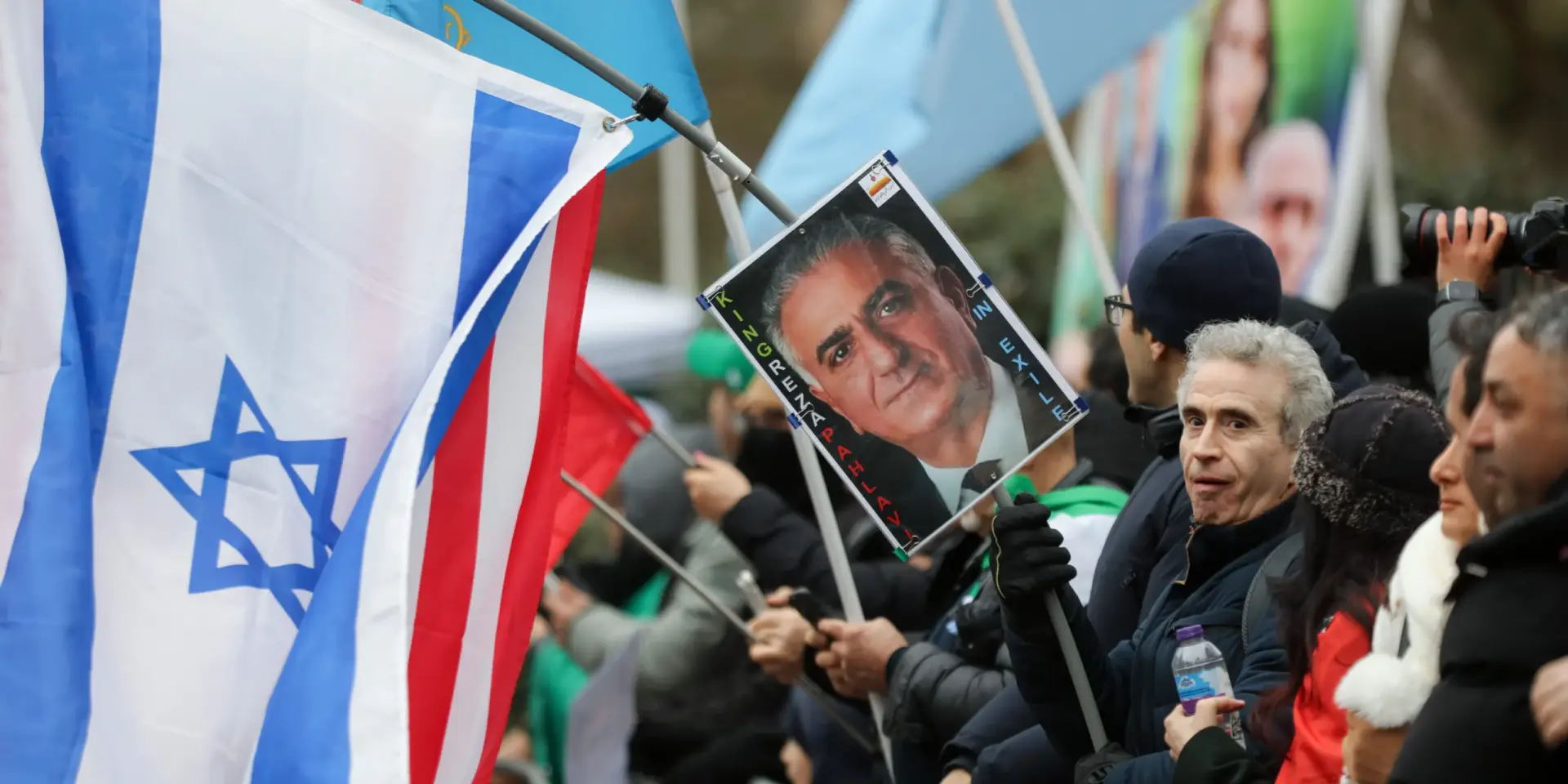
AP Photo / via The Intercept
On Reza Pahlavi, the Monarchist Fallacy, and the Corruption of Logic
A ceasefire has come into effect between the United States, Israel, and Iran. For most rational observers, this is a moment of cautious relief—a pause in a war that has already claimed nearly two thousand lives and wounded tens of thousands more. But for one man and his devoted followers, the ceasefire is an inconvenience. At CPAC in Texas barely ten days ago, Reza Pahlavi urged America to “stay the course” in its bombardment of his own country. He wants the war to continue. Let that sink in.
The Question That Answers Itself
“What is the alternative to Reza Pahlavi?”—this is the monarchist camp’s favourite question, deployed as both shield and sword. It presupposes that Pahlavi is already the default leader of the Iranian opposition, and that anyone who disputes this must first produce a superior candidate. The question is designed to end debate, not to open it. But it collapses under the lightest scrutiny.
Reza Pahlavi has no alternative—not because he is indispensable, but because he has made himself impossible to compete with in sheer ineptitude and moral vacancy. He is, as the Americans who once courted him now openly say, a “loser prince” and a “useful idiot.” A US intelligence assessment shown to President Trump concluded that Pahlavi possesses no meaningful network inside Iran. He has not set foot in the country in nearly fifty years. His every major political intervention—from the Woman, Life, Freedom movement to the current war—has ended in devastation for the very people he claims to represent. No one can rival this record of failure. In that sense alone, indeed, what is the alternative?
The Slogan That Reveals Everything
The monarchist camp has a slogan: “Marg bar seh fasad: Akhund, Chap-i va Mojahed” —“Death to the three corrupts: the Mullah, the Leftist, and the Mojahed.” This is not a throwaway chant. It is the philosophical skeleton of the entire movement. Examine what it does: it eliminates anyone with religious convictions from the political arena. It eliminates anyone with leftist tendencies. It eliminates the revolutionary organisations that participated in the 1979 uprising. In a single slogan, the monarchist camp has excommunicated every major ideological current in Iranian politics except itself.
This is precisely the mechanism they claim to despise. For forty-seven years, the Islamic Republic’s Guardian Council has disqualified rival candidates to create the illusion of choice in elections. Pahlavi’s camp performs the identical operation—not through legal authority but through rhetorical extermination. They declare the field empty, then point to the emptiness as proof of Pahlavi’s uniqueness. It is a conjuring trick disguised as political logic.
The Mirror Image of What They Oppose
The monarchist worldview is binary to the point of caricature. They are the truth, the whole truth, and nothing but the truth. Everyone else is falsehood. The Islamic Republic divided the world into the axis of good and the axis of evil; the monarchists have simply reversed the labels while preserving the identical structure. When you define the world in black and white—when you insist that your camp alone represents virtue and that all others embody corruption—you have not created a democratic alternative. You have created a monarchy in waiting with the psychology of a theocracy.
Political leadership is not inherited. It is not bestowed by lineage, nor is it validated by a nostalgic mythology about a grandfather’s modernisation programme. Leadership is earned through demonstrable competence, moral clarity, and the ability to unite—not to exclude. By every one of these measures, Reza Pahlavi fails.
The Moral Catastrophe
In recent months, as American and Israeli bombs fell on Iranian soil, 168 children were killed. Reza Pahlavi said nothing. Not a single word of mourning for his “own compatriots,” his “own fellow countrymen.” Instead, he appeared at CPAC, wrapped in the rhetoric of “Make Iran Great Again,” urging Trump not to negotiate but to press on with the bombardment. His supporters, in London, Washington, Toronto, Vancouver, Paris, Berlin, and Munich, took to the streets waving Israeli flags and dancing in celebration of the strikes.
Twice in the past year, this camp has refused to condemn the violation of international law. They support military intervention because they have concluded—in their desperation—that no internal solution exists, that international institutions are impotent, and that therefore the law itself is redundant. This is not the posture of a liberation movement. It is the posture of native informants cheering on foreign bombardment of their own people. It is the recipe, as history has shown repeatedly, for civilisational disaster.
The Corruption of Logic
The monarchist argument ultimately reduces to this: “Anything is better than the Islamic Republic.” This is the sum total of their intellectual proposition. It is born not of reason but of hatred so all-consuming that it has devoured the capacity for basic moral judgement. If anything is better than the status quo, then a man who stays silent when children are murdered, who applauds foreign powers bombing his homeland, and who eliminates all ideological competitors through a slogan of death—that man, too, is acceptable.
But logic is not selective. If the monarchists can say “anything but the Islamic Republic,” then by the same principle, anyone can say “anything but Reza Pahlavi.” The formula works in both directions. And when it does, the monarchist edifice collapses, because stripped of the “no alternative” claim, Pahlavi has nothing to offer—no organisation, no domestic support, no moral authority, no track record of competence, and no vision beyond performative allegiance to whichever foreign power will have him.
A Principled Position
The ceasefire—however fragile—is a moment of truth. It reveals who wanted peace and who wanted war. Reza Pahlavi wanted war. He urged it, promoted it, and celebrated it from the comfort of his Maryland suburban home. His followers wanted war. They marched for it in Western capitals while Iranian families buried their dead.
The principled position is simple: no authoritarian voice—whether it wears a turban or a crown—has the right to tell a nation of ninety-three million people that it alone holds the truth and everyone else is evil. The fight against the Islamic Republic’s authoritarianism does not end at its borders; it must also confront the authoritarianism that presents itself as the cure. Reza Pahlavi is not the alternative to the Islamic Republic. He is its mirror image, dressed in a Western suit, speaking from a CPAC podium, asking a foreign army to do what he could never do himself.
He has no alternative—because he has made himself uniquely, spectacularly unfit for the role he claims. And until his followers can see past their hatred long enough to recognise this, they will remain trapped in the very cycle of authoritarianism they believe they are fighting to end.
Leave a Reply to مرد بیجانشین – ملکوت Cancel reply