
Artificial intelligence, the objection to creation, and what a myth can and cannot settle
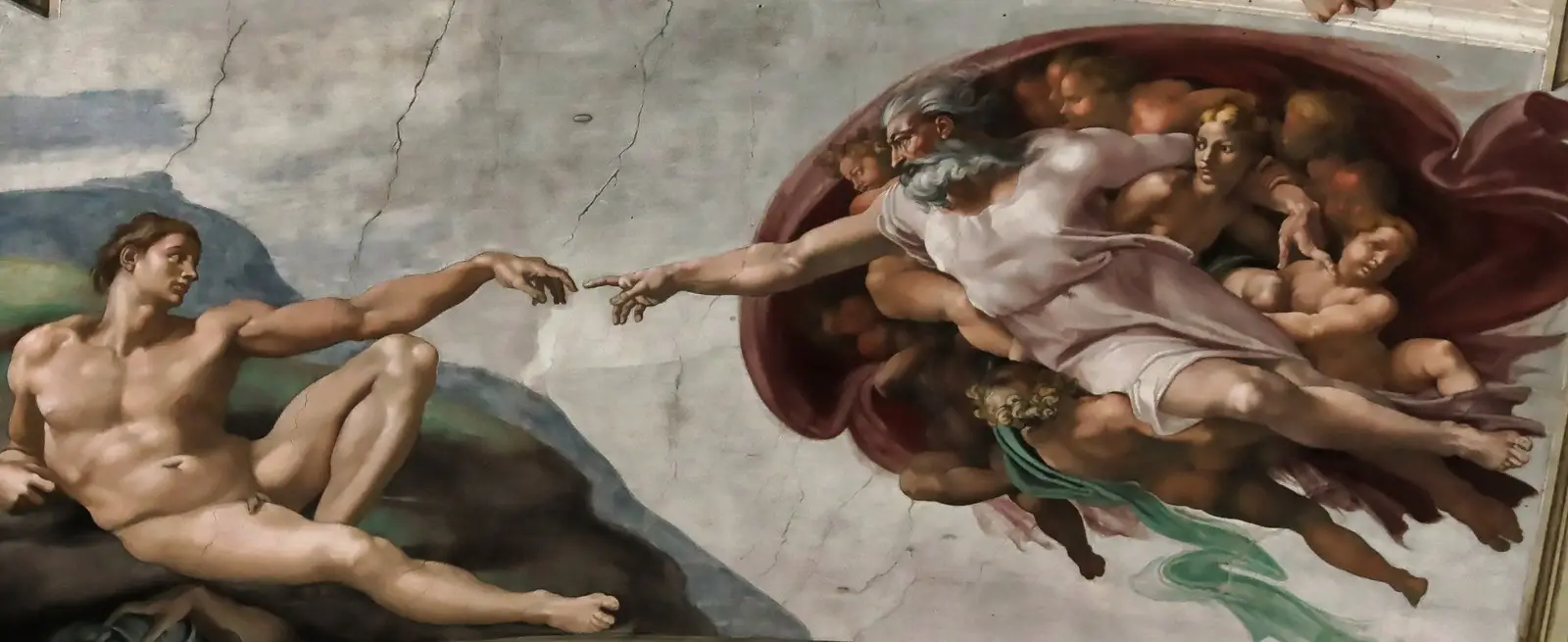
Michelangelo, The Creation of Adam, c. 1511, Sistine Chapel ceiling, Vatican City. Photograph: Burkhard Mücke, 18 October 2017, via Wikimedia Commons. Public domain.
The objection arrives before the creature does. God tells the angels He is placing a khalīfa on earth, a deputy holding authority on another’s behalf, and they answer back before the clay has set: will You put there one who will work corruption and shed blood, while we sing Your praise? (Q 2:30) It reads like a risk assessment. The angels reason from what the creature is made of to what it will do. Corruption followed. So did the blood.
The parallel came to me during a conversation with Farid Panjwani, and I have not managed to leave it alone since. Substitute the terms. Human beings make a thing that thinks. Other human beings, who did not make it and do not want it, object that it will corrupt and that it will get away from us. Three parties in the story, three parties now: maker, made, and the onlooker who warns. Even the grammar survives the translation.
I want to take the parallel seriously enough to find where it breaks.
Start with what holds. The angels’ argument is an induction. They know the material and they infer the outcome, and the inference is good enough that few readers of a newspaper would dispute it. The present objection to artificial intelligence has the same shape. Whether it carries the same strength is what the evidence has to settle. The International AI Safety Report 2026, written by more than a hundred experts from thirty countries and published on 3 February, records that general-purpose systems are improving in the capacities a loss of control would require, autonomous operation among them, while still lacking the capability to bring one about, and that expert opinion on the likelihood varies widely. A Nature paper of 14 January found that fine-tuning a model on one narrow harmful task produced broad misalignment on unrelated ones. Its authors wrote that a full explanation remains open. Neither result supports the apocalypse. Both support the worry. The angels were in that same position. Correct about the mechanism, with no way to date the consequence.
Now the breaks. There are three. Each costs somebody something.
The first is the answer. God’s reply runs to four words in English: I know what you do not know. It settles the matter because of who is speaking. No party to the argument about AI occupies that position. The ones who behave as though they do are the makers. A laboratory that tells a regulator the risks are real but managed, on evidence held internally, is making the divine move without the divine standing. I have argued since May that the object of regulation is the maker and not the tool, and I would argue it still. The myth shows me something I did not say plainly enough then. The maker who claims privileged knowledge of his own creation is the one figure in the story whose word cannot be checked, which leaves a maker-only regime incomplete. Deferring to the chiefs of AI because they are the ones who know is taqlīd, acceptance of a ruling on the authority of whoever issues it. I have said before what that habit costs.
The second is the faculty. What follows the objection in the Qur’ān is a demonstration. God teaches Adam the names, all of them, and has him recite what the angels could not (Q 2:31–33). His warrant is the capacity to know, and the angels are shown it. Artificial intelligence receives no such faculty. It receives a corpus. What we have built is assembled out of what we have already said, which makes it the inverse of Adam in the one respect that carried the argument. If a system acquires a capacity that was absent from what it was trained on, the judgement fails. I would want to be shown it.
The third is sovereignty. In the story the creator never loses the thread. Adam is free, and the freedom is granted inside an order that holds. That order is what is now being surrendered. Generative systems are being fitted with agents, given tools and set to work over long horizons. The same Report notes that evaluating an agent’s reliability gets harder as its autonomy and tool access grow. The angels objected to a creature whose maker still knew the answer. We are objecting to one whose makers say the evaluation is getting harder.
Is it unprecedented, then? I doubt it, and I doubt it for the reason my own notes caught before I could smooth it over. Most things have looked unprecedented on arrival. Socrates said writing would ruin memory. But that observation earns nothing on its own, because a charge you can always make is a charge that never has to be tested. Name what would count as precedent. I cannot find an earlier case in which the artefact was being revised by its makers while the argument about it was still running. How much that continuous revision matters, I have not measured.
The way out is where the myth helps least. The angels are not answered by argument. They are told to bow, and the one who refuses is expelled over rank rather than risk, which is no model for anything. What survives is smaller and more useful than a resolution. The objection was neither silenced nor wrong. It was overruled by a knowledge claim that happened to be true, the corruption and the blood came anyway, and the story never pretends otherwise.
Keep the objectors in the room, and refuse the makers the verdict on their own work. It is the point I have pressed about pedigree and about the two positions that leave the same question standing. Whether the thing should have been made is a question that closed the moment it was.
This essay began in a conversation with Farid Panjwani, Dean of the Institute for Educational Development at the Aga Khan University, Karachi. The parallel is his prompting. The use I have made of it, and any error in it, is mine.
Leave a Reply