
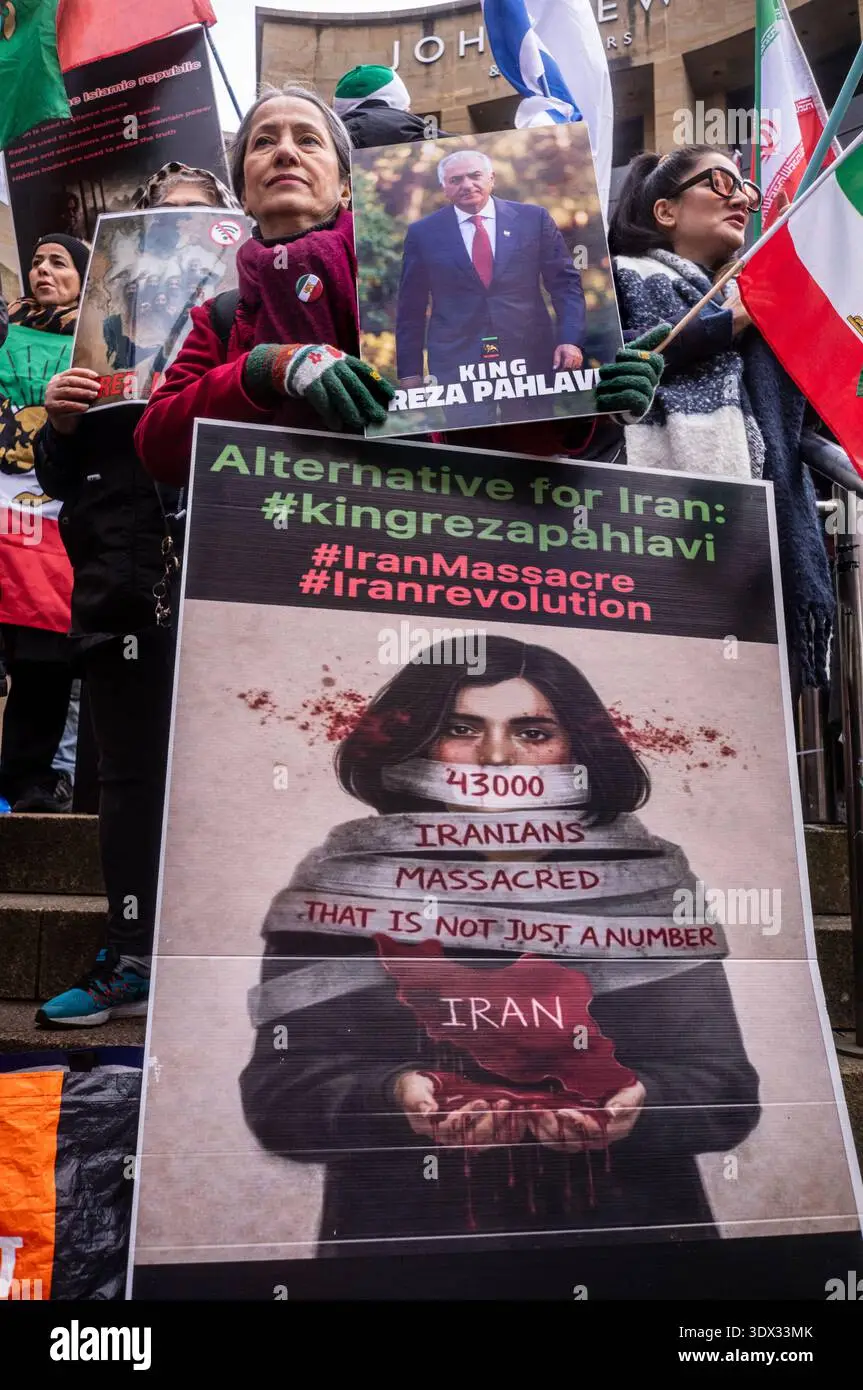
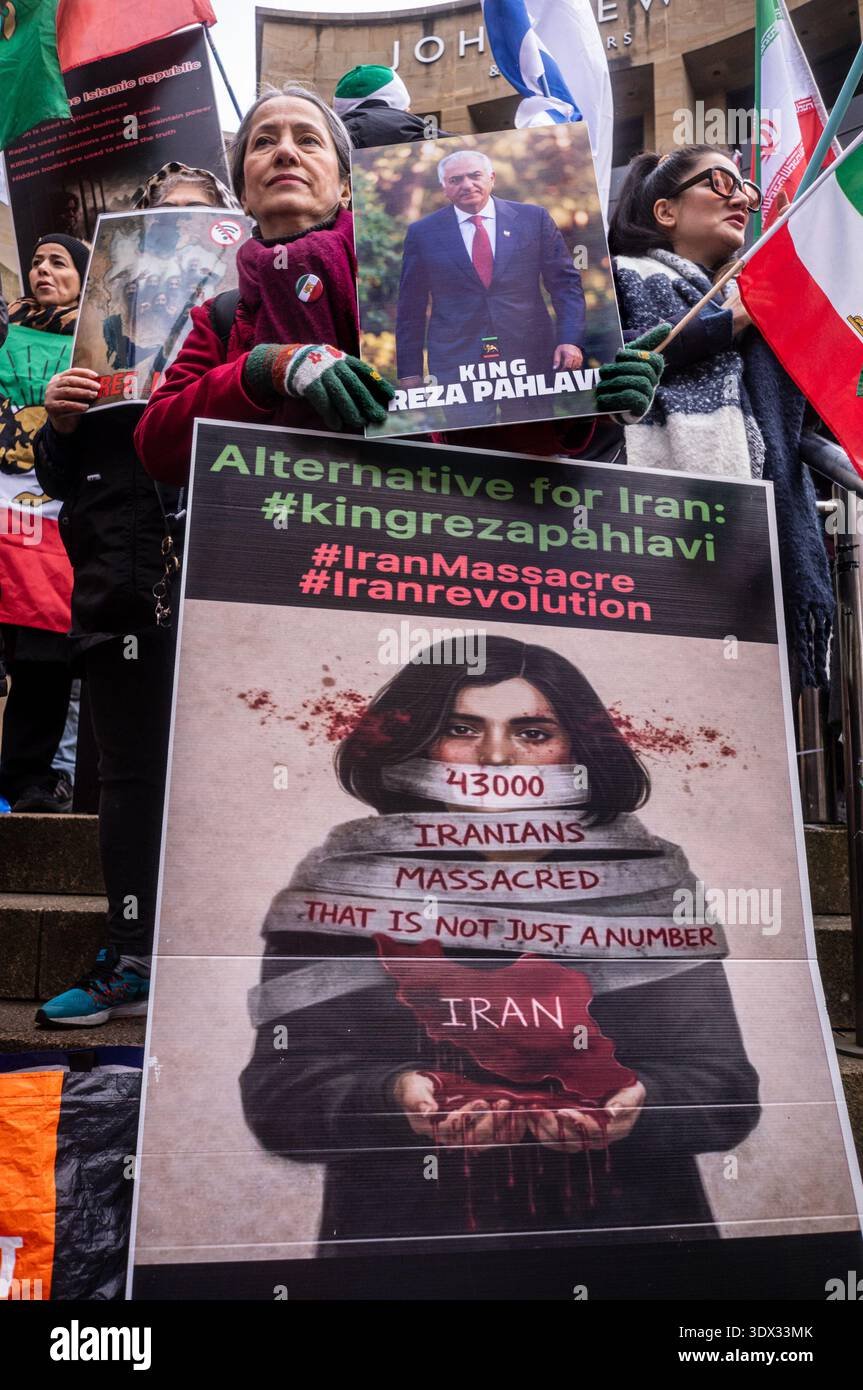
A pro-monarchy demonstrator in Glasgow holds a placard that includes a reference to SAVAK. The event, on February 28, 2026, was a rally celebrating US-Israeli strikes on Iran.
Over the past year, the global perception of Iranians has shifted in a direction that neither passport indices nor the slogan-politics of a loud exilic faction can register. Under sanctions, bombardment and the machinery of media caricature, ordinary Iranians have conducted themselves with a composure that Europeans and North Americans have begun, quietly, to notice. This essay argues that the shift is real; that the myth of a lost universal esteem — that all Iranians were once revered and are now despised — must be named and refused; and that while a loud diaspora, still litigating 1979, cannot see the shift, a quieter and wiser diaspora has long been reading it correctly.
A Portuguese friend, trained in anthropology, Faranaz Keshavjee, wrote to me recently that the forty-seven seconds of Tehran footage looped on her evening news did not square with the voice-over. The voice-over spoke of a horrific theocracy that must disappear; the footage showed women in Zara-adjacent outfits eating ice-cream, men in sunglasses, a bazaar going about its business. She asked, with the honesty of someone untrained to choose a side, whether she was reading her own screen correctly. She was. Her question could not have been posed by most of the louder Iranian exiles of my generation, because the apparatus through which they process Iran was sealed shut in the winter of 1979 and immunised, in the Popperian sense, against every subsequent refutation.
My first submission is that something has shifted in how Iranians are encountered abroad, and the shift is not an artefact of self-regard. The evidence is modest, anecdotal and cumulative, and precisely for that reason social scientists ought to take it seriously. An Iranian passenger at a Frankfurt taxi rank is waved to the front of the queue by a driver following the news. A Lisbon greengrocer presses a second pomegranate into her customer’s bag and refuses payment. A Toronto professor tells her seminar that the most composed work she has received this term came from a student whose cousins were being bombed. None of this appears in any index. All of it circulates, person to person, in the ordinary transactions by which reputations are formed.
The second submission is that this shift has been produced not by diaspora advocacy but by the conduct of Iranians inside the country — the very population a loud segment of the diaspora addresses as a silent object awaiting liberation. Under sanctions that have hollowed out the middle class, under a war economy imposed from without and an ideological economy imposed from within, Iranians have continued to run schools, stage concerts, publish poetry, conduct weddings and bury their dead with a dignity no foreign observer can entirely unsee. The women walking through Tehran with their hair uncovered are not staging a photo-op for a Washington think-tank; they are negotiating, piecemeal and at real risk, the terms of their own ordinary life — a form of moral seriousness legible even to audiences who cannot name a single Iranian poet.
It is imperative to name a myth that has hardened into diaspora common sense: that all Iranians, before 1979, enjoyed a universal esteem that has since been forfeited, and that we now carry an unearned stigma. The myth is seductive because it contains a fragment of truth — the green Pahlavi passport did open certain counters at certain airports — and dangerous because the fragment has been inflated into a metaphysics. Pre-revolutionary Iranians abroad were, like every other migrant population, a mixed constituency whose standing varied by class, language, comportment and the prejudices of their hosts. Orientalist caricature did not begin in 1979; nor did European warmth towards Iranians end there. What changed was the arrival of a regime whose conduct supplied new material to old caricatures. To say that Iranians were once universally revered and are now universally suspect is to trade a complex sociological reality for a consoling fairy tale.
Here a loud segment of the exilic diaspora misreads the score. The typical polemical post that circulates in Farsi these days — and such posts are abundant — rehearses a familiar choreography: a catalogue of real grievances, a rewinding of the tape to 1979, and the nomination of a single legitimate heir who alone can restore the train to its rails. The diagnosis of diaspora vanity is often sharp and in many respects just. The prescription, however, reproduces the very structure it condemns: a politics of restoration staged in Paris or Los Angeles, addressed to an Iran that no longer exists. The binary my Portuguese friend was cautioned against — the people want regime change / the people are content with theocracy — is the same binary the loud diaspora keeps reinscribing in monarchist, republican and leftist variants alike.
But the diaspora is not monolithic, and to speak as though it were would reproduce the very error under examination. Alongside the loud faction there is a quieter diaspora that has been reading the situation correctly for some time — scholars, physicians, engineers, teachers and unshowy artists who carry Iran in their work rather than their slogans. They mentor students without auditioning for television, fund clinics and archives without branding them, translate without proselytising, and decline the invitation to convert grief into spectacle. They are less vocal and more resolute; less photogenic and more useful; less certain about the next slogan and more disciplined about the next decade. Much of the shift this essay traces has been prepared, invisibly, by their conduct.
There is a structural reason for the louder faction’s blindness. Exile, as Said reminded us, is first a condition and only afterwards a vantage point; when the condition hardens into an identity, the vantage point narrows. A self-understanding predicated upon 1979 has a powerful incentive to keep the catastrophe freshly lit, because the alternative — conceding that Iranians inside the country are now generating their own reputations without exilic intermediation — is to concede that the forty-nine-year vigil may not have been the axis around which Iran was turning. The vigil has had its dignities. But dignity is not accuracy, and grief, however earned, is not a method.
What, then, should be said to the interlocutor trying in good faith to read past her evening news? The answer is not a counter-slogan but an invitation to attend to the texture of ordinary Iranian life — the cousin’s wedding, the school run, the queue at the bakery — and to the parallel conduct of the quieter diaspora whose daily work has been slowly restoring what the louder faction imagines was permanently lost. A theory that cannot be refuted by any observation has become a creed; a politics that cannot be revised by the conduct of those in whose name it is conducted has become a performance. Iranians inside the country, together with the wiser part of the diaspora outside it, are conducting the actual refutation. The question is whether the rest of us will learn from them, or go on carrying, in Hafez’s phrase, a smiling lip over a bleeding heart — mistaking the bleeding for the argument.