
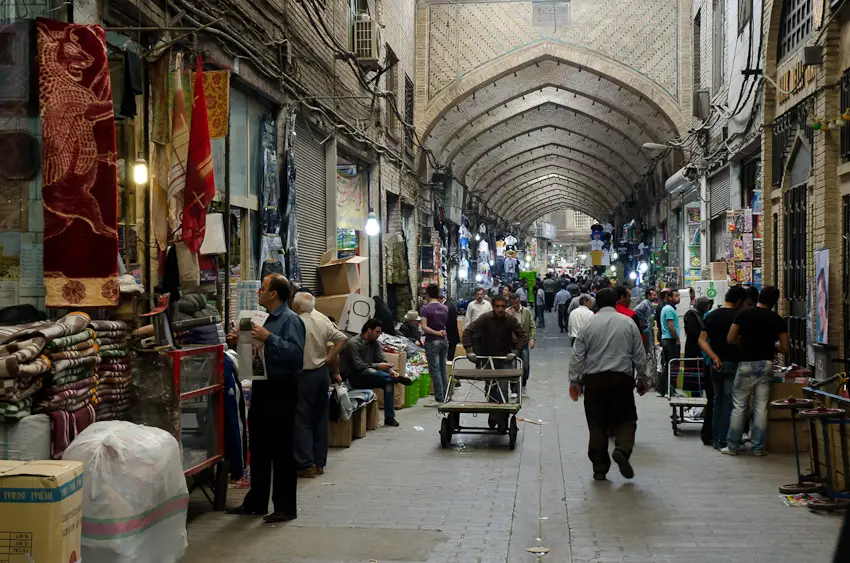
Hazrati Alley in Tehran’s Grand Bazaar, April 2011—captured just before the most stringent international sanctions were imposed. The image shows the bustling daily commerce and the civilian economic fabric whose protection is at the heart of the argument that follows.
On Sanctions, the Temptation of a War Economy, and the Quiet Labour of Breaking the Cycle
A reflection on a conversation between Hossein Hamdieh and Esfandyar Batmanghelidj in the Borj series.
The sanctions doctrine rests on a falsified premise. For a century, economic coercion has been justified to Western publics as an alternative to military conflict. The empirical record shows the opposite: sustained economic pressure on industrialised states increases the probability of armed confrontation. This is not a marginal effect or a contested interpretation. It is the dominant pattern. The oil embargo on Japan precipitated Pearl Harbour. Maximum pressure on Iran, sustained from 2012 through 2025, has now been crowned by direct American military strikes. The theory fails its own test.
What Esfandyar Batmanghelidj identifies, in his recent conversation with Hossein Hamdieh, is the structural logic beneath this failure—what he terms the cycle. Economic pressure generates domestic instability. Instability, at sufficient magnitude, becomes the justification for the military intervention that economic coercion was purportedly designed to avoid. This is not rhetorical flourish. It is pattern recognition. The question Batmanghelidj places before us is simultaneously intellectual and political: how does one interrupt a cycle when every institution—military, bureaucratic, ideological—has configured itself to perpetuate it?
My purpose here is not summary but analysis. I take up Batmanghelidj’s diagnosis and extend it through three domains: the falsifiability problem in sanctions theory, the regional architecture required to break the cycle, and the structural temptation of the war economy. Each domain reveals hidden assumptions that, once made explicit, dissolve certain comforting binaries and clarify the actual decision space.
The Sanctions Doctrine and the Problem of Self-Immunisation
Premise one: economic coercion is presented as a substitute for armed conflict. Premise two: if this claim were empirically sound, we would observe a negative correlation between sanction intensity and subsequent military engagement. What we observe instead is a positive correlation. Nicholas Mulder’s The Economic Weapon documents this pattern across a century. More careful economists warned in the 1920s that accumulating pressure on large economies tends to make war more likely, not less. The prediction has been borne out repeatedly.
A falsifiable theory, confronted with systematic disconfirmation, would be revised or abandoned. The sanctions doctrine has instead been immunised through auxiliary hypotheses: sanctions were insufficiently comprehensive; the target regime was unusually resilient; the next iteration will succeed. What cannot be entertained—because it would destabilise too many institutional commitments—is that the core premise is wrong. This is Popperian self-immunisation: the theoretical framework survives not through empirical adequacy but through the continuous addition of ad hoc protections.
Batmanghelidj observes that the sanctions imposed under Obama in 2012 and rebranded as Trump’s maximum pressure in 2018 are substantially identical. This dissolves the partisan narrative by which American liberals reassure themselves that present cruelty is a Trumpian aberration rather than bipartisan structural logic. The cruelty is encoded in the system. Iran has been constructed, across decades and administrations, as a target rather than a negotiating partner.
The Ideological Incoherence Hypothesis
A second binary requires dismantling: the current American administration characterised as either civilisational crusader or transactional deal-maker. Batmanghelidj’s diagnosis is more precise and, I submit, correct: the obstacle is not excessive ideology but insufficient ideological coherence. Incoherence is the problem.
This matters because a segment of Iranian opinion has convinced itself that Western antagonism is metaphysical—that an independent Iran is ontologically intolerable to the West. If true, diplomacy is theatre and fortress politics the only rational posture. But the historical record contradicts this. The United States has negotiated settlements with governments whose ideology it finds repugnant—Vietnam, contemporary Syria—when structural conditions align. To foreclose diplomacy on civilisational grounds is sophisticated fatalism, and fatalism is typically the rationalisation of abdicated agency.
The task is harder and less dramatic: identify the political conditions under which agreement becomes possible, and cultivate them. Batmanghelidj’s suggestion that transformative diplomacy—a non-aggression framework, explicit mutual economic benefit, regional normalisation architecture—may be required rather than narrow technical fixes deserves examination. These are not utopian aspirations. They constitute the minimal vocabulary of any durable settlement.
The Regional Horizon as Strategic Depth
Thesis: the decisive plane of action has shifted from bilateral (Iran-US) to regional (Iran-Gulf). This is not a geographical observation but a structural one. The seven years of diplomatic groundwork towards normalisation with Riyadh, Doha, and Abu Dhabi was not sentiment. It was the construction of strategic depth through economic interdependence—dense transactional webs with co-geographical actors.
Batmanghelidj’s analogy to postwar Europe is apt. Airbus is the institutional residue of a Franco-German decision to become co-owners of prosperity rather than perennial combatants over territory. The mechanism: create joint economic assets sufficiently valuable that their destruction becomes mutually ruinous. Why should Iran-Saudi Arabia, or Iran-Qatar, not follow this logic?
The recent conflict has imposed costs on this project. Targeting Gulf infrastructure has depleted Iranian political capital in capitals where it was beginning to accumulate. But the project is deferred, not terminated. The critical variable is whether Iranian leadership resists the Hormuz temptation—the idea that a choke point, tolled or closed, can substitute for regional partnership. It cannot. A demonstrated deterrent is not equivalent to a structural economic position. Confusing the two is a category error with generational consequences.
Hidden assumption made explicit: regional economic integration requires Iran to function as a normal state—predictable, treaty-abiding, oriented towards mutual gain—not as a revolutionary vanguard. This is not a moral judgement. It is a structural prerequisite. Revolutionary rhetoric is incompatible with the trust infrastructure required for joint economic projects.
The Asymmetry of Societies
Batmanghelidj notes an asymmetry that Western discourse systematically inverts. For all the rhetoric about an ideological Islamic Republic, Iranian society has not been mobilised into the expansionist, revanchist, paranoid politics observable in contemporary Israel. The dialogue between state and society in Iran is strained but extant. Demands are still made from below; power, however reluctantly, still responds. This is the empirical foundation for any claim to normalcy.
The human being is the measure and axis of value—madār va miḥvar-i arzish mā ādamī ast. A society that mourns its dead as persons, not as units in a cosmic drama, that seeks functional roofs and competent schools, is a society whose normalcy warrants defence. Defending it is the political project. This is not sentimental. It is the criterion by which state legitimacy is assessed.
The War Economy Threshold
Batmanghelidj’s reference to Adam Tooze’s Wages of Destruction functions as a structural warning. Interwar Germany’s trajectory was not solely ideological derangement. It was the economic reorganisation of an industrial base under sustained external pressure, combined with unresolved resentment, until weapons production became more profitable than welfare production. The state ceases to serve society; society is conscripted into serving the state’s armament requirements.
Iran has, to date, avoided this threshold. Its industrial economy remains predominantly civilian-oriented. But the capacity to tip is latent. Every month of attrition marginally increases the probability. The deepest defence of the nation is not state armament but protection of the civilian fabric upon which any legitimate state must rest. This is the Popperian criterion: what would falsify the claim that Iran is defending itself? Answer: the subordination of civil society to permanent mobilisation.
Indigenous Economic Thinking as Exit Strategy
Batmanghelidj’s final recommendation—Isabella Weber’s How China Escaped Shock Therapy—points to the necessary intellectual labour. The answer to imposed orthodoxy is not counter-orthodoxy but the patient excavation of indigenous economic frameworks capable of articulating a development path that is neither IMF template nor autarky. Iranian economic debate has oscillated between state dirigisme and market fundamentalism. Neither is sufficient. What is required is unglamorous, iterative, fallibilist work to construct a model fitted to Iran’s actual contingencies.
The Cycle and Its Interruption
The cycle Batmanghelidj identifies is the machinery that disperses collective agency—through sanction, war, and manufactured emergency that suspends ordinary reasoning. Breaking the cycle requires protecting the conditions under which a society can think, argue, build, correct, mourn, and begin again. This is not heroic. It is daily. And it is the measure of seriousness.
I return to the image: we are droplets, and the river forms only when the space between us opens. The work is to defend that space against the forces—external and internal—that profit from its closure.