
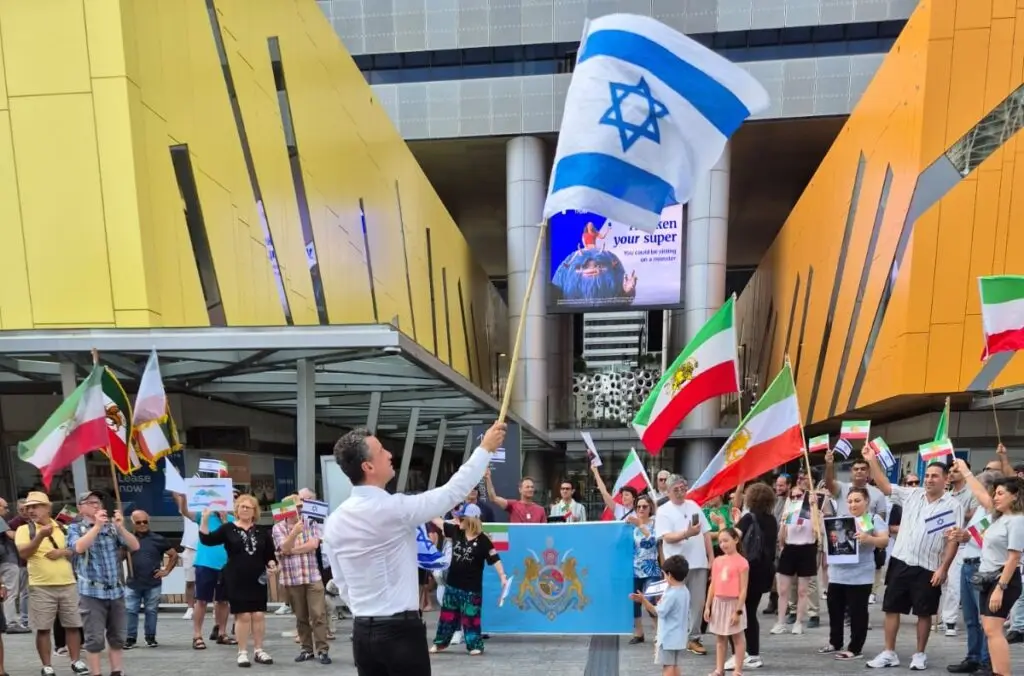

Members of the Iranian diaspora in Perth, Australia, holding a solidarity rally on 10 January 2026 against the Islamic Republic | Source: Wikimedia Commons | Credit: Gnangarra
Listen to this essay:
I have watched the Iranian diaspora move deeper into an information war that rewards certainty over truth. In that war, social media does not merely transmit opinion; it manufactures moral weather. Anger is packaged as analysis, repetition as evidence, and algorithmic virality as legitimacy. The result is a predictable compression of political judgment: every event is forced into a binary script where one camp speaks for freedom and the other for barbarism. In that script, complexity is treated as betrayal.
I often hear the claim that the Islamic Republic’s military spending proves total indifference to ordinary life because wartime infrastructure—sirens, shelters, civil defense systems—remains inadequate. The criticism sounds intuitively powerful, and parts of it are valid. But I reject the hidden premise that preparedness failures automatically identify the principal moral culprit in a conflict. This framing can displace responsibility from aggressor to target, treating civilian vulnerability as evidence against the victim before it is evidence against the attacker. It is a rhetorical move with a familiar history: structural suffering is blamed on those who endure it, not those who produce it.
At the same time, I do not consider civil defense morally trivial. States owe populations practical protections regardless of who fired first. So my argument is not that preparedness is irrelevant; it is that preparedness cannot be the sole diagnostic of legitimacy. A government may be negligent in protection while external actors remain culpable for unlawful escalation. Reducing this layered reality to a single accusation—”if people die, the local state is the only enemy”—is analytically lazy and politically dangerous.
I also see a related inflation in our discourse: the claim that the regime is not merely oppressive or incompetent, but the singular and absolute threat to all Iranian life, such that almost any external violence becomes morally tolerable if it weakens Tehran. This logic converts despair into permission. Once the domestic state is rebranded as an existential totality, legal categories blur: sanctions that devastate households become strategic necessities; assassinations become technical corrections; preemptive war is reframed as humanitarian surgery. The rhetorical endpoint is not liberation but moral deregulation.
Geopolitically, I believe this discourse relies on selective memory. Iran’s post-1979 record includes repression, regional proxy warfare, and interventions that deserve robust criticism. Yet I cannot analyze the regional order without parallel scrutiny of U.S.-Israeli coercive strategy: covert sabotage, recurring strikes, maximal sanctions, and repeated pressure campaigns that weakened diplomatic off-ramps. The collapse of the JCPOA after U.S. withdrawal in 2018 did not simply end a treaty; it strengthened hardline security logics on all sides. When diplomacy is repeatedly undermined, militarists inherit the stage.
Timing matters. Attacks launched during negotiation windows do not merely produce immediate casualties; they alter the argument structure of politics. They teach publics that compromise is naive, that institutions are decorative, and that force is the only reliable language. This does not exonerate Tehran’s authoritarian machinery. It shows, instead, how regime securitization and external militarization are mutually reinforcing systems. Each side harvests the violence of the other as domestic proof of its own necessity.
I want to be equally clear about legal rhetoric, because legal rhetoric is often where political manipulation hides. Terms like “self-defense,” “deterrence,” and “preemption” are now used as moral shortcuts rather than legal tests. In my view, if imminence is undefined, evidence is withheld, and proportionality is post hoc storytelling, then legal language has been reduced to branding. We cannot build credible anti-authoritarian politics by borrowing the most elastic justifications of militarized statecraft. Precision is not a luxury here; it is the minimum ethical duty.
I see diaspora media ecosystems intensify this cycle through three mechanisms. First, emotional monetization: trauma-rich narratives outperform careful reporting, so outrage becomes an economic model. Second, epistemic tribalism: users learn to trust identity proximity over verification, producing sealed interpretive communities. Third, performative absolutism: visibility is awarded to maximal claims, not defensible ones. In this environment, disagreement is recoded as collaboration, and policy questions collapse into loyalty tests.
A fourth mechanism also deserves attention: moral outsourcing. Instead of testing claims against documents, timelines, and legal standards, we outsource certainty to charismatic accounts that mirror our pain. I understand why this happens; communities under prolonged injury seek emotional coherence before analytical coherence. But when political judgment is outsourced, accountability disappears. The loudest narrator becomes the temporary court of appeal, and facts become decorative props in a drama whose ending is already written.
This produces a striking mirror effect. Opposition echo chambers accuse state media of propaganda while reproducing propaganda form: decontextualized footage, inflated casualty rhetoric, and strategic omission of inconvenient facts. Regime channels, for their part, weaponize every diaspora excess to discredit legitimate criticism, presenting dissent as foreign orchestration. Both narratives depend on the same cognitive technology—fear plus simplification—and both punish nuanced speech. The citizen becomes either a slogan or a suspect.
The framework I advocate begins with symmetry in moral method, not symmetry in political power. I reject both apologetics for authoritarian repression and romanticism about coercive foreign policy. I ask the same questions of every actor: Who initiated force in this instance? What legal authority exists? What civilian costs are foreseeable? What diplomatic alternatives were available, and by whom were they blocked? Which claims are evidenced, and which are emotionally outsourced to collective grievance? Without this methodological discipline, analysis degenerates into factional mythmaking.
For the diaspora, the central task is epistemic adulthood. To me, that means distinguishing opposition to the regime from consent to war, and anti-war critique from regime loyalty. It means refusing the intoxicating fantasy that bombardment can perform democratic pedagogy. It means acknowledging that a population can be simultaneously oppressed by domestic autocracy and endangered by external punishment regimes. Most of all, it means resisting the conversion of legitimate rage into a permanent marketplace of distortion.
That epistemic adulthood has practical consequences. It asks us to cite better, pause longer, and speak with fewer theatrics when evidence is uncertain. It asks academics, journalists, and activists—including me—to separate interpretation from assertion and to mark the limits of what we know. It also asks institutions in exile to reward correction instead of punishing it. A political culture that cannot revise itself cannot democratize itself. Humility, in this sense, is not weakness; it is infrastructure.
I believe the future of Iranian political imagination depends less on who shouts the loudest than on who restores standards of argument under pressure. If our public sphere remains hostage to algorithmic panic and geopolitical ventriloquism, diaspora politics will continue mistaking amplification for insight. But if analytical rigor, historical memory, and moral consistency are reintroduced into debate, a different possibility emerges: criticism that neither flatters power nor licenses catastrophe. In that narrower and harder space, truth becomes less theatrical, but far more useful.