
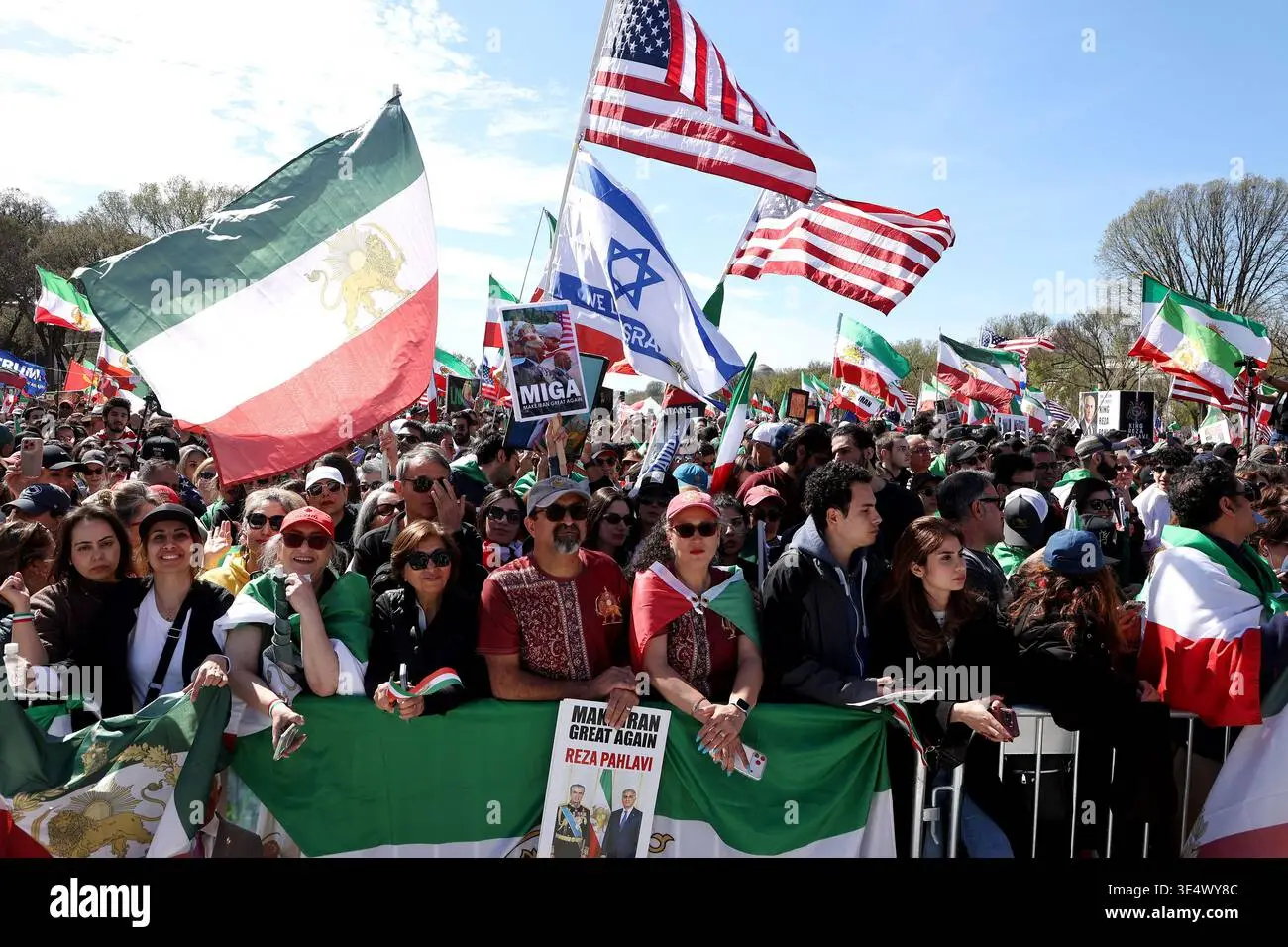

Credit: © ZUMA Press, Inc. / Alamy Live News
On the Comprador Character in the Iranian Diaspora and the Collapse of Borrowed Salvation
A Character Type, Not a Person
Every imperial project produces its own native chorus—voices from the colonised world who sing the coloniser’s hymn in an accent the metropole finds authentic and therefore useful. Hamid Dabashi, in Brown Skin, White Masks (2011), calls them comprador intellectuals: a structurally produced character type whose function is to provide ideological cover for the power dismantling her homeland. Malcolm X named the same figure with greater economy: the house slave who, when the master’s house catches fire, fights harder to extinguish the blaze than the master himself. “What’s the matter, boss, we sick?” The we is the tell—the grammatical signature of a consciousness that has relocated itself entirely into the normative universe of the master.
On 8 April 2026, as Iran smouldered under five weeks of bombardment by the United States and Israel, Illinois Public Media’s The 21st Show offered a near-perfect specimen of this type. An associate professor of information systems at a Midwestern university—Iranian-born, long settled in America—declared: “I still maintain that the greatest threat to Iranian life, liberty and the pursuit of happiness is not this war or any foreign intervention. It’s the regime itself.” The phrasing is diagnostic: life, liberty and the pursuit of happiness—the sacred trinity of the American Declaration of Independence, deployed without irony while compatriots were being bombed by the nation that authored those words. The individual is incidental. The type is what demands scrutiny.
The Selective Arithmetic of Suffering
The comprador character’s most reliable instrument is what the historian Mateo Mohammad Farzaneh, speaking on the same programme, called the selective presentation of facts. When confronted with the destruction of a school in Minab that killed over 145 children, the comprador voice does not deny the atrocity. It changes the subject—pivoting to the regime’s executions, its poisoning of rivers, its engineering of poverty. Every horror from without is met with a horror from within, as though American missiles and Iranian state violence existed on a balance sheet in which the latter would always tip the scales.
This is deflection elevated to a worldview. “I do not condone Mr President’s Stone Age comments,” the voice concedes, before adding: “but IRGC was already systematically driving us there.” The grammatical structure tells the story: the threat to annihilate a civilisation is a subordinate clause; the regime’s crimes are the main sentence. The bombed are made responsible for their own bombing. By this logic, no colonised people could object to colonisation so long as their own leaders were imperfect—a standard that would justify the bombardment of every nation on earth.
The One-Percent Wager
The type reveals itself most nakedly in moments of candour. On the programme, the following calculus was offered: if there is even a one-percent probability that this war could topple the Islamic Republic, one should take it—over “the guaranteed destruction that IRGC has been imposing on my country.” A one-percent chance of regime change is worth the near-certainty of mass death. This is not politics; it is theology—a sacrificial logic in which the faithful offer up their compatriots’ bodies for redemption by a foreign saviour who has explicitly promised to reduce the offering to rubble.
Ibrahim Abu-Rabi’ called this condition aborted modernity: the machinery of Western modernity imported without the critical consciousness to operate it autonomously. The comprador type absorbs the vocabulary of American liberalism—freedom, democracy, human rights—but severs these concepts from any analysis of the power structures that determine who gets to enjoy them. Human rights become a weapon against Tehran but never against Washington. Democracy means regime change from without, not a people’s sovereignty over its own fate.
Brown Skin, White Mask
Dabashi’s taxonomy, drawing on Fanon, Said, Malcolm X, and Memmi, traces the pathology of the colonised subject who internalises the coloniser’s gaze so thoroughly that she sees her own people through it. Memmi’s diagnosis deserves to be quoted:
The recently assimilated place themselves in a considerably superior position to the average coloniser. They push a colonial mentality to excess, display proud disdain for the colonised and continually show off their rank… Still too impressed by their privileges, they savour them and defend with fear and harshness; and when colonisation is imperilled, they provide it with its most dynamic defenders, its shock troops, and sometimes instigators.
The specimen on display in this broadcast was a professor of information systems—a discipline as remote from the philosophy of sovereignty as one could imagine. This is precisely the point. The native informer’s authority derives not from expertise but from identity: she is from there, she is now here, and she is willing to say what the bombers need said. The empire does not need her knowledge. It needs her face.
The Mirage of Whiteness
Multiplied across the diaspora, the comprador character constitutes the terminal stage of a paradigm whose bankruptcy is now undeniable. Vali Nasr has diagnosed it: a significant segment of exiled Iranians has been consumed by the desire “to be white”—to claim kinship with the civilisational mainstream of the West, to distance itself from the Global South to which Iran structurally belongs. The aspiration manifests in specific alignments: the embrace of Zionism, support for American military adventurism, the revival of pre-Islamic Aryan mythology as a credential for respectability.
But the order to which these figures pledge allegiance is itself in moral decomposition. We live in a post-Epstein era—an era in which Western liberal democracy has been exposed, from its intelligence agencies to its philanthropic networks, as harbouring predatory corruption at its core. To seek recognition from this order is not merely futile, as Dabashi argues via Dussel; it is self-negation in the service of a mirage. The imaginary whiteness collapses the moment the American president promises to bomb their homeland “back to the stone ages, where they belong.” No flag-waving, no alignment with the American right can purchase the ticket to civilisational belonging that was never on offer.
Beyond the Binary
Dabashi’s distinction between hokoomat (the state apparatus) and hakemiyat (sovereignty residing in the nation) offers the exit from the paralysing binary in which the comprador character remains trapped. One can be fiercely critical of the Islamic Republic and simultaneously proud of national resilience under bombardment. The comprador type cannot hold both ideas because its intellectual operating system does not permit it. To criticise the regime is to endorse its destruction from without; to oppose the war is to support the regime. This is the most corrosive legacy of the self-other dichotomy.
Farzaneh exposed this on air with a single correction. When the comprador voice claimed ninety percent of Iranians supported the war, he responded: “The great majority of people inside Iran do not support bombs being dropped on their heads.” The statement is so obvious that its necessity reveals the depth of the delusion. The comprador has travelled so far from the field that she can no longer hear its voice—or, hearing it, dismisses it as regime propaganda.
The Reckoning
The Copernican Revolution of the Iranian mind, as Dabashi calls it, has begun. The old centre—the imaginary West that once organised every axis of self-understanding—no longer holds. The comprador character belongs to the exhausted paradigm: not its architect but its symptom, the terminal expression of a borrowed modernity that could not survive contact with the reality it served. The stone ages to which Trump promised to consign Iran are the stone ages of his own moral imagination—a landscape in which entire civilisations can be reduced to rubble and their people called animals without consequence. The real question is not whether Iran will survive. It already has. The question is whether those who cheered for their own negation will have the honesty to reckon with what they endorsed—and what they failed to think.
And if you, the reader, recognise yourself in this character type—if you hear your own voice in its cadences, your own rationalisations in its logic, your own silence where condemnation of the bomber ought to have been—then the task before you is not defensive indignation. It is the far more difficult and more dignifying labour of rethinking, from the ground up, the entire edifice of assumptions upon which you have constructed your understanding of yourself and of the world. The hour is late, but the door is not yet closed.
- • •
This essay draws on the transcript of The 21st Show (Illinois Public Media, 8 April 2026); Hamid Dabashi, Brown Skin, White Masks (Pluto Press, 2011); Hamid Dabashi, Iran Without Borders (Verso, 2016); Ibrahim M. Abu-Rabi’, Contemporary Arab Thought (Pluto Press, 2004); and the public remarks of Vali Nasr on the Iranian diaspora’s aspiration to whiteness.
2 responses to “The House Slave at the Microphone”
[…] اصلی این یادداشت به زبان انگیسی است. نسخهی بالا با مساعدت هوش مصنوعی و ویرایشهای […]
[…] is precisely the posture of a recognisable character type in the Iranian diaspora—what I have described elsewhere as the comprador intellectual, borrowing Malcolm X’s sharper coinage: the house slave. When the […]