
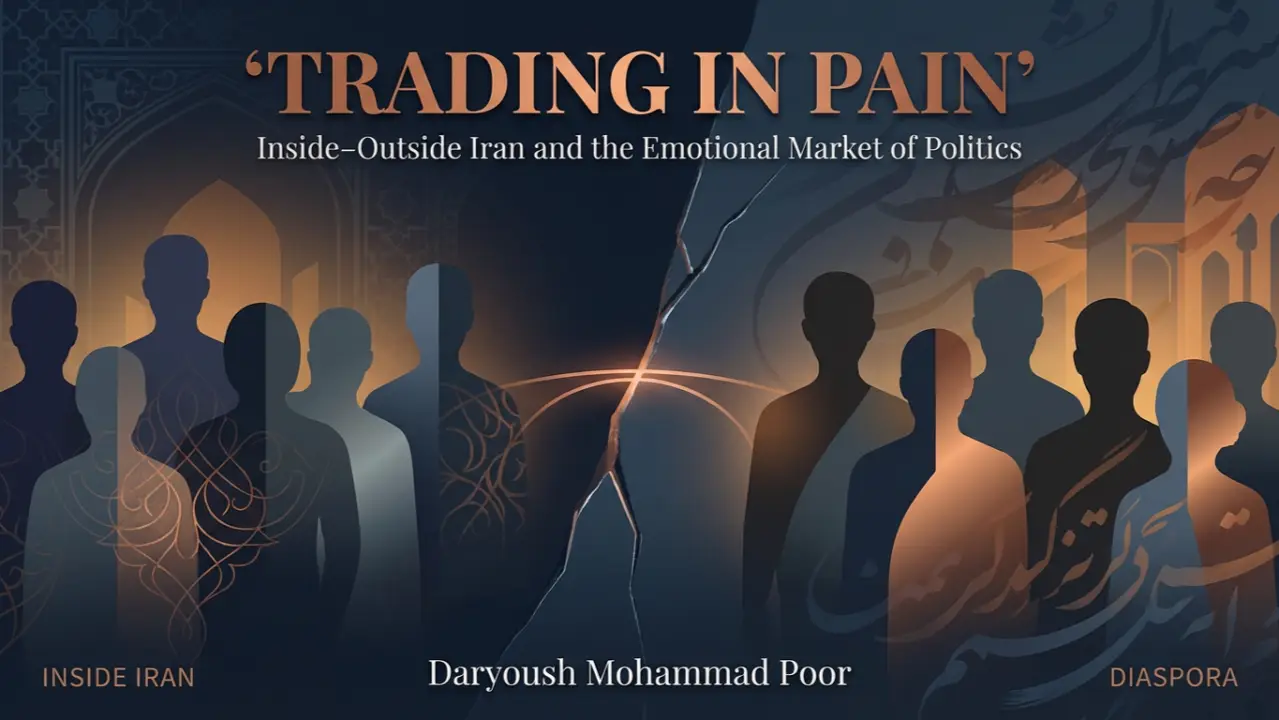
The fracture between Iranians living under the Islamic Republic and those in the diaspora is not, at its core, a political disagreement. It is something much older, cruder, and far more difficult to resolve: a collision between two entirely different lived realities that have, over decades, produced two incompatible languages, two irreconcilable hierarchies of suffering, and two mutually exclusive claims to the right to speak.
The Iranian inside the country inhabits a world defined by the immediate and the mortal. The spectre of arbitrary arrest, economic asphyxiation, crippling sanctions, state violence, and the daily disappearance of neighbours, colleagues, and friends has, over time, pushed the collective psyche out of the register of deliberation and into what can only be called a psychology of survival. In survival mode, nuance is not a luxury; it is perceived as an obscenity. The only question that retains meaning is brutally simple: who is here with us, physically and mentally, in this, and who is not?
The Iranian abroad lives in a world that, for all the genuine anguish of exile and dislocation, offers something the other does not: distance. Distance from the immediate threat, and with it, the cognitive space to analyse, theorise, debate, and disagree. If the insider is standing in a burning building, the outsider is in the monitoring room, watching the instruments. When the outsider speaks — even from a place of genuine solidarity — their words arrive in the burning building as something close to an insult: the composed vocabulary of someone who has the luxury of composing themselves.
From this asymmetry grows one of the most corrosive dynamics in Iranian political life: the transformation of suffering into a form of moral capital. To have stayed, to have endured, becomes not merely a biographical fact but a credential — the credential that supposedly confers the right to determine how resistance should be conducted, what sacrifices are acceptable, and whose voice carries weight. The diaspora, in this framework, has forfeited its standing. It left. And in this particular context, leaving — you may call it migration — in the grammar of survival, is indistinguishable from abandonment.
The diaspora, for its part, experiences this verdict as a profound injustice. Exile is not escape; it is its own form of destruction — the slow erosion of identity, the grief of severance, the particular torment of watching catastrophe unfold from a position of helplessness. To be told, from that position, that one’s pain does not count and one’s voice does not qualify is experienced not as a political argument but as a second dispossession.
These two forms of suffering do not recognise each other. Instead of functioning as complements — two facets of the same historical wound — they operate as rivals, each delegitimising the other, each certain that the other either cannot understand or will not. Suffering becomes a kind of emotional currency in a zero-sum market: every acknowledgement of the other’s pain is felt as a devaluation of one’s own.
This mutual incomprehension is deepened by a history that has given Iranians every reason to be structurally suspicious. A revolution stolen from within. Foreign interventions that left catastrophe in their wake. Opposition movements that fractured, betrayed, and consumed themselves. In such a landscape, every external voice — governmental or oppositional — is heard through a filter of presumed hidden interest.
That suspicion is not without foundation. A visible and vocal segment of the external opposition has, over the decades, conducted itself with a narcissism and opportunism that has poisoned the well for everyone. When suffering becomes the raw material for political brand-building — when the name on the human-rights conference poster matters more than the nameless prisoner whose case it invokes — the insider’s contempt is not paranoia. It is pattern recognition.
Yet the insider’s response carries its own distortion. The behaviour of the loudest and least scrupulous in the diaspora is used to indict the whole. The diaspora is vast and heterogeneous. It contains the self-promoting and the self-effacing, the cynical and the genuinely devoted, the ideologically rigid and the pragmatically humble. To flatten that complexity into a single figure of the comfortable, complicit exile is to commit precisely the kind of reductive thinking that the insider rightly resents when it is directed at them.
The languages, too, have drifted apart. Inside, the operative vocabulary is one of unity, action, cost, and sacrifice. Outside, the dominant register is pluralism, the dangers of populism, the necessity of critical analysis, and the fear of repeating 1979. When the insider says “unity,” the outsider hears the suppression of dissent. When the outsider says “analysis,” the insider hears a stalling tactic dressed in intellectual clothing. Each side is, in a precise sense, speaking a different language — and each is certain that the other’s incomprehension is either a failure of intelligence or an act of bad faith.
This pattern is not uniquely Iranian. It is the recurring grammar of societies fractured by authoritarian violence and mass displacement. In the former Yugoslavia, diaspora communities simultaneously gave voice to victims and, in some cases, amplified the ethnic hatreds that produced them — before, in later years, contributing meaningfully to documentation, reconciliation, and the slow reconstruction of civic trust. In Pinochet’s Chile, the exiled left spent years in a relationship of mutual suspicion with those who had remained: the exiles accused of naivety about compromise, the stayers accused of not understanding the full picture from inside the pressure. Yet it was ultimately the accumulated networks, legal expertise, and international relationships of that same diaspora that helped make Chile’s democratic transition and its reckoning with the past possible.
In Syria, the failure was more complete and more instructive. An external opposition claimed to represent a people it had largely lost contact with, entered geopolitical games with the confidence of a government-in-waiting, and was seen from inside the rubble as simply another set of actors using Syrian blood as a bargaining chip. The lesson Syria offers is the starkest: when the diaspora mistakes its platform for a mandate, it does not merely fail to help — it actively deepens the wound.
This fracture is now being tested by the fires of a widening war. As the Islamic Republic reels from the loss of the Supreme Leader and senior military leadership and signals a desperate desire for de-escalation, the external push for total regime change has reached a fever pitch. But in this moment of maximum volatility, the asymmetry of risk remains absolute. For the diaspora, ‘regime change’ is a geopolitical objective or a long-awaited historical justice; for the insider, it is a process that will be written in the language of more blood, more rubble, and the terrifying uncertainty of what follows a collapsed state. If the external opposition views this as a market opportunity to be seized, they must account for the fact that the ‘cost of entry’ will be paid exclusively by those inside the burning building. To ignore this is to repeat the Syrian tragedy: mistaking a moment of regime vulnerability for a mandate to gamble with the lives of a population that has already reached the limits of its endurance.
The common thread across all these cases is this: the gap between inside and outside does not close through argument, and it does not close through the assertion of superior suffering. It closes, where it closes at all, through a specific and difficult discipline — the willingness of each side to recognise the other’s pain not as a competitor to its own, but as a different expression of the same rupture.
For the Iranian outside the country, this means something more demanding than the standard repertoire of diaspora activism. It means asking, with genuine honesty, whether any given act of political engagement serves the people inside or primarily serves the actor’s own need for relevance, absolution, or identity. There is a meaningful difference between amplifying the voice of an unknown prisoner and placing one’s own name on the poster. There is a meaningful difference between making resources available to those at direct risk, without condition or credit, and using those same resources to sustain one’s own political infrastructure. The most important thing the diaspora can do is to disentangle its own visibility from its usefulness — to understand that the two are not the same thing, and that confusing them is precisely what has eroded trust for so long.
For the Iranian inside, the corresponding discipline is equally difficult: to resist the temptation of the totalising verdict. Not everyone who left, left lightly. Not every critical voice from outside is a form of appropriation. The recognition that exile is also a kind of devastation — different in texture but not necessarily lesser in weight — does not diminish the insider’s claim. It enlarges the conversation.
The fracture between Iranians inside and outside is, in the end, the fracture of a society that has been under sustained, extreme pressure for more than half a century. It is the product of collective trauma, of histories of betrayal, of languages that have drifted apart under the pressure of incompatible circumstances. It will not be healed by a single gesture or a single conversation.
But it begins — where it begins at all — with the capacity to say to the other: you have lived a different kind of hell, and that hell was real. From Belgrade to Santiago, from Damascus to Tehran, that sentence — simple, and almost impossibly difficult to mean — has been the first stone of every bridge that was ever actually built.
Leave a Reply