
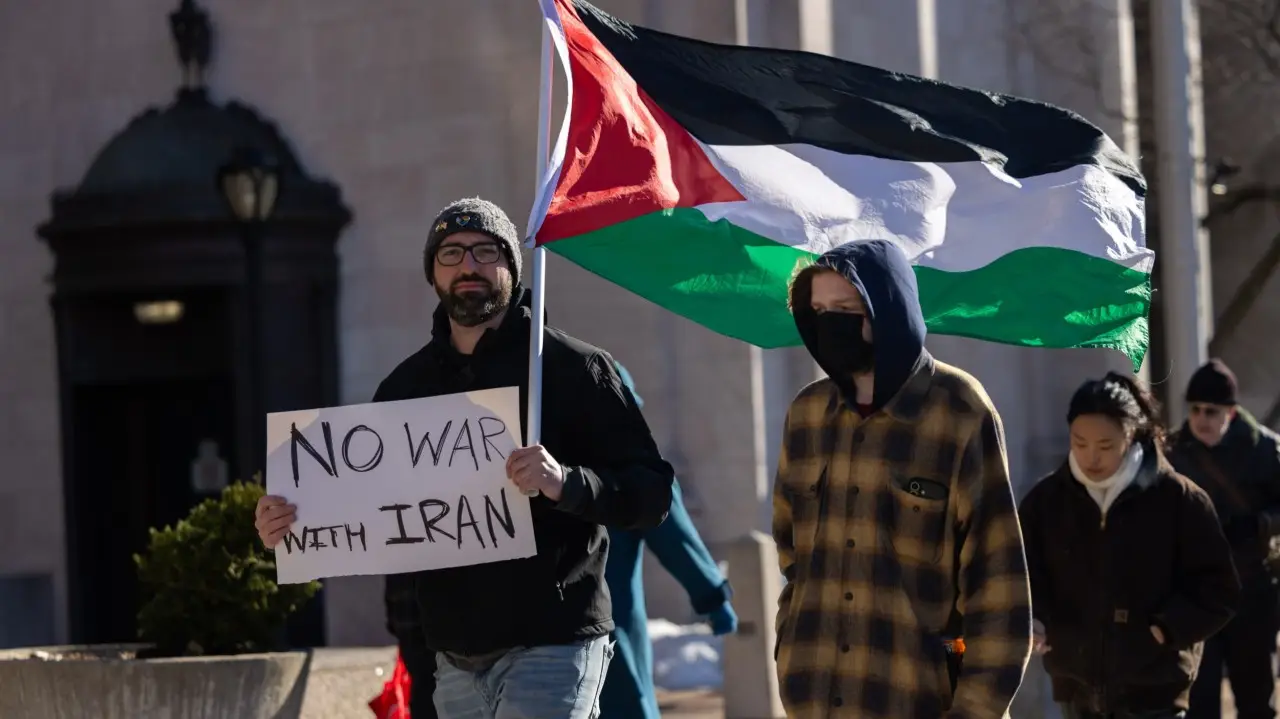
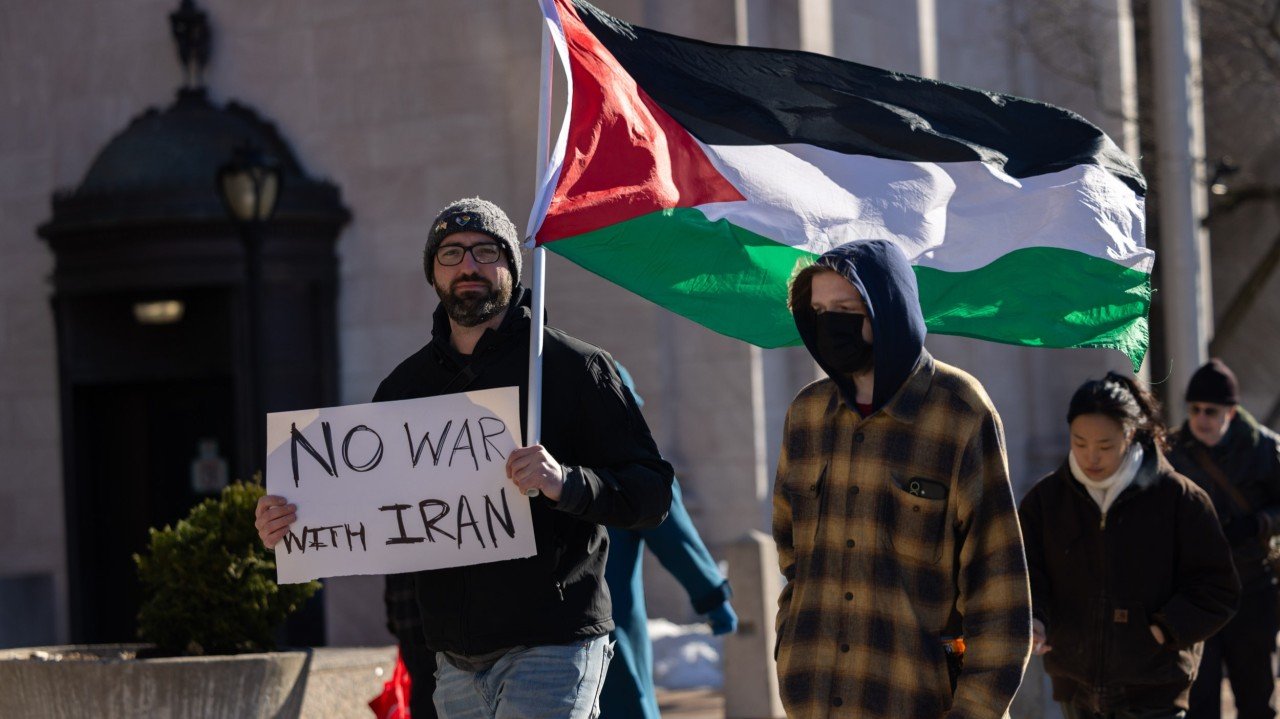
Image credit: Chris Randall / New Haven Independent — Anti-war demonstrators rally in downtown New Haven, March 1, 2026.
Hacking War with the Only Weapon We Have Left
For S. S. who planted the seed of this essay in my mind.
The Ominous Timing of War
It is ominous—and it should unsettle every thinking person—that both times Iran came under invasion, Iran and the United States were in the midst of diplomatic negotiations. The Omani mediator Badr al-Busaidi had expressed optimism just one day before the war broke out, noting tangible progress toward an agreement. Diplomacy was moving. Then it was murdered.
In both instances, the norms of negotiation were dishonoured by the invading party. Israel was never a direct participant—it was the wildcard, the runaway train, the power that instigated this unprovoked war. Contrary to the rhetoric deployed by Israeli officials—and, disturbingly, by a vocal segment of the Iranian diaspora—that this was a pre-emptive strike, there was nothing pre-emptive about it. It was pre-meditated disregard for international law, unsurprising to anyone who has examined the staggering record of UN resolutions against Israel.
Even if the US government harboured genuine intention toward peace, the Israeli war machinery hacked this fragile diplomacy. The last time such diplomacy worked was the JCPOA, signed by all parties. Israel was deeply wounded by that agreement. To them, any deal that does not lead to war is a bad deal. As one well-known Iranian diaspora activist declared with chilling candour: “Peace is boring.” They feed on war.
The Ledger of Impunity
Consider the numbers—not as abstractions, but as the accumulated weight of a world that has chosen complicity over conscience. Over the past seventy years, the United Nations has passed a staggering number of resolutions against Israel: at least 173 in the General Assembly between 2015 and 2024 alone, 112 in the Human Rights Council since 2006, and 131 in the Security Council between 1967 and 1989. A conservative estimate places at least 112 to 150 of these as directly related to human rights violations, illegal occupation, and breaches of international humanitarian law. The cumulative total across all UN bodies exceeds 400 resolutions.
Now set that figure against Iran’s record. Between 1979 and 2026, the total number of UN resolutions against Iran stands at 39—sixteen from the Security Council, sixteen from the General Assembly, and seven from the Human Rights Council. Of these, only 23 pertain directly to human rights.
The disparity is not marginal. It is volcanic. Over 400 resolutions against one state; 39 against the other. Which is the rogue state? I leave the question open-ended—but the numbers do not. They scream into a silence the world has chosen to maintain. What makes humanity’s conscience so numb is precisely the ignoring of these facts—facts that speak for themselves, if only we would let them.
Minab: The Silence That Indicts
Today, 27 March 2026, the United Nations Human Rights Council convened an urgent debate on the aerial strike that destroyed the Shajareh Tayyebeh Girls’ Elementary School in Minab, Iran, on 28 February—the very first day of the war. At least 175 people were killed, over 100 of them schoolchildren. Girls aged seven to twelve. The school was struck multiple times by precision munitions. Fifty children’s bodies were never recovered—pulverised. A mother named Mohaddeseh Fallahat addressed the Council via video link: “No mother is prepared to hear the words: your child is not coming back.”
UN Human Rights Chief Volker Turk demanded justice. Human Rights Watch called for the strike to be investigated as a war crime. The UN Special Rapporteur on the Right to Education noted that if journalists and civil society groups could establish the school’s civilian status through open-source data, the US military—with its vastly superior intelligence apparatus—had no excuse for failing to do the same.
And where is the Iranian diaspora? Where are those who claim to be the voice of Iran? They are silent—not because they lack information, but because the indictment falls upon their presumed saviours. The Minab school does not fit their narrative. The dead children cannot be instrumentalised to justify more bombing. So the children are erased—not by the missile alone, but by the refusal to see them. The diaspora that counts the regime’s victims twice cannot bring itself to count these children even once. This is not indifference. It is moral bankruptcy.
Make Love, Not War—The Forgotten Hack
The true originator of “Make love, not war” remains contested. The earliest uses surfaced in Berkeley in early 1965—signs reported by the Daily Californian in February, bumper stickers noted by the Oakland Tribune in March. Gershon Legman claimed he coined it during a 1963 lecture; Penelope and Franklin Rosemont insisted they created it at their Chicago bookshop; Diane Newell Meyer said it simply “popped into her head” at an April 1965 rally. No single claim holds. The phrase emerged organically from the anti-Vietnam War counterculture, various people independently crystallising an era’s yearning for peace over destruction.
That phrase was itself a hack—an intervention in the circuitry of war, a disruption of the logic that frames violence as inevitable. It did not stop Vietnam. But it shifted something in the conscience of a generation. It planted a seed that outlived the war it protested. This is what hacking war means: not the naive belief that words stop missiles, but the insistence that the moral architecture of a society cannot be surrendered to those who profit from its collapse.
Hacking War: A Plea from the Burning Building
So let us hack this war. But what do we have at our disposal? For people like me—and like Hasan Aghamiri, the man inside Iran with an eight-year prison sentence who spent seven million tomans on a VPN to tell the world that 168 schoolchildren had been killed, that a five-year-old girl in Tehran had been rendered mute by trauma—all we have is our pen. Our intellectual might is the only weapon we possess. We do not have war machines or propaganda machines. We do not engage in smear campaigns or dehumanising tactics. All we have is the integrity we must abide by, the conscience we must keep sensitive and alert.
As I have written in these war diaries—from “Trading in Pain” to “The Burning Building and the Monitoring Room”—the fracture between Iranians inside and outside is not a political disagreement but a collision between two lived realities. The insider stands in the burning building; the outsider watches from the monitoring room. When the outsider prescribes more fire as the cure, the asymmetry becomes obscene. The regime once told Iranians sanctions were a blessing. Now, parts of the diaspora say war is a blessing. Both are lies paid for in blood—just not theirs.
How do we hack this war? Humanistically. It sounds utopian—perhaps unrealistic. But this is how unexpected change happens. In the midst of absolute despair, something can penetrate the wall of hostility, as long as we keep our humanity resilient and alive. The children of Minab cannot wait for our conferences. But they deserve that those who claim to speak for their future do not advocate for their destruction. That is the lowest bar imaginable. And the fact that so many cannot clear it is the true measure of our moral crisis.
This is our hack. The pen. The conscience. The refusal to let hatred author our story. It is all we have. It must be enough.
Leave a Reply