
A Regime That Does Not Cooperate With Its Own Downfall
An Israeli journalist recently made ironic commentary on President Trump’s war strategy, capturing in a single tweet what might be called the most revealing paradox of our time. But this is not merely about Donald Trump. This is about a cognitive dissonance that has come to define large portions of the Iranian diaspora—a contradiction so fundamental that it exposes the very chasm between rhetoric and reality, between wishful thinking and strategic coherence.
Over the past year, one question has echoed persistently through diaspora networks, social media platforms, and satellite television broadcasts: Why doesn’t the regime just give up? It is one of those astonishingly simple questions that, upon examination, reveals a caricature so profound that those asking it seem unable to see themselves reflected in it.
The Logical Paradox at the Heart of Diaspora Politics
Let us examine this question with the cold clarity it demands. If the Iranian regime is meant to be so compassionate, so caring, so benevolent, and so kind that one can simply ask those in power to step down for the good of the country and its people—then why, precisely, do you want its downfall? Why mobilize international pressure, sanctions, and military threats against a government capable of such selfless surrender?
Conversely, if the regime is as cruel and tyrannical as claimed—as corrupt, as violent, as utterly indifferent to human suffering—then why do you keep asking it not to resist? Why expect mercy from the merciless? Why anticipate rationality from those you’ve characterized as fundamentally irrational? Why demand altruism from those you’ve spent decades condemning as irredeemably selfish?
There is a discrepancy here, a dissonance in the cognitive architecture of certain segments of the diaspora that fails to grasp—or refuses to acknowledge—the gravity of the situation. You cannot simultaneously argue that a regime is brutally authoritarian and expect it to behave with democratic gentility when facing its own extinction. The two positions are logically incompatible. They cancel each other out, leaving only the hollow echo of moral posturing without strategic substance.
This is not mere philosophical hair-splitting. This is the difference between understanding power and performing outrage, between formulating strategy and indulging fantasy. No authoritarian regime in history has ever politely excused itself from power because external voices deemed it appropriate. The Soviet Union did not dissolve because dissidents asked nicely. Apartheid South Africa did not end because the international community expected benevolence. Authoritarian systems collapse when the internal contradictions become unsustainable, when the cost of maintaining power exceeds the capacity to extract it—not when they are asked to cooperate with their own demise.
The Existential Stakes and the Spiral of Threat
For the regime, this is an existential situation. Not a political inconvenience. Not a public relations crisis. An existential threat. And existential threats are not met with negotiation—they are met with survival instincts that override all other considerations.
When the dominant voices of the diaspora openly threaten repercussions not only for those responsible for atrocities committed over the past forty-seven years—a legitimate demand for justice—but also for all those who even slightly differ from them in opinion, even those who have themselves been victims of the same regime, what message does this send? What incentive structure does this create?
If the choice facing regime officials is between fighting to the death and facing execution anyway, rational calculation dictates one course of action: resist with everything available. If surrender promises no mercy, if stepping down guarantees the same fate as fighting on, then why step down? Will they be executed more humanely? Will their families be spared because they cooperated? History suggests otherwise.
This is the perverse logic the diaspora’s maximalist rhetoric has created: by promising total retribution regardless of cooperation, it eliminates any incentive for de-escalation. By conflating every level of complicity, from active perpetrator to passive bureaucrat, it ensures that everyone within the system has equal reason to fight until the end. This is not a strategy for regime change. This is a recipe for catastrophic escalation.
And what of the Iranian people—the millions who have no choice but to live with the consequences of this confrontation? If we accept the premise that the regime is so corrupt, so committed to its own survival that it will fight to its last breath even at the expense of destroying Iran and all its infrastructure before surrendering, then we must confront an uncomfortable question: Is a strategy that pushes for confrontation at any cost truly in the interest of those people? Or is it something else entirely?
The Test of Solomon: Biophilia or Necrophilia?
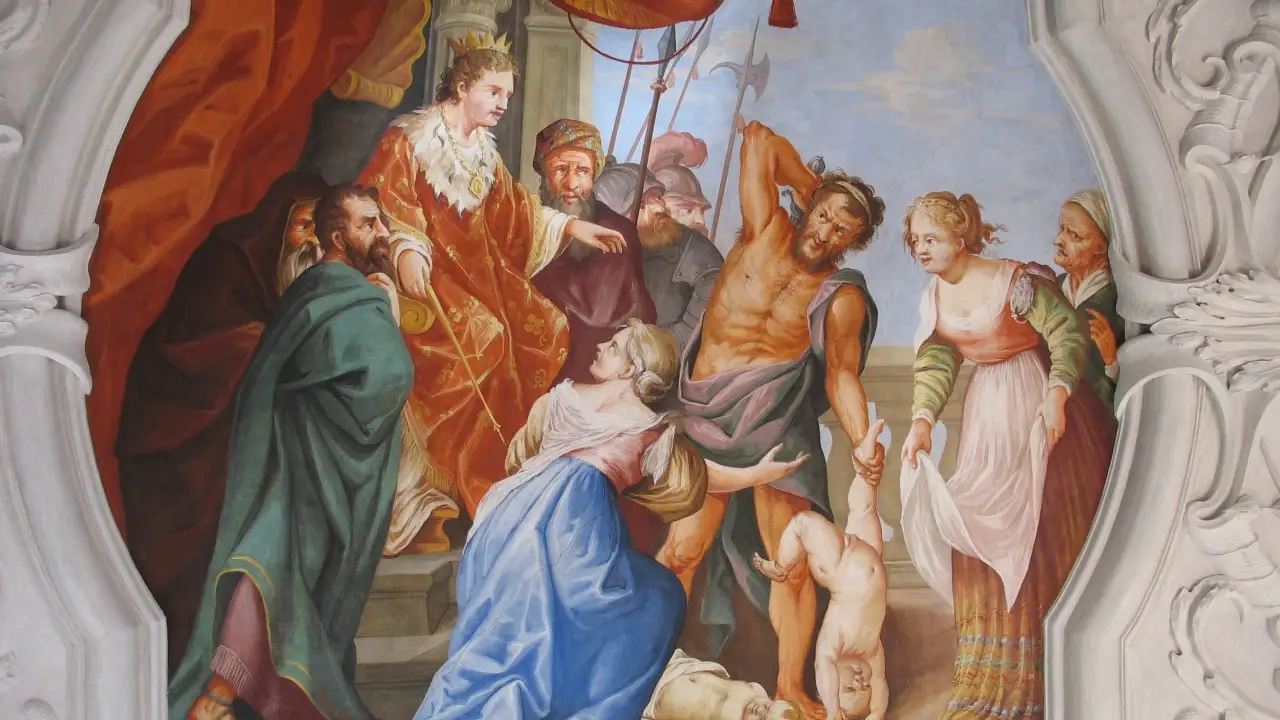
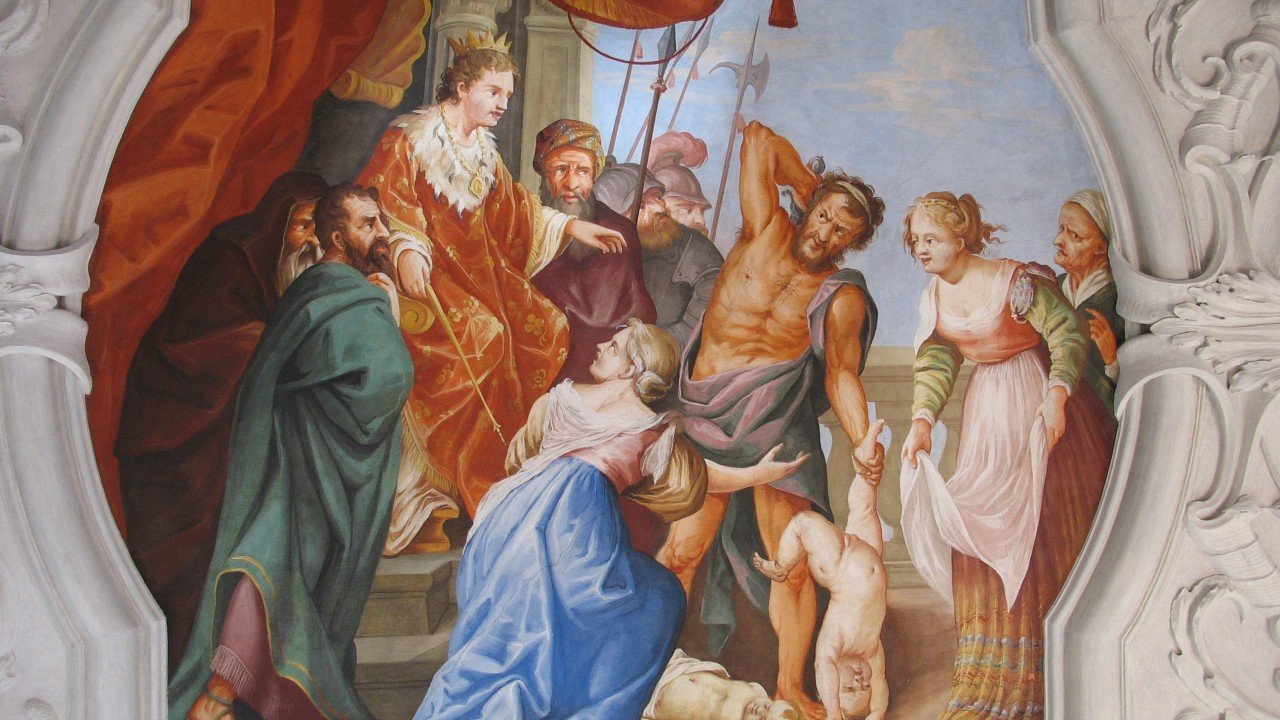
There is a story shared by both Jewish and Muslim traditions that illuminates this moment with devastating clarity. In the Tanakh, King Solomon is confronted with two women, each claiming to be the mother of a newborn baby. How does he discern the truth? With what Erich Fromm would later call a biophile-necrophile test: ‘Cut the baby in half and give each woman half.’
The true mother—the biophile, the lover of life—is immediately prepared to give up her child rather than see it killed. The impostor—the necrophile—prefers to have a properly divided dead child than to see a living one belong to another. (1 Kings 3:16-28)
The question this ancient parable poses to the Iranian diaspora is uncomfortable but necessary: What happens when your preferred strategy risks cutting Iran in half? When the escalation you advocate threatens to destroy the very infrastructure, institutions, and social fabric of the nation you claim to love? When military confrontation promises devastation to cities, displacement of millions, and generational trauma?
Does the true lover of Iran step back from the brink, even if it means not seeing immediate regime change? Or does the pursuit of revenge—let us be honest enough to call it what it often is—justify any level of destruction, any amount of suffering, any price paid by people who had no role in the decision-making that led to this moment?
This is not a question about whether the regime deserves to fall. That is not in dispute. This is a question about whether the commitment to Iran itself—to its people, its heritage, its future—takes precedence over the commitment to see specific individuals punished. It is a question about whether the discourse is driven by profound love for the living nation or by profound hatred for the existing government.
Both can coexist, certainly. But when they conflict—when the path to punishment requires destruction, when the route to justice demands catastrophe—which impulse prevails? The answer to that question reveals everything about the true nature of the movement.
The Iranian diaspora faces a moment of moral reckoning. It must decide whether it is advocating for the liberation of Iran or the annihilation of its enemies, whether it seeks the flourishing of its people or the satisfaction of its grievances. These are not the same thing. They have never been the same thing. And the persistent refusal to acknowledge this difference—the insistence on asking a tyrannical regime to cooperate with its own downfall while simultaneously threatening total destruction—reveals a fundamental unseriousness about the work of actual change.
Common sense demands we confront reality as it is, not as we wish it to be. Conscience demands we ask whether our strategies serve the living or simply satisfy the aggrieved. And wisdom—the wisdom of Solomon—demands we recognize that sometimes the greatest act of love is not fighting for possession at any cost, but fighting for preservation above all else.
The baby must not be cut in half. Iran must not be cut in half. The question is: who among us loves her enough to say so?
Leave a Reply