
Hamid Dabashi on Sovereignty, Selfhood, and the End of Western Validation
The Day After the Ceasefire
On the Wednesday after the ceasefire was announced, Hossein Hamdieh sat in a repurposed factory near Azadi Square in Tehran—a building that had once housed industrial machinery and now served as a hub for young entrepreneurs and start-up founders. The irony was not lost on him. For weeks, the skies over the Iranian capital had rained ordnance. Inside, the instruments of a fragile future hummed on. Across the Atlantic, in New York, the Columbia University scholar Hamid Dabashi waited to join a video call that, only hours earlier, neither man was sure would be possible.
When they finally connected, what unfolded was not a conventional interview. It was a reckoning—an attempt by two Iranian intellectuals to name what had just happened to them and to the nation they both claimed, one from within its borders, the other from a lifetime of exile.
The backdrop was stark. For over thirty days, Iran had endured a sustained military campaign backed by two nuclear powers. The threat of an atomic strike was not theoretical; it was a lived, visceral terror. Hamdieh described scrolling through social media and finding, instead of news or analysis, an avalanche of farewells—messages written by ordinary people who believed they would not survive the night. The language of the American president compounded the dread: Iranians were called “animals” undeserving of electricity and infrastructure, “lunatics” to be wiped from the face of the earth, a “civilisation” to be bombed back to the Stone Age. This was not merely belligerent rhetoric. It was, Hamdieh insisted, a systematic programme of dehumanisation—a linguistic architecture designed to render an entire people shapeless, voiceless, and nameless.
What cut deepest, Hamdieh confessed, was not the fear—though that was real enough, especially for a man with a small child at home—but the anger. The anger of invisibility. When he followed the international coverage, he found no Iranian faces, no Iranian voices, no Iranian stories. Others spoke for them, about them, over them. Iranians were reduced to numbers: casualty figures in a strategic calculus, collateral damage in someone else’s geopolitical algebra. Those who had lived among Europeans for years recalled bitterly that the continent’s conscience had stirred not when Iranian bodies were pulled from rubble, but when the price of petrol rose at European pumps. It was, as Dabashi had written in his book After Savagery, the condition of being rendered formless—of existing only as a shadow on someone else’s wall.
And yet Iran held. The ceasefire came not because the nation broke, but because it did not. It is from this paradox—the survival of a people whom the most powerful military apparatus on earth had declared expendable—that Hamid Dabashi builds his central argument. What happened in those thirty-odd days, he contends, was not merely a military or political event. It was an epistemic revolution.
The Epistemic Shift
Dabashi reaches for the largest available metaphor. What Iran has undergone, he says, is nothing less than a “Copernican Revolution”—a phrase he uses with full awareness of its philosophical weight. Just as Copernicus displaced the Earth from the centre of the cosmos and forced humanity to reconsider its place in the universe, the crisis of recent weeks has displaced a set of deeply entrenched assumptions from the centre of the Iranian intellectual universe. The “paradigm shift,” in the sense that Thomas Kuhn gave the term, is total: Iranians can no longer look at the world, or at themselves, through the lenses they wore before the twenty-eighth of February.
Dabashi likens this moment to the discovery of a new “verb” in the nation’s political and philosophical vocabulary. The old verbs—the ideological structures defined by the 1979 revolution, the binaries of reform and reaction—have been fully conjugated; their tenses are exhausted. This new verb has only just been unearthed. It will take a generation, perhaps longer, to spell out and conjugate its full meaning.
The old paradigm, in Dabashi’s account, was defined by a chronic orientation towards the West. For generations, Iranian intellectuals, politicians, and ordinary citizens measured their worth, their modernity, and their civilisational standing against a Western yardstick. Whether they embraced the West or rejected it, the West remained the fixed point of reference—the sun around which the Iranian self-image orbited. This was true of the Pahlavi-era modernisers who sought to replicate European modernity wholesale; it was equally true, Dabashi argues, of the post-revolutionary Islamists who defined themselves in opposition to that same modernity. Both camps were prisoners of the same binary. What has now shattered is not one side of the binary but the binary itself.
The evidence for this shattering, Dabashi suggests, is not to be found in policy documents or diplomatic communiqués. It is to be found in the behaviour of the people. During the crisis, all internal divisions—supporters and opponents of the Islamic Republic, reformists and hardliners, secularists and the devout—dissolved in the face of a shared existential threat. This was not orchestrated unity; it was spontaneous solidarity. The factional grammar that had defined Iranian politics for four decades—who is a reformist, who is a principlist, who is loyal and who disloyal—was suddenly revealed as irrelevant, a dialect spoken by elites that the nation itself had outgrown.
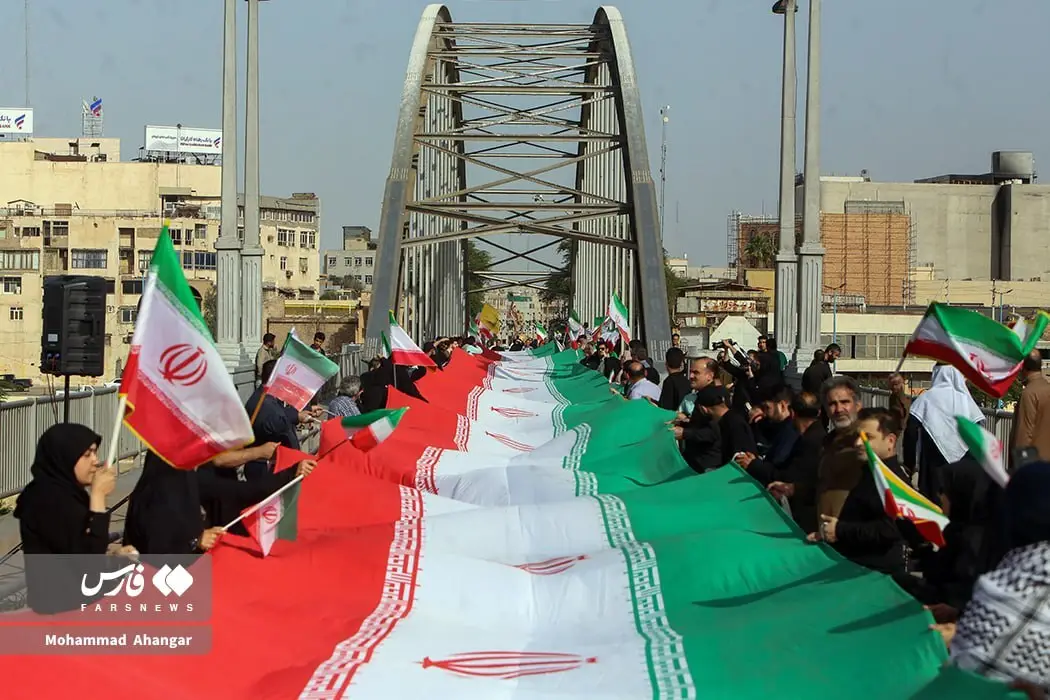
Dabashi recalls the scene on the White Bridge of Ahvaz, his hometown, with an emotion that nearly overtakes him on camera. He had crossed that bridge four times a day as a schoolboy, attending Dr. Hesabi High School on the far bank of the Karun River, riding a balam beneath the bridge’s arches to the river islands on warm afternoons. Now, decades later and thousands of miles away, he watched footage of the same bridge crowded with people—from military personnel manning defence systems to the ordinary grocer walking across with quiet resolve—defiant, unbowed, together. It was, he says, one of the most moving images of his life. The bridge was not simply infrastructure; it was a metaphor made concrete. It connected two banks of a river, just as the crisis had connected the fractured halves of a national psyche.
The Imaginary White Man in Our Minds
The most provocative element of Dabashi’s argument is his direct critique of Edward Said, the Palestinian-American scholar whose 1978 book Orientalism remains the foundational text of postcolonial thought. Dabashi does not reject Said; he honours him and then moves beyond him. In Said’s mind, Dabashi argues, there always sat an imaginary white man—a spectral interlocutor to whom Said spent his entire life trying to prove that the Palestinians had been wronged. Until that imaginary figure was persuaded, it was as though no injustice had occurred. The framework was radical in its diagnosis, but it remained, in its very structure, dependent on Western acknowledgement. The colonised mind was still performing for the coloniser’s gaze.
Hamdieh sharpens the point with a bitter observation: the tragic laboratory of Gaza has proven that sharing images of national pain and suffering to beg for the empathy of the “progressive” Western world is a fundamentally ineffective tactic. The bodies pile up; the empathy never arrives.
Dabashi grounds this failure in a philosophical genealogy. Citing the Argentine philosopher Enrique Dussel, he argues that within the metaphysical framework of European modernity, the non-Western subject simply does not exist as a fully realised human being. The European ego cogito—Descartes’s “I think”—was historically preceded by the ego conquiro: “I conquer.” Because the non-Western world was conquered, it was stripped of its subjectivity and metaphysical agency in the Western imagination. The white man does not refuse to see the Iranian; he is constitutionally incapable of seeing him. To seek his recognition is therefore not merely futile; it is a category error.
Dabashi declares the performance over. The epistemic shift he describes is, at its core, a shift in audience. “That person is no longer in my mind,” he says. “Who am I talking to? I am talking to all the people who are like me—in Asia, in Africa, in Latin America.” The new interlocutor is not the Western academy, not the European liberal conscience, not the American policy establishment. It is the vast majority of humanity that shares a common experience of colonial dispossession and is engaged in a parallel project of self-recovery. He names Dussel and the Japanese thinker Kōjin Karatani as exemplary figures in this new constellation—thinkers who are articulating modernity from within their own traditions, not as supplicants at the gates of European reason.
This is not, Dabashi is careful to emphasise, an anti-Western posture. It is a post-Western one. The distinction is crucial. Anti-Westernism is still a form of dependence; it defines itself by what it opposes. What Dabashi envisions is an Iran that has simply moved on—that has ceased to see itself in the mirror of the West and has begun to see itself in the mirror of the world. The shift is not from one master to another but from the very logic of mastery. The question is no longer “What does the West think of us?” but rather “What do we think of ourselves, and with whom shall we think it?”
There is a liberating quality to this move, but also an enormous burden. For if the imaginary white man no longer adjudicates the validity of Iranian experience, then Iranians must adjudicate it for themselves. This is, in the end, what Dabashi means by the epistemic shift: not merely a change in political orientation but a transformation in the very ground on which knowledge is produced and evaluated. It is the difference between borrowing a map and learning to read the terrain.
The Poverty of Borrowed Modernity
This line of reasoning leads Dabashi to a sharp critique of an earlier generation of Iranian intellectuals, whom he accuses of promoting what he calls a “received modernity”—a modernity handed down from Europe as a gift that Iranians were supposedly not yet worthy of receiving. He singles out figures such as Dariush Ashuri as representative of a tendency to treat Western philosophical categories as universal truths and Persian intellectual traditions as parochial curiosities in need of translation.
The problem, in Dabashi’s view, is not with modernity itself but with the assumption that modernity has only one address. He points to the rich indigenous resources of Persian thought—the long tradition of ‘orf (customary law) that has always existed alongside and in tension with Sharia, the philosophical sophistication of thinkers who wrote in Persian and Arabic centuries before the European Enlightenment, the absorptive genius of a civilisation that metabolised Greek philosophy, Zoroastrian cosmology, and Islamic jurisprudence into something entirely its own.
Dabashi challenges the Orientalist label of “Islamic Philosophy,” a term he argues was invented by Western scholars to differentiate the East from Western philosophy. Iran’s philosophical tradition is not simply Islamic; it is heavily anchored in the Persian language and incorporates pre-Islamic Khosravani wisdom as well as Greek and Indian thought. Thinkers like Suhrawardi did not merely produce “Islamic philosophy”; they contributed to a vast, synthesised Persian philosophical continuum that predates, absorbs, and transcends any single religious tradition.
Dabashi is equally impatient with the linguistic dimension of this dependency. He notes the tendency of intellectuals in the Arab and Iranian worlds to fabricate neologisms—like the Arabic ‘ilmānī for “secular”—in a futile effort to domesticate Western concepts. Persian, he observes, has wisely refused this game; Iranians simply say “secular” and move on. He also warns against the uncritical adoption of Western historical periodisation: concepts like the “Middle Ages” are uniquely tied to the timeline and experience of European history, and attempting to map them onto Persian history forces a civilisation with its own rhythms and ruptures into a foreign mould.
Iran possesses its own rich discursive universe—blending philosophy, mysticism (irfan), politics, and religious law (Sharia)—which must be understood on its own terms. The task is not to import foreign vocabulary but to excavate and activate what is already there.
If modernity is not a European patent but a universal human possibility, then every civilisation has its own pathway to it—and its own version of it. The Iranian experience is not a belated copy of the French Enlightenment; it is an independent experiment in how a society negotiates the competing demands of tradition, reason, faith, and power. The intellectuals who dismissed this experiment as derivative were, in Dabashi’s view, themselves the most derivative thinkers of all: they could not imagine a thought that had not first been thought in Paris or Berlin.
Sovereignty Belongs to the Nation, Not the State
At the political heart of Dabashi’s vision lies a careful distinction between hokoomat (the state, the apparatus of government) and hakemiyat (sovereignty, the ultimate authority of the people). Sovereignty, he argues, resides intrinsically in the nation. It is lent—temporarily, conditionally—to whatever government happens to hold power. The loan can be recalled.
This formulation allows Dabashi to accomplish something that many Iranian intellectuals have found difficult: to defend the nation without defending the regime. One can be fiercely critical of the Islamic Republic’s domestic policies and simultaneously fiercely proud of the national resilience that the crisis revealed. These are not contradictory positions; they are expressions of the same underlying principle—that the country belongs to its people, not to its rulers. The soil of Iran, Dabashi insists, holds a sacred status for its people—a reverence that has persisted whether the nation was Zoroastrian, Manichaean, Mazdaki, Islamic, or Shiite. It is this deeper, civilisational loyalty—not allegiance to any particular government—that animated the collective defence.
Dabashi is explicit about the misunderstanding he wishes to pre-empt. Criticism of the government must never be confused with disloyalty to the country. The conflation of the two—by the state, by the exiled opposition, by Western commentators eager to claim Iranian dissidents as fellow travellers—has been one of the most debilitating features of post-revolutionary discourse. If the epistemic shift means anything, it means the right to hold both truths at once: that the Islamic Republic has often governed badly, and that the Iranian nation has just demonstrated, under unimaginable pressure, a dignity that puts most of the world’s democracies to shame.
This distinction also enables Dabashi to address, and dismiss, one of the most corrosive slogans to have circulated in recent years: “Neither Gaza, nor Lebanon—my life for Iran.” He regards this as a dangerously naïve form of isolationism that betrays a fundamental misreading of geopolitics. Iran’s national interest, he argues, is not a hermetically sealed category. It is embedded in a regional and global web of relationships, alliances, and strategic realities. A nation that retreats from its neighbourhood does not become safer; it becomes weaker and more vulnerable to precisely the kind of assault it has just survived. The point is not to sacrifice Iranian interests on the altar of solidarity, but to understand that solidarity and self-interest are, in a world shaped by imperial power, often the same thing.
A Cosmopolitan Patriotism
Perhaps the most striking feature of Dabashi’s position is its refusal to choose between patriotism and cosmopolitanism. He is, by his own description, proudly a “child of ’57”—a product of the 1979 revolution, an event he regards not as an aberration but as the origin point of a still-unfolding struggle for national self-determination. He reclaims the term deliberately, knowing that it is often used pejoratively. The revolution, for all its subsequent distortions, was an act of collective will—a refusal, by an entire people, to accept a future dictated from without.
But Dabashi’s patriotism is not parochial. He envisions an Iran rooted in its own soil and history while simultaneously open to the world. He shares historical anecdotes to illustrate the enduring continuity of Iranian culture. He recalls how the Jameh Mosque of Isfahan was built directly over a Zoroastrian temple—layer upon layer of unbroken cultural synthesis, each era absorbing and transforming the one before it rather than erasing it.
He also tells the story of Fakhrolmolk, the daughter of Naser al-Din Shah, who secretly transcribed the oral tales told to her father by the court storyteller, Nāghib al-Mulk, effectively creating the first modern Persian novel, Amir Arsalan-e Namdar. The anecdote serves a double purpose: it demonstrates the indigenous roots of Iranian modernity, and it reveals the role of a woman’s quiet subversion in preserving and transforming a cultural tradition. “We won’t let go of this,” Dabashi declares. External powers cannot simply bomb a civilisation into submission and expect it to vanish.
Dabashi proudly embraces all facets of modern Iranian identity. The Iranian self, he argues, is an amalgamation of the religious, the leftist, and the nationalist—strands that are often presented as contradictory but that have, in practice, always been woven together. To deny any one of them is to deny the complexity of the nation’s actual history. The child of ’57 carries within him the Shia mourning of Ashura, the Marxist critique of capital, and the nationalist love of homeland; to amputate any limb is to cripple the whole body.
He invokes Rumi’s parable of Moses and the shepherd to crystallise the point. In the story, a simple shepherd prays to God in homely, even blasphemous terms—offering to comb God’s hair and wash God’s clothes. Moses, scandalised, rebukes him. But God, in turn, rebukes Moses: “You have separated a lover from the Beloved.” Dabashi uses the parable as a metaphor for the old intellectual posture—the earnest, well-meaning effort to make Iranian thought presentable to Western sensibilities, to translate raw conviction into the acceptable vocabulary of the Western academy. That phase, he declares, is over. The shepherd no longer needs Moses’s permission to pray.
This cosmopolitan patriotism is, in the end, the emotional and philosophical centre of Dabashi’s vision. It is a love of country that refuses to become chauvinism, and a love of the world that refuses to become rootlessness. It asks Iranians to hold two things in creative tension: the fierce particularity of their own experience—the taste of the water in the Karun, the cadences of Hafez, the memory of revolution—and the universal aspiration to build a world in which no people are rendered invisible, no civilisation dismissed as inferior, no language judged inadequate for the work of thought. If the crisis taught Iran anything, Dabashi suggests, it is that these two loyalties are not in competition. They are the same loyalty, seen from different angles.
The Task Ahead
Dabashi is under no illusion that the epistemic shift he describes is complete. He acknowledges that its full dimensions are not yet visible—that those who lived through the crisis, whether inside Iran or in the diaspora, are still too close to the event to map its contours with precision. The Copernican Revolution is underway, but the new astronomy has yet to be written. It may take years, perhaps a generation, before the full implications of what has occurred can be articulated with the clarity they deserve.
What he does insist upon is the nature of the task. Iranian intellectuals—scholars, writers, artists, filmmakers, philosophers—must now “conjugate the new verb” that the crisis has disclosed. They must articulate this transformed consciousness in language that is their own, for an audience that is their own. The project is not to explain Iran to the West, nor to defend Iran against the West, but to think Iran—and to think it in conversation with the rest of the world. This means engaging seriously with the philosophical traditions of other civilisations that have undergone similar convulsions, and building institutions—journals, publishing houses, translation projects, university programmes—that serve this new audience rather than the old one.
The reference in his book Islam and the West: The Future of Two Illusions is pointed: both “Islam” and “the West” are mirages, reified categories that dissolve under scrutiny. The real world is more complex, more plural, and more interesting than any binary can capture. The task of the Iranian intellectual is to inhabit that complexity honestly—to resist the temptation of easy oppositions and to do the harder, slower work of building a vocabulary adequate to the new reality.
He closes the conversation on a note of guarded hope. Iran, he says, must become aware of its own “cosmopolitan dimension”—must learn to see itself not in the distorting mirror of the West but in the clarifying mirror of the wider world. Notably, Dabashi rejects even the vocabulary of “Global North” and “Global South” as reductive and inherently colonial—categories that still organise the world around a Western axis. Instead, he calls for Iran to see itself simply in the “mirror of the world”: Asia, Africa, Latin America. These are not peripheral locations but the centres of a new intellectual geography.
The people of these continents are not subalterns waiting to be spoken for; they are interlocutors, equals, companions in the shared project of building a world no longer organised around a single civilisational pole. The national pride that swelled during the crisis—the instinct to proclaim Iran the fourth great power—is understandable, even admirable. But Dabashi gently redirects it: the real achievement would be not to climb an existing hierarchy but to render the hierarchy itself obsolete.
After the Bridge
The image that lingers from this conversation is not an idea but a place: the White Bridge of Ahvaz, spanning the Karun River, crowded with people who have chosen, against every rational calculation, to stand. Dabashi crossed that bridge as a boy, and when he speaks of it now, his voice catches. It is a private memory made public, a personal geography transformed into a symbol of collective endurance. Every nation has such places—sites where private biography and public history intersect, where the personal and the political become indistinguishable. For Dabashi, the White Bridge is where the abstract arguments of this conversation acquire flesh and weight.
There is something fitting about the fact that this conversation took place between two men separated by an ocean but joined by a language, a history, and a wound. Hamdieh spoke from the epicentre of the crisis, still vibrating with its aftershocks. Dabashi spoke from the distance of exile, a distance that sharpens certain things and blurs others. Between them, they enacted the very cosmopolitan patriotism that Dabashi advocates: a love of country that does not require proximity, and an intellectual seriousness that does not require permission.
What Hamid Dabashi offers in this conversation is not a finished philosophy but an opening—a clearing in the intellectual landscape where new thinking might take root. He asks Iranians to do something at once simple and enormously difficult: to stop performing for an audience that was never really listening, and to begin the slow, painstaking work of speaking to—and for—themselves. It is a call not to arms but to thought—to the kind of sustained, rigorous, and courageous intellectual labour that alone can give lasting form to what a nation has endured and discovered. The books must be written, the arguments forged, the conversations had—not in translation, but in the original language of the experience itself.
The Copernican Revolution of the Iranian mind has begun. The old centre—the imaginary West that once organised every axis of self-understanding—no longer holds. What remains is the vertiginous, exhilarating, and deeply human task of learning to navigate without it: to chart new constellations in an unfamiliar sky, guided not by the borrowed light of someone else’s stars, but by the hard-won luminance of one’s own.
Leave a Reply