
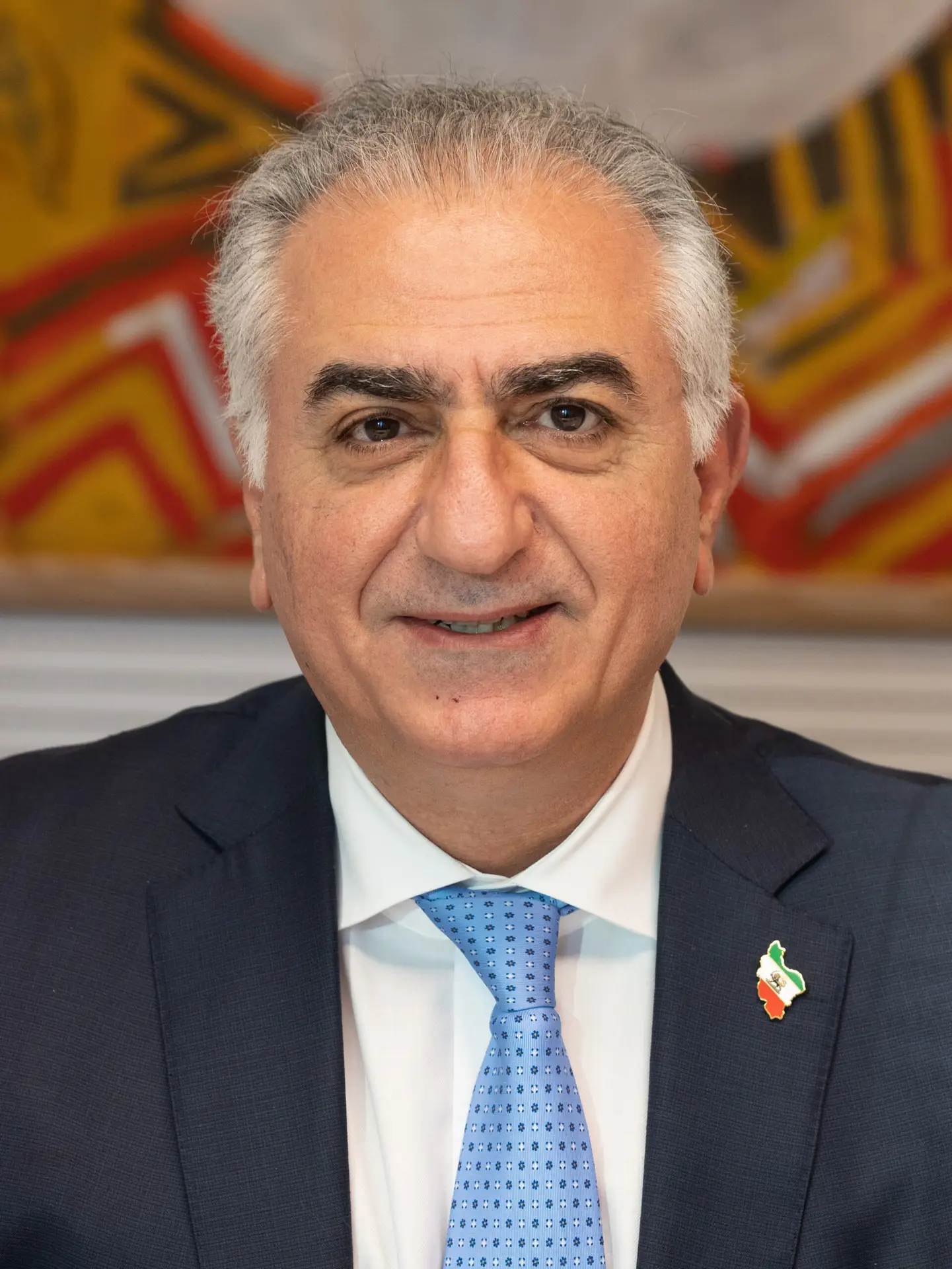
Reza Pahlavi wants his throne back, and he is willing to see Iran broken to get it. For more than four decades, from the safety of American exile, the last scion of the Pahlavi dynasty has waged a campaign of dynastic restoration disguised as democratic liberation — courting Washington hawks, cheering on sanctions that gut Iranian livelihoods, and lending his name to military scenarios that would reduce the country his grandfather built to rubble. In recent months he has called for “humanitarian intervention” to strike Iran’s nuclear facilities, declared that “it’s a war, and war has casualties” in response to domestic protests, and slammed UK Prime Minister Keir Starmer for welcoming a US–Iran ceasefire — accusing Britain of “endlessly appeasing” the Islamic Republic. Strip away the press conferences and the congressional testimonies, and what remains is not a political programme. It is a vendetta with a flag.
To understand the nature of what Pahlavi is doing, one must first understand what his public statements actually amount to in the cold light of law. The answer depends entirely on where you stand — literally, on which soil, under which legal order.
In the United States, where Pahlavi has lived since adolescence, his calls for regime change, his courtship of foreign powers, his encouragement of internal uprising — all of this is almost certainly protected political speech under the First Amendment. American constitutional doctrine draws a bright line between advocacy and incitement, and Pahlavi’s pronouncements, however reckless, remain comfortably on the protected side. No serious prosecutor would touch the case. The legal architecture of the republic that shelters him is, ironically, the very thing that permits him to call for the destruction of another.
Cross the Atlantic to the United Kingdom, and the picture shifts. British law, particularly the broad and muscular language of the Terrorism Act 2006, could plausibly form the basis of a prosecution. The Act’s provisions on the encouragement and glorification of terrorism cast a wide net, and some of Pahlavi’s more inflammatory statements — those urging direct confrontation with the Iranian state, those that could be read as endorsing or facilitating violence — might fall within its reach. Such a case would not be straightforward; it would face a formidable challenge grounded in freedom of expression and the proper interpretive limits of the statute. But the fact that the question is even arguable tells us something important about the elastic relationship between political speech and criminal conduct.
Now turn to Iran itself — either the Islamic Republic as it exists today, or the Imperial State as it existed before 1979. In both systems, the analysis is brutally simple. Pahlavi’s statements constitute clear and undeniable acts of treason and rebellion. The Islamic Republic would prosecute him for sedition and moharebeh — war against God — with the same mechanical certainty that his father’s regime would have prosecuted anyone calling for the overthrow of the Shah. In neither system does oppositional political speech enjoy meaningful legal protection. A prosecution would be initiated. A conviction would follow. The sentence would be death. The symmetry is instructive: the regime Pahlavi despises and the regime his family built would treat him with identical severity.
This jurisdictional analysis is more than a legal curiosity. It illuminates a foundational truth about the relationship between law, speech, and power. The distinction between political dissent and criminal sedition is not fixed in nature. It is a product of a nation’s foundational legal principles — its commitments regarding freedom of expression, its definitions of national security, its tolerance for the uncomfortable and the destabilising. Pahlavi operates in the gap between these systems, exploiting the freedoms of one jurisdiction to wage war on another, accountable to none.
But legality is not legitimacy, and protection is not vindication. The fact that Pahlavi can say what he says from the safety of a Potomac suburb does not mean that what he says serves the interests of the Iranian people. This is the crux of the matter, and it is here that the assessment must be unflinching.
What Reza Pahlavi is engaged in is not national liberation. It is the politics of personal loss dressed in borrowed idealism. His animating impulse is not a considered programme for Iranian democracy, nor a sober reckoning with the complexities of Iranian society. It is partisan rage — a deep, abiding hatred for a regime that overthrew his father, dismantled his dynasty, and deprived him of the throne he was raised to occupy. Every press conference, every congressional testimony, every carefully staged appearance alongside hawkish American politicians, radiates this singular grievance. The Iranian people are not the subject of his project. They are its prop.
Consider what Pahlavi actually advocates. He has repeatedly aligned himself with the most aggressive elements of American and Israeli foreign policy toward Iran. He has courted sanctions regimes that have devastated ordinary Iranians — collapsing the currency, gutting the healthcare system, impoverishing the middle class. He has signalled not merely openness but active enthusiasm for military strikes on Iranian nuclear facilities, framing the prospect of foreign bombing as a “humanitarian” gift to the Iranian people. When protests erupted inside the country, he did not counsel restraint or solidarity; he described state media buildings as “legitimate targets” and told demonstrators that war has casualties. And yet, in a characteristic display of incoherence, he has also insisted that “change in Iran is ultimately in the hands of the people” and that the regime is “collapsing” without outside help — a claim difficult to reconcile with his simultaneous lobbying for American bombs. He has done all of this while claiming to speak for the Iranian nation from a mansion in Maryland.
This is not the behaviour of a patriot. It is the behaviour of a man so consumed by what was taken from him that he would see the country itself destroyed rather than governed by those who took it. He is prepared, by word and by strategic alignment, to dismantle the very infrastructure — physical, institutional, industrial — that his own grandfather built and his father expanded. The factories, the roads, the energy grid, the military apparatus, the administrative state — all of it expendable, so long as the hated mullahs fall with it.
The comparison to his predecessors is devastating. Reza Shah, for all his autocratic brutality, was a builder. He dragged Iran into the twentieth century by force of will — modernising its military, secularising its legal code, constructing its first national railway, founding the University of Tehran. Mohammad Reza Shah, for all his repressive excess and ultimate political blindness, continued this project of national development. He invested oil revenues in infrastructure, industrialisation, and education on a scale Iran had never seen. One can criticise the Pahlavis harshly — and history does — without denying that they understood themselves as architects of a stronger Iran.
Their grandson and son understands himself as something else entirely. He is not building. He is not even preserving. He is offering to collaborate in the demolition of a nation so that he might rule its ruins — or, more likely, so that he might enjoy the psychic satisfaction of seeing his family’s enemies crushed, even if Iran is crushed with them.
The Iranian people are not blind to this. A page is turning in the political consciousness of the diaspora and of Iranians within the country itself. It was not long ago that protesters in the streets of Tehran and Isfahan chanted slogans honouring Reza Shah — invoking his memory as a rebuke to the clerical establishment, wishing his soul peace as a way of saying that Iran deserved a stronger, more modern state. That viral sentiment — “Reza Shah, rohat shad” — was not really about monarchism. It was about dignity, about national pride, about the memory of a time when Iran built things rather than merely endured.
But increasingly, Reza Pahlavi is eroding even that borrowed capital. His alignment with forces openly hostile to Iranian sovereignty, his willingness to serve as a mascot for policies designed in Washington and Tel Aviv rather than in Tehran, his transparent instrumentalisation of Iranian suffering — all of this is exposing him not as the heir to a proud legacy but as a traitor to it. When a fragile ceasefire between the United States and Iran briefly opened a window for diplomacy, Pahlavi attacked Keir Starmer for welcoming it, demanding instead that Britain expel Iran’s ambassador and prosecute the IRGC — as though the destruction of every diplomatic channel were itself a form of liberation. He is not continuing what Reza Shah started. He is desecrating it. He is not honouring what his father tried, however imperfectly, to build. He is volunteering to help others tear it down.
The question that now lingers — whispered in living rooms in Tehran, debated in cafes in Los Angeles, typed into encrypted messages by young Iranians who once chanted his grandfather’s name — is an uncomfortable one. It is not merely whether Reza Pahlavi is the right leader for Iran. That question was settled long ago; he is not. The deeper, more corrosive question is this: will the Iranian people, who once honoured Reza Shah’s memory as a symbol of national strength, begin to curse that same memory for having produced such progeny?
It is a cruel irony. But history is not sentimental, and nations do not owe dynasties gratitude in perpetuity. If Reza Pahlavi continues down his current path — serving as the willing face of a project that would immiserate and destroy Iran in the name of liberating it — he will not merely fail to reclaim the throne. He will succeed in something far worse: retroactively poisoning the legacy of the very family whose name he trades on.
The crown prince has no crown, no country, and, increasingly, no credibility. What he has is a grievance, a platform, and a dangerous willingness to mistake the destruction of Iran for its salvation. The Iranian people deserve better. They always have.
Leave a Reply