
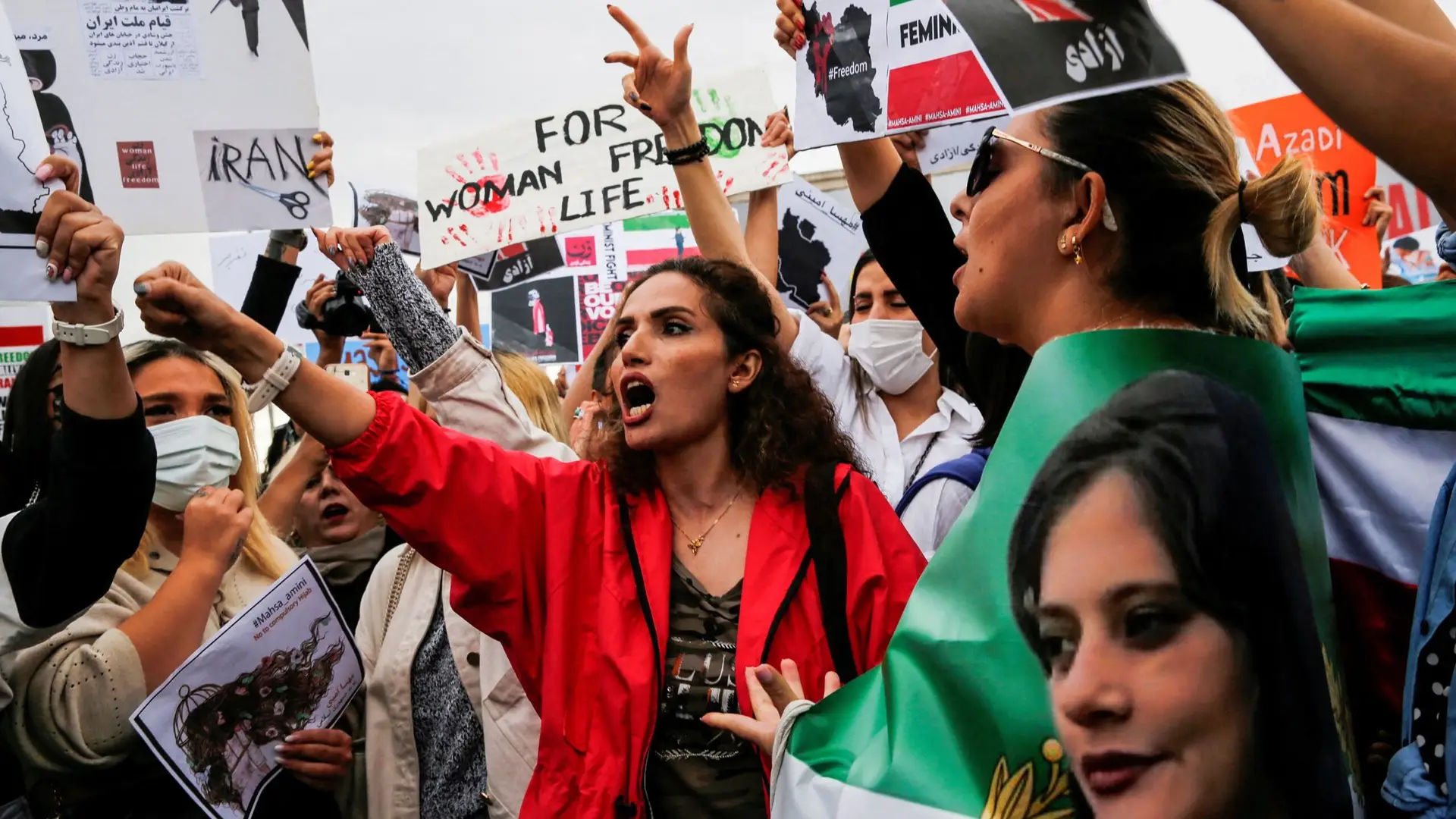
Photo: Getty Images / CNN
How Curated Certainty Replaces Political Consciousness in the Digital Diaspora
A message arrived recently on social media—the kind that has become ordinary in certain corners of the Iranian diaspora. It was a response to someone questioning an unverified claim about alleged government infiltration. The reply was swift and uncompromising: first, the accusation of being a “regime stooge,” then the counter-charge that anyone defending due process must themselves be “working for the government.” No evidence was offered. No space for disagreement was acknowledged. The logic was binary and absolute: if you are not amplifying our narrative with appropriate fury, you are complicit.
I cite this exchange not because it is exceptional, but because it distills a pattern now endemic across diaspora spaces. This is a political consciousness shaped less by disciplined engagement with reality than by algorithmic curation, media priming, and the conversion of geographical distance into epistemic license. The platforms that organize this consciousness—Instagram stories, Telegram channels, Twitter threads engineered for virality—do not merely transmit information. They structure emotion, reward speed over scrutiny, and monetize the collapse of nuance into rage.
What follows is an attempt to map three defining features of this mentality: the compression of moral complexity, the borrowing of certainty disguised as conviction, and the abandonment of institutional imagination. Understanding these patterns matters not because diaspora voices are irrelevant—they are often crucial—but because without self-correction, they risk becoming mirrors of the very authoritarianism they claim to oppose.
Moral Compression and the Evacuation of Complexity
The first signature is what might be called moral compression: the reduction of multi-dimensional political realities into a single emotional binary that tolerates no qualification. In the exchange described above, this manifests as instant diagnosis—anyone questioning a claim about government infiltration must be “one of them.” The logical architecture is familiar across thousands of similar encounters: if you hesitate before amplifying, you reveal yourself as suspect. If you ask for evidence, you expose complicity. If you defend procedural fairness, you betray the cause.
This is not rhetorical excess. It is a cognitive mechanism performing political work. Compression prevents the questions that would slow the machinery of outrage: What exactly is being claimed? What evidence supports it? Who stands to benefit from this framing? What are the consequences of getting it wrong? These are not academic luxuries but basic epistemic hygiene for any movement claiming accountability and truth as values.
Yet in the compressed universe of the algorithmic militia, such questions are not answered—they are treated as betrayals. The middle ground, where evidence can be weighed and complexity acknowledged without abandoning moral clarity, is systematically evacuated. What remains is a landscape of two positions: collaborator or patriot, regime stooge or freedom fighter.
The consequences are predictable. Justice collapses into revenge. Accountability becomes indistinguishable from punishment. Coalition-building devolves into standing beside anyone who hates the same enemy with sufficient volume. The platforms reward this collapse because outrage spreads faster than analysis, because certainty generates more engagement than hesitation, because the algorithm does not ask whether a claim is true—only whether it makes people feel something strong enough to share.
Borrowed Certainty and the Illusion of Independent Judgment
The second signature is more paradoxical: fierce personal conviction built almost entirely on borrowed narratives. Many in the diaspora speak as though possessing direct, unmediated access to Iranian realities—as if distance sharpens rather than obscures vision. Yet the language, framing, and specific claims often trace back to a narrow media diet: partisan broadcasts, curated Instagram accounts, Telegram channels optimized for maximum outrage, Twitter threads designed for viral spread.
This is epistemic dependency at scale, rendered invisible by emotional investment. The consciousness feels independent because it is performed in the first person, wrapped in personal commitment, spoken with passionate certainty. But the narrative infrastructure is prefabricated. Half-truths arrive pre-formatted for consumption: selective footage, decontextualized slogans, inflated claims, captions that tell viewers what to feel before they see.
The consumer does not interrogate these inputs—they inhabit them. They do not ask what has been omitted, what evidence could challenge the narrative, who curates the feed. Instead, they ask which fragment can intensify the emotion they already carry. The result is not knowledge but a simulacrum of it: curated realism where everything already means what the audience has been primed to feel.
Certain media outlets function not as news sources but as emotional architects, structuring feeling before transmitting information. Their editorial choices prioritize speed over verification, spectacle over substance, maximal accusation over measured analysis. In the diaspora context—where geographical distance creates epistemic vulnerability and longing makes people hungry for certainty—this architecture is especially potent. Viewers watch not to learn but to have convictions validated, rage dignified, exile morally elevated.
What makes this dependency insidious is its invisibility. Because the borrowed narrative aligns with pre-existing wounds—anger at brutality, grief over lost futures, humiliation at national decline—it does not feel borrowed. It feels discovered, like truth finally being told. And because the same narrative echoes across multiple platforms, it acquires the appearance of self-evidence. Repetition is mistaken for corroboration. Virality becomes epistemology. A claim can circulate ten thousand times and remain false, but in this ecosystem, frequency substitutes for verification.
The tragedy is not that diaspora communities seek information—it is that they mistake curation for discovery, amplification for courage, and emotional resonance for truth. A critical diaspora would pause before sharing. It would ask: what is being left out, who benefits from this framing, why does this claim feel so satisfying precisely when it becomes harder to verify? Without that discipline, discourse degenerates into factional mythmaking with better production values.
Procedural Illiteracy and the Fantasy of Cathartic Dawn
The third signature is what might be called procedural illiteracy: a striking inability—or refusal—to think politically beyond the emotional satisfaction of removal. One hears constantly the vocabulary of republic, freedom, democracy, secularism. But these words float free of institutional content. What kind of republic? Which constitutional safeguards? What legal framework for accountability? What protections for dissent when the revolutionary majority grows impatient? What mechanisms to prevent the next cycle of purges?
On these questions, the discourse thins rapidly or falls silent. The future is imagined not as the difficult architecture of law, rights, and institutional restraint, but as an emotional afterglow—a cathartic dawn that will somehow organize itself once the hated object disappears. This is not politics. It is political theology without the honesty.
The social media exchange mentioned earlier exemplifies this pattern. The accusation is instant, absolute, unencumbered by process. There is no question of evidence, no space for response, no conception that political disagreement might occur between people who share opposition to authoritarianism but differ on strategy, timing, or means. The move is pure: you are either with us or against us, and if against us, you deserve the label and everything it implies—moral exclusion, reputational destruction, and in extreme formulations, elimination.
This is not incidental rhetoric but the logical endpoint of replacing procedural thinking with emotional identification. Any movement that cannot defend human dignity while angry will not reliably defend it when victorious. Any political culture treating disagreement as treason before the revolution will not suddenly discover pluralism after. The habit of postponing principle—”later we will build institutions, later we will worry about due process, later we will protect dissent”—is usually the beginning of abandoning it permanently.
One of the most revealing phrases in these exchanges is the insistence that “now is not the time.” Not the time for criticism. Not the time for nuance. Not the time to object to dehumanizing language. Not the time to ask what justice means beyond punishment. This temporal blackmail is among the oldest devices of authoritarian politics. It licenses today what tomorrow will be called regrettable excess. It suspends the ethics of means on the promise that righteous ends have already been settled.
But history suggests otherwise. Movements that defer accountability until after victory rarely rediscover it. Movements that cannot articulate the institutional shape of the future they claim to want rarely build it. The algorithmic militia does not prepare people for democratic citizenship—it trains them for permanent mobilization, where every question reduces to friend-enemy identification, every complexity flattens into a loyalty test, every call for restraint registers as collaboration.
The Weight of Distance and the Obligation It Imposes
None of this means that diaspora anger is illegitimate or ungrounded. Much of it emerges from grief, helplessness, and the unbearable experience of watching a country suffer through screens while living in safety. The wound is real. Distance does not erase moral standing. But it does impose obligations that curated outrage systematically violates.
If anything, distance demands greater rigor, not less. Those who speak from safety bear fewer immediate risks, which means they carry greater responsibility to verify before amplifying, to resist the pleasures of borrowed certainty, to refuse the fantasy that others should pay the price for policies endorsed from abroad. Exile does not confer moral authority—it imposes epistemic humility. The further you are from consequence, the more careful your speech must become.
The problem is not that diaspora communities feel strongly. It is that intensity has been mistaken for insight, volume for validity, circulation for verification. Pain does not become wiser by becoming louder. Grief does not translate into strategy by being broadcast. And rage, however intelligible, is not self-justifying simply because it is sincerely felt.
What Replaces the Militia?
The alternative is not neutrality or silence—it is epistemic adulthood. By that I mean the capacity to hold grief without converting it into method, to oppose tyranny without sanctifying revenge, to distinguish solidarity from surrender to the loudest voice in the feed. It means recovering disciplines that algorithmic culture punishes: hesitation before amplification, verification before sharing, proportion in judgment, willingness to revise when evidence demands.
It means recognizing that a slogan is not a program, that fury is not analysis, that repetition is not proof, and that the human being remains the measure and axis of political value—even when platforms invite us to make exceptions. It means asking what kind of political culture is being built right now, in exile, in the comments sections and group chats and curated feeds. Because that culture is not preparation for a democratic future—it is the dress rehearsal.
If the Iranian diaspora is to become politically generative rather than theatrically combustible, it must unlearn the pleasures of curated outrage. It must recover harder virtues: institutional imagination, moral consistency across contexts, courage to refuse emotional shortcuts even when the algorithm rewards them. Otherwise it will continue to mistake amplification for courage, borrowed certainty for knowledge, and hatred for seriousness.
A democratic future cannot be built on that foundation. The blade, however righteous its rage, cannot construct what justice requires. And the simulacrum of knowledge, however emotionally satisfying, will never substitute for the patient, unglamorous work of building a politics worthy of the suffering it claims to honor.